|
VOOZH | about |
|
VOOZH | about |
He will assume final responsibilityExplanation:
’The buck stops here’ means - Responsibility is not passed on beyond this point.
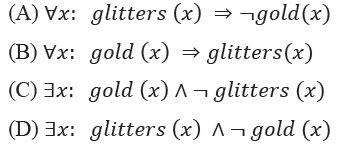
“Not all that glitters is gold”Predicate glitters(x) is true if x glitters and predicate gold(x) is true if x is gold. Which one of the following logical formulae represents the above statement? 👁 GATECS2014Q11
DExplanation:
The statement “Not all that glitters is gold” can be expressed as follows :
¬(?x(glitters(x)?gold(x)) ... (1)
Where ?x(glitters(x)?gold(x) refers that all glitters is gold. Now,
?x¬(glitters(x)?gold(x)) ... (2), Since we know ¬?x() = ?x¬()
(Where => refers to -> All and ?x refers to -> There exists some).
As we know, A?B is true only in the case that either A is false or B is true. It can also defined in the other way :
A?B=¬A?B (negationA or B ) ... (3)
From equation (2) and (3), we have ?x(¬(¬glitters(x)?gold(x))
??x(glitters(x)?¬gold(x)) ... (4), Negation cancellation ¬(¬) = () : and ¬(()?()) = (¬()?¬()) .
So Answer is (D) .
it was a former British colonyExplanation:
A country is called postcolonial if it came into existence after the colonies of the British and the Europeans were abolished and the countries then under their rule were declared independent. India was under the British colonial rule till 1947, i.e. it was a former British colony and thus is called a postcolonial country. So, A is the correct option.
did you say
 Column 1 Column 2
1) eradicate P) misrepresent
2) distort Q) soak completely
3) saturate R) use
4) utilize S) destroy utterly
1:S, 2:P, 3:Q, 4:RExplanation:
"eradicate" means "destroy utterly" "distort" matches with "misrepresent" "saturate" matches with "soak completely" "utilize" matches with "use"
Kaliningrad is a part of Russia despite it not being contiguous with the rest of RussiaExplanation:
A is not true in the light of the given factsSo, B is the correct option
- A is incorrect because the First line says that Kaliningrad (Koenigsberg before war) had a majority of the German population before the war. So, it was historically German and not Russian.
- B is correct as although Kaliningrad is not contiguous with the rest of Russia (being surrounded by countries of Poland in the south and west, Lithuania in the east and Baltic sea on the north), it has a predominantly Russian population.
- C cannot be inferred from the passage as it is nowhere in the passage what the original Russian name of Koenigsberg was.
- D is also not true because no data about the route is mentioned in the passage.
The number of people with malarial fever (also contracted from mosquito bites) has increased this yearExplanation:
- A contradicts the conclusion of the municipal authorities. So, A is not the correct choice.
- B is an incorrect choice because there is no data in the passage relating the reporting of cases and the efficiency of the administrative capabilities of the municipal authorities.
- C is also incorrect as it contradicts the conclusion of the municipal authorities.
- D is the correct choice as both malarial fever and dengue fever are caused by mosquito bite. If dengue fever had increased because of some other reason other than that concluded by the municipal authorities, then there would not have been an increase in the people with malarial fever. This statement supports the conclusion of the municipal authorities.
D
C
D
B
B
B
betrayedExplanation:
There should be word like showed or revealed or betrayed.
indirect
conserve