|
VOOZH | about |
|
VOOZH | about |
He will assume final responsibilityExplanation:
’The buck stops here’ means - Responsibility is not passed on beyond this point.
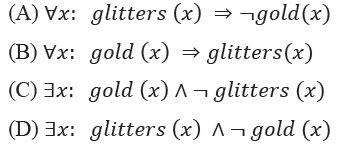
“Not all that glitters is gold”Predicate glitters(x) is true if x glitters and predicate gold(x) is true if x is gold. Which one of the following logical formulae represents the above statement? 👁 GATECS2014Q11
DExplanation:
The statement “Not all that glitters is gold” can be expressed as follows :
¬(?x(glitters(x)?gold(x)) ... (1)
Where ?x(glitters(x)?gold(x) refers that all glitters is gold. Now,
?x¬(glitters(x)?gold(x)) ... (2), Since we know ¬?x() = ?x¬()
(Where => refers to -> All and ?x refers to -> There exists some).
As we know, A?B is true only in the case that either A is false or B is true. It can also defined in the other way :
A?B=¬A?B (negationA or B ) ... (3)
From equation (2) and (3), we have ?x(¬(¬glitters(x)?gold(x))
??x(glitters(x)?¬gold(x)) ... (4), Negation cancellation ¬(¬) = () : and ¬(()?()) = (¬()?¬()) .
So Answer is (D) .
it was a former British colonyExplanation:
A country is called postcolonial if it came into existence after the colonies of the British and the Europeans were abolished and the countries then under their rule were declared independent. India was under the British colonial rule till 1947, i.e. it was a former British colony and thus is called a postcolonial country. So, A is the correct option.
did you say
 Column 1 Column 2
1) eradicate P) misrepresent
2) distort Q) soak completely
3) saturate R) use
4) utilize S) destroy utterly
1:S, 2:P, 3:Q, 4:RExplanation:
"eradicate" means "destroy utterly" "distort" matches with "misrepresent" "saturate" matches with "soak completely" "utilize" matches with "use"
Kaliningrad is a part of Russia despite it not being contiguous with the rest of RussiaExplanation:
A is not true in the light of the given factsSo, B is the correct option
- A is incorrect because the First line says that Kaliningrad (Koenigsberg before war) had a majority of the German population before the war. So, it was historically German and not Russian.
- B is correct as although Kaliningrad is not contiguous with the rest of Russia (being surrounded by countries of Poland in the south and west, Lithuania in the east and Baltic sea on the north), it has a predominantly Russian population.
- C cannot be inferred from the passage as it is nowhere in the passage what the original Russian name of Koenigsberg was.
- D is also not true because no data about the route is mentioned in the passage.
The number of people with malarial fever (also contracted from mosquito bites) has increased this yearExplanation:
- A contradicts the conclusion of the municipal authorities. So, A is not the correct choice.
- B is an incorrect choice because there is no data in the passage relating the reporting of cases and the efficiency of the administrative capabilities of the municipal authorities.
- C is also incorrect as it contradicts the conclusion of the municipal authorities.
- D is the correct choice as both malarial fever and dengue fever are caused by mosquito bite. If dengue fever had increased because of some other reason other than that concluded by the municipal authorities, then there would not have been an increase in the people with malarial fever. This statement supports the conclusion of the municipal authorities.
D
C
D
B
B
B
betrayedExplanation:
There should be word like showed or revealed or betrayed.
indirect
conserve
fallow: land
People in military establishments like to use chemical agents in war.Explanation:
Civil Strife means civil disorder, a term used to describe unrest caused by a group of people, which is not true in the light of the given passage. So, A is not the correct option. B is incorrect because there is no fact in the data justifying the use of chemical agents for warfare. C is also incorrect because it is mentioned in the second line that chemical agents appear to be suited for such warfare, which implies that they are desirable. It is mentioned in the last line that there exist people in military establishments who think that chemical agents are useful for warfare, which makes D correct.
adapt toExplanation:
In the above phrase, the underlined part is *cope with*. "Cope" - It's a verb. Meaning - deal effectively with some difficulty. Example Sentence - "his ability to cope with stress" "adopt" - verb. Meaning - choose to take up or follow (an idea, method, or course of action). Sentence - "this approach has been adopted by many big banks" "adapt" - verb. Meaning - become adjusted to new conditions. sentence -"a large organization can be slow to adapt to change" "adept" - adjective Meaning - very skilled or proficient at something. Sentence - "she is adept at cutting through red tape" "accept" - verb Meaning - consent to receive or undertake (something offered). Sentence - "he accepted a pen as a present" Hence, only "adapt" goes right with the phrase described in the question.
mediocreExplanation:
Here, superb and exhilarating would imply that the performance was brilliant. But, the fact that he could not understand why she got awarded the first prize indicates that her performance was not that amazing in his opinion. So, A and D are incorrect. Medium is more used as a noun, and denoted intermediate in quality, value, etc. So, B is incorrect Mediocre is used as an adjective (to represent quality) and means low in performance, i.e., normal and not extraordinary and C is the correct choice.
B
D
D