|
VOOZH | about |
|
VOOZH | about |
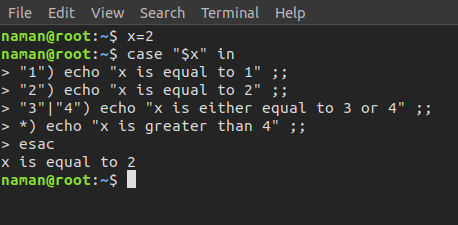
The case command in Linux is an essential tool for simplifying script logic, especially when multiple if/elif conditions need to be evaluated for a single variable. It offers a more readable and efficient way to execute commands based on pattern matching, making your shell scripts easier to maintain and understand.
Here, we will better understand the case command in Linux, learning about its syntax, examples, and options.
case WORD in [PATTERN [| PATTERN]...) COMMANDS ;;]... esacwhere,
help case: Displays help information and details about the case command usage.👁 help case
The case command is an adaptable and efficient alternative to if/elif when dealing with multiple conditional checks on a single variable. By using pattern matching, case allows for more readable and maintainable scripts, particularly when handling a wide variety of input conditions.