|
VOOZH | about |
|
VOOZH | about |
Channel Design is a design or plan prepared for the distribution and movement of goods and services from the manufacturer to the customer. Thus, Channel Design Decisions refer to the strategic choices and actions taken by a company to create an effective distribution and communication network for its products or services. These decisions involve determining the types of channels (such as direct, indirect, or hybrid), the number and location of intermediaries, and the integration of various communication and delivery methods. Channel design decisions also encompass considerations, such as channel length, breadth, and depth. The goal is to design a channel system that efficiently and effectively connects the company with its target customers, ensuring the right product reaches the right place at the right time while also maximising customer satisfaction and achieving business objectives.
Table of Content
Channel design decisions are crucial as they directly impact the effectiveness and efficiency of a company's distribution and communication efforts. By strategically designing channels, businesses can optimise the flow of products or services from production to end-users. This ensures that the right products reach the right customers at the right time, maximising customer satisfaction and loyalty. Effective channel design decisions also help minimise costs, streamline operations, and improve overall channel performance. By carefully selecting distribution channels, businesses can expand their reach, penetrate new markets, and gain a competitive edge. Ultimately, well-designed channels contribute to the overall success and profitability of a company.
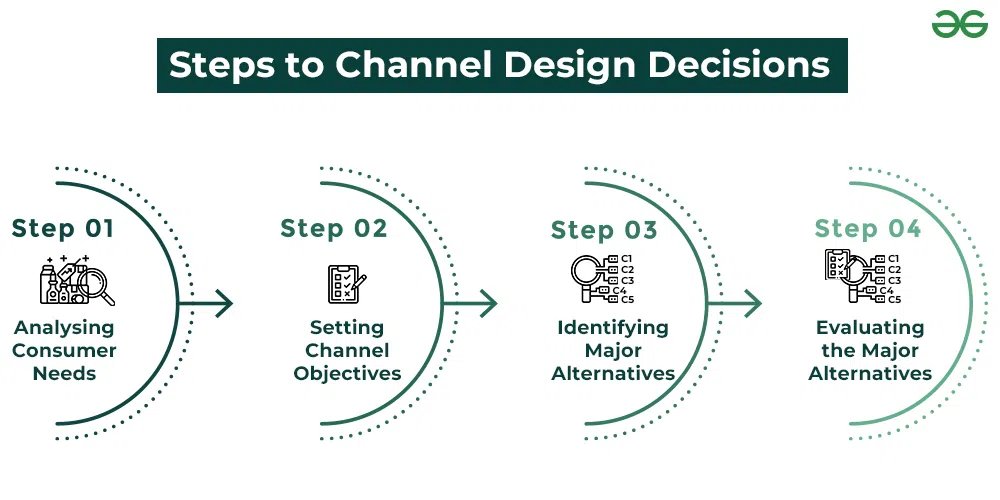
There are four steps to Channel Design Decisions:
The first step in channel design decisions is to analyse consumer needs and desires from the channel. This involves understanding customers' preferences, expectations, and behaviours regarding how they want to access and purchase products or services. It can be done by answering the following questions:
It is not possible for any company to provide all the desired services to the consumers as the company and its channel members may not possess all the required skills for the same. Also, if a company provides higher service levels to the consumers, then it will increase the cost of the channel, ultimately increasing the prices for consumers. Therefore, it is essential for the company to maintain a balance between consumer needs, feasibility and cost of meeting those needs, and customer price preference. Besides, through the success of discount retailing, it can be said that consumers will be ready to get lower services if they have to pay lower prices for the same.
Thus, by gaining insights into consumer needs, businesses can tailor their channel design to meet those requirements and deliver an enhanced customer experience.
After analysing consumer needs, the next step is to establish clear channel objectives. It means that the company, in this step, will have to state its marketing channel objectives according to the targeted level of customer service. For this, a company has to first identify different segments of consumers who want different service levels, and then decide which segment they should serve along with the best channel for each of the selected segments. The basic motive of the company for each segment is to minimise the total channel cost of meeting the requirements of customers-service.
Other factors that influence the channel objectives of a company include the company's nature, its products, marketing intermediaries, competitors, and the environment. For example, a company can decide between which marketing function to handle itself and which to give to the intermediaries through its size and financial situation. Besides, the companies selling perishable products may use more direct marketing so they can avoid delays and too much handling of the product.
In this step, businesses need to identify major alternatives for their distribution channel. This involves considering the types of intermediaries, determining the number of marketing intermediaries, and defining the responsibilities of channel members.
a) Types of Intermediaries: Different types of intermediaries can be considered based on the nature of the product, target market, and distribution strategy. Some common types of intermediaries include:
A company has to identify the different types of channel members that are available for its channel work. Some companies use many channel members to provide their customers with their products. For example, earlier, Dell used to sell directly to its final consumers and businesses through internet marketing and its sophisticated phone. It also used to sell directly to large institutional, government, and corporate buyers through its direct sales force. But, in order to reach more consumers, and to match its competitors (such as Lenovo, HP), the company, besides the older ways, now sells its product indirectly with the help of retailers like Croma, Big Bazaar, Wal-Mart, and E-Zone. Along with the retailers, it also sells through independent distributors, value-added resellers, and dealers who develop computer applications and systems based on the needs of small and medium-sized business customers.
b) Number of Marketing Intermediaries: The decision regarding the number of marketing intermediaries depends on various factors, such as the complexity of the product, target market coverage, and distribution efficiency. Options to consider include:
c) Responsibilities of Channel Members: Each channel member has specific roles and responsibilities within the distribution process. It is the duty of the producer and the intermediaries to agree on the terms and responsibilities of each of the channel members. They should agree with each other on the price policies, sale conditions, services to be performed by each party, and territorial rights. For this, the producer has to first prepare a list price and set a fair discount rate for the intermediaries. It is essential to define the territory of each channel member and be careful while placing new sellers. Also, it is important to carefully spell out the mutual duties and services (especially in the case of franchise and exclusive distribution channels).
Once the major alternatives have been identified, businesses need to evaluate them based on factors, such as cost, efficiency, market reach, customer satisfaction, and compatibility with overall business objectives. This evaluation helps in selecting the most suitable channel design alternative. For better evaluation, it is essential to check each alternative against economic, control, and adaptive criteria.
Therefore, to be a better alternative, a channel with long-term commitments should be superior in terms of economic and control criteria.