A Go-to-Market (GTM) strategy is a structured plan that outlines how a company will launch a product or service and deliver it to its target customers effectively. It ensures that the right audience is reached with the right message through the right channels, maximizing adoption and revenue.
A well-crafted GTM strategy aligns product, marketing, sales, and distribution efforts, enabling businesses to enter the market with clarity, confidence, and competitive advantage.
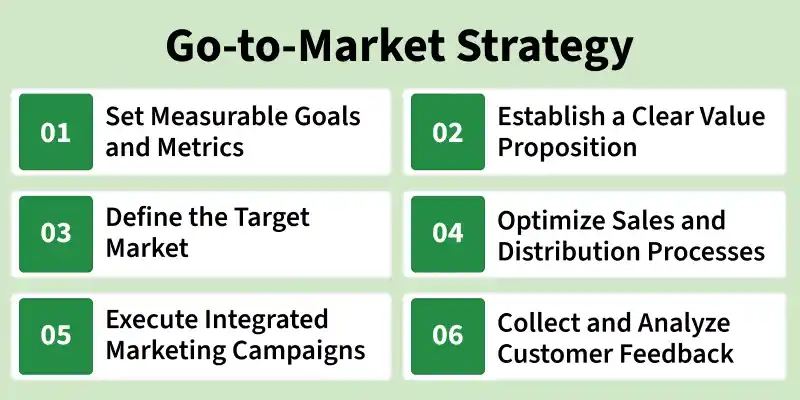
👁 go_to_market_strategy Who Needs a Go-to-Market Strategy A GTM strategy is essential for organizations of all sizes:
Startups: Validate ideas and enter markets efficiently with limited resources Product Teams: Gain clarity on positioning, messaging, and launch execution Mid-sized Businesses: Ensure scalable and consistent product launches Large Enterprises: Coordinate complex, multi-market product rollouts Investors: Evaluate business viability through structured market entry plans Key Elements of a Go-to-Market Strategy 1. Target Market Definition Identify ideal customers through research and segmentation Build detailed buyer personas (needs, behavior, pain points) 2. Value Proposition Clearly define how the product solves a specific problem Highlight unique benefits and differentiation from competitors 3. Goals and Metrics Set measurable KPIs such as: Customer acquisition Revenue targets Conversion rates Retention and satisfaction metrics 4. Sales and Distribution Strategy Choose effective sales channels (direct, partners, online/offline) Equip sales teams with training and tools 5. Marketing and Promotion Execute integrated campaigns across: Digital (SEO, social media, email) Offline (events, PR, partnerships) Maintain consistent messaging across all channels 6. Feedback and Optimization Collect customer insights through surveys, analytics, and testing Continuously refine product and strategy Steps to Build a Go-to-Market Strategy Define Business Goals: Align with revenue and growth objectives Identify Target Market: Segment and understand customers deeply Craft Value Proposition: Map product benefits to customer needs Analyze Competition: Identify differentiation opportunities Set Pricing Strategy: Balance competitiveness and profitability Enable Sales Teams: Provide tools, training, and messaging Plan Marketing Campaigns: Design awareness and demand generation roadmap Track Metrics: Monitor performance and optimize continuously Benefits of a Go-to-Market Strategy Higher Revenue Potential: Targets the right customers with relevant solutions Reduced Customer Acquisition Cost (CAC): Focused marketing reduces waste Improved Team Alignment: Clear roles and coordination across departments Faster Time-to-Market: Structured execution accelerates launches Stronger Brand Positioning: Consistent messaging builds trust and recall Continuous Innovation: Feedback loops drive product improvements Best Practices for an Effective GTM Strategy Deep Customer Understanding : Use surveys, interviews, and analytics to uncover real needs Focused Product Positioning : Solve a specific problem for a defined audience Data-Driven Marketing : Prioritize high-performing channels and optimize continuously Competitive Intelligence : Analyze competitors to identify gaps and differentiation Continuous Improvement : Iterate based on real-world performance and customer feedback Real-World GTM Strategy Examples Uber: Launched city-by-city to refine operations and build demand locally Amazon: Started with books, then expanded into broader e-commerce ServiceNow: Focused on IT helpdesk before scaling enterprise-wide Instagram: Targeted photographers and youth with a simple, engaging product