|
VOOZH | about |
|
VOOZH | about |
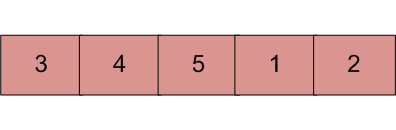
An element in a sorted array can be found in O(log n) time via binary search. But suppose we rotate an ascending order sorted array at some pivot unknown to you beforehand. So for instance, 1 2 3 4 5 might become 3 4 5 1 2. Devise a way to find an element in the rotated array in O(log n) time.
👁 sortedPivotedArrayInput : arr[] = {5, 6, 7, 8, 9, 10, 1, 2, 3};
key = 3
Output : Found at index 8
Input : arr[] = {5, 6, 7, 8, 9, 10, 1, 2, 3};
key = 30
Output : Not found
Input : arr[] = {30, 40, 50, 10, 20}
key = 10
Output : Found at index 3
All solutions provided here assume that all elements in the array are distinct.
Input arr[] = {3, 4, 5, 1, 2}
Element to Search = 1
 1) Find out pivot point and divide the array in two
 sub-arrays. (pivot = 2) /*Index of 5*/
 2) Now call binary search for one of the two sub-arrays.
 (a) If element is greater than 0th element then
 search in left array
 (b) Else Search in right array
 (1 will go in else as 1 < 0th element(3))
 3) If element is found in selected sub-array then return index
Else return -1.
Below is the implementation of the above approach:
Index of the element is : 8
Instead of two or more pass of binary search the result can be found in one pass of binary search. The binary search needs to be modified to perform the search. The idea is to create a recursive function that takes l and r as range in input and the key.
1) Find middle point mid = (l + h)/2
2) If key is present at middle point, return mid.
3) Else If arr[l..mid] is sorted
 a) If key to be searched lies in range from arr[l]
 to arr[mid], recur for arr[l..mid].
 b) Else recur for arr[mid+1..h]
4) Else (arr[mid+1..h] must be sorted)
 a) If key to be searched lies in range from arr[mid+1]
 to arr[h], recur for arr[mid+1..h].
 b) Else recur for arr[l..mid]
Below is the implementation of above idea:
Index: 2
Thanks to Gaurav Ahirwar for suggesting above solution.
It doesn't look possible to search in O(Logn) time in all cases when duplicates are allowed. For example consider searching 0 in {2, 2, 2, 2, 2, 2, 2, 2, 0, 2} and {2, 0, 2, 2, 2, 2, 2, 2, 2, 2, 2, 2}.
It doesn’t look possible to decide whether to recur for the left half or right half by doing a constant number of comparisons at the middle.
Please refer complete article on Search an element in a sorted and rotated array for more details!