VOOZH about

URL: https://www.geeksforgeeks.org/project-mgmt/project-monitoring-and-controlling-phase/

⇱ Project Monitoring and Controlling Phase - GeeksforGeeks


  • Courses
  • Tutorials
  • Interview Prep

Project Monitoring and Controlling Phase

Last Updated : 30 Mar, 2026

The Monitoring & Controlling Phase ensures the work is progressing correctly, efficiently, and within approved limits. It provides continuous oversight so that deviations are detected early and corrective action is taken before issues escalate.

Strong control practices consistently lead to:

  • Fewer late-stage scope disruptions
  • Stronger adherence to schedule and budget targets
  • Higher stakeholder confidence and decision clarity
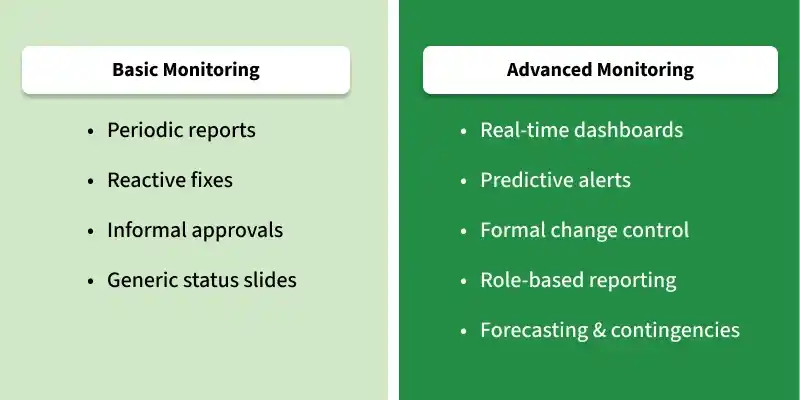
👁 high_vs_low_maturity_monitoring

This phase acts as the project’s control system, measuring performance, protecting approved baselines and enabling disciplined adaptation when change is necessary.

Core Purpose of Monitoring & Controlling

The objective is to safeguard project performance while enabling controlled flexibility.

  • Keep execution aligned with business objectives
  • Detect performance variances early
  • Minimize the cost and impact of corrective actions
  • Provide transparent, data-driven status to decision-makers
  • Ensure changes are deliberate, evaluated, and authorized

Monitoring & Controlling is not a post-execution step. It runs continuously from the start of execution until project closure.

What Distinguishes Great Monitoring & Controlling

AspectAverage PracticeWhat you should aim for
Measurement frequencyPeriodic status reportingContinuous tracking + structured reviews
Variance detectionReactive (after deviation)Real-time & predictive alerts
Change handlingInformal approvalsFormal integrated change control
Performance focusSchedule and cost onlyIntegrated scope, schedule, cost, quality, risk, benefits
ForecastingBasic estimatesScenario-based forecasting & contingencies
Stakeholder reportingGeneric updatesRole-specific dashboards & exception reports

Essential Processes & Focus Areas

Monitoring & Controlling spans multiple dimensions of project performance, ensuring every critical area stays within approved thresholds.

1. Integrated Performance Oversight

Provides a consolidated view of project health by converting raw performance data into actionable insights and forecasts.

  • Collect performance data
  • Analyze trends and variances
  • Report current status
  • Forecast future performance
  • Use Earned Value metrics for objective schedule and cost health

2. Integrated Change Control

Ensures that every change is evaluated systematically so project stability is maintained while enabling necessary adaptation.

  • Evaluate all change requests formally
  • Assess impact across scope, schedule, cost, quality, and risk
  • Approve or reject through defined governance
  • Update baselines and communicate decisions clearly

3. Scope, Schedule & Cost Control

These controls protect the three core performance baselines and prevent uncontrolled deviation.

Scope Control: Ensures deliverables match approved requirements.

  • Validate deliverables
  • Prevent scope creep and gold-plating

Schedule Control: Keeps timelines realistic and achievable.

  • Track milestones and critical path
  • Monitor float and slippage risks

Cost Control: Maintains financial discipline throughout execution.

  • Monitor expenditure and burn rate
  • Track contingency usage
  • Review estimate accuracy trends

4. Quality & Compliance Verification

Protects deliverable standards and ensures outputs meet regulatory and contractual expectations.

  • Inspections and testing
  • Audits and walkthroughs
  • Defect tracking and root-cause analysis

5. Risk & Issue Surveillance

Maintains proactive awareness of uncertainties and active problems that could affect performance.

  • Maintain active risk register reviews
  • Monitor trigger conditions
  • Track secondary risks
  • Manage issue resolution lifecycle

6. Stakeholder & Benefits Monitoring

Ensures the project remains aligned with stakeholder expectations and intended business value.

  • Track engagement levels
  • Detect dissatisfaction signals early
  • Monitor benefits realization indicators

Advanced Tools & Techniques to Master

Elite monitoring relies on analytical and visual tools that transform data into precise decision intelligence.

  • Earned Value Management (EVM) metrics
  • Variance and trend analysis
  • Control charts and performance dashboards
  • Contingency and reserve tracking
  • Predictive risk and delay analytics
  • Exception-based reporting
  • Decision logs for governance traceability

Warning Signs You Are Losing Control

Early detection of control breakdowns helps prevent cascading project failure.

  • Rising number of urgent or unplanned issues
  • Frequent last-minute changes
  • Positive verbal updates but weak performance data
  • Repeated contingency usage without justification
  • Stakeholders seeking ad-hoc status updates
  • Sustained negative performance trends

Leadership Behaviors That Define Elite Control

Strong leadership discipline ensures monitoring translates into timely action and sustained performance.

  • Radical transparency in status reporting
  • Fast, evidence-based decision-making
  • Strict adherence to change governance
  • Proactive stakeholder communication
  • Valuing early warnings and rapid corrections
Comment