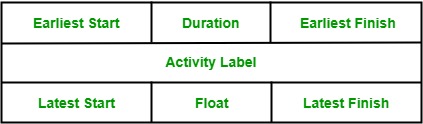
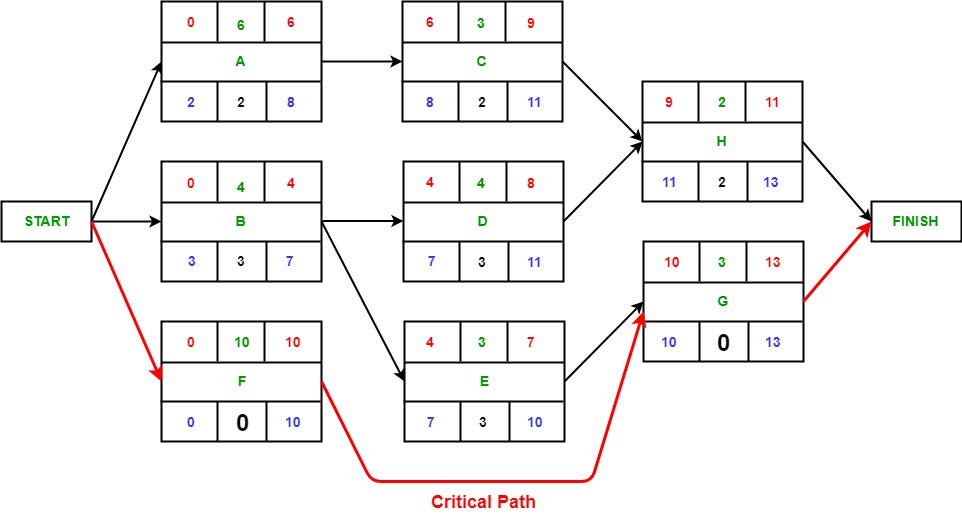
Critical Path Method (CPM) is a project management technique used for planning, scheduling, and controlling projects. It helps determine the minimum time required to complete a project and identifies activities that directly impact the project completion date. CPM is especially useful for complex projects with multiple interdependent tasks.
A critical task is an activity that cannot be delayed without delaying the overall project completion. Any delay in a critical task immediately affects the project deadline.
The critical path is the longest sequence of dependent activities in a project network. It represents the shortest possible project duration. All activities on this path are called critical activities, and they have zero float.
Relationship Between Critical Task and Critical Path
A critical task (activity) and the critical path are closely related concepts in the Critical Path Method:
A critical task is any activity with zero float, meaning it cannot be delayed without delaying the project.
The critical path is the continuous sequence of critical tasks from the start of the project to the end.
Every activity on the critical path is a critical task, but not every project activity is critical.
Delaying any single critical task will delay the entire critical path, and therefore delay the project completion.
Benefits of Using Critical Path Method
Provides a clear visual representation of the project schedule
Identifies the most important (critical) tasks
Helps anticipate and manage project risks
Improves communication and coordination within the project team
Steps to Find the Critical Path
Identify all activities required to complete the project
Define the sequence and dependencies of activities
Estimate the duration of each activity
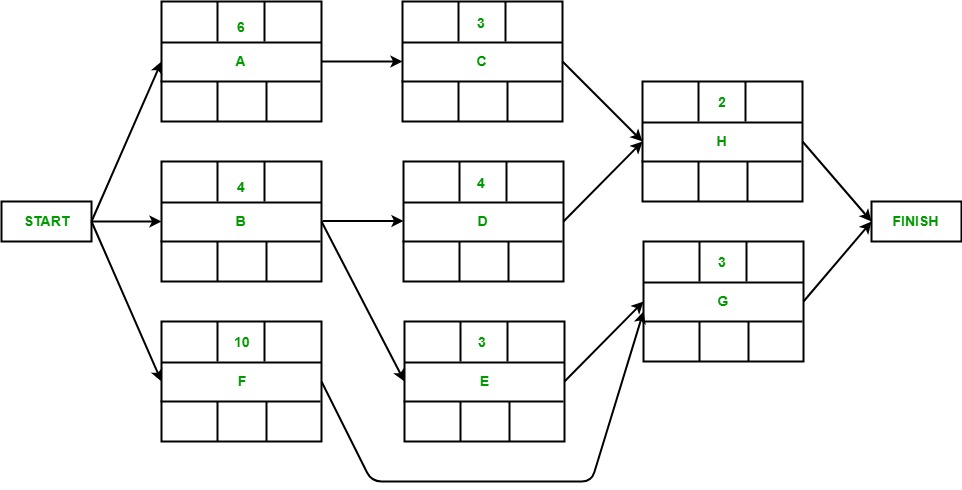
Draw the Activity-on-Node (AON) network diagram
Perform a forward pass to calculate earliest times
Perform a backward pass to calculate latest times
Calculate float and identify the critical path
Project Activity Data
The table given below contains the activity label, its respective duration (in weeks), and its precedents. We will use the critical path method to find the critical path and activities of this project.
Activity
Duration (in weeks)
Precedents
A
6
-
B
4
-
C
3
A
D
4
B
E
3
B
F
10
-
G
3
E,F
H
2
C,D
Rules for Activity-on-Node (AON) Network Diagram
Only one start node and one end node
Each node represents an activity and has a duration
Arrows show precedence relationships and have no duration
Time flows from left to right
The network should not contain loops or dangling activities
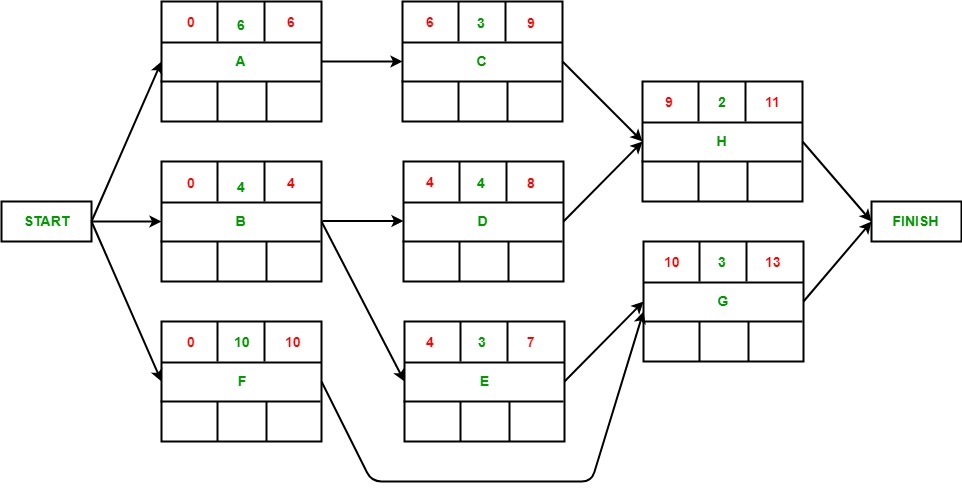
The forward pass is carried out to calculate the earliest dates on which each activity may be started and completed.
Activity A may start immediately. Hence, the earliest date for its start is zero i.e. ES(A) = 0. It takes 6 weeks to complete its execution. Hence, earliest it can finish is week 6 i.e. EF(A) = 6.
Activity B may start immediately. Hence, the earliest date for its start is zero i.e. ES(B) = 0. It takes 4 weeks to complete its execution. Hence, the earliest it can finish is week 4 i.e. EF(B) = 4.
Activity F may start immediately. Hence, the earliest date for its start is zero i.e. ES(F) = 0. It takes 10 weeks to complete its execution. Hence, the earliest it can finish is week 10 i.e. EF(F) = 10.
Activity C starts as soon as Activity A completes its execution. Hence, the earliest week it can start its execution is week 6 i.e. ES(C) = 6. It takes 3 weeks to complete its execution. Hence, the earliest it can finish is week 9 i.e. EF(C) = 9.
Activity D starts as soon as Activity B completes its execution. Hence, the earliest week it can start its execution is week 4 i.e. ES(D) = 4. It takes 4 weeks to complete its execution. Hence, the earliest it can finish is week 8 i.e. EF(D) = 8.
Activity E starts as soon as Activity B completes its execution. Hence, the earliest week it can start its execution is week 4 i.e. ES(E) = 4. It takes 3 weeks to complete its execution. Hence, the earliest it can finish is week 7 i.e. EF(E) = 7.
Activity G starts as soon as activity E and activity F completes their execution. Since the activity requires the completion of both for starting its execution, we would consider the MAX(ES(E), ES(F)). Hence, the earliest week it can start its execution is week 10 i.e. ES(G) = 10. It takes 3 weeks to complete its execution. Hence, the earliest it can finish is week 13 i.e. EF(G) = 13.
Activity H starts as soon as activity C and activity D completes their execution. Since the activity requires the completion of both for starting its execution, we would consider the MAX(ES(C), ES(D)). Hence, the earliest week it can start its execution is week 9 i.e. ES(H) = 9. It takes 2 weeks to complete its execution. Hence, the earliest it can finish is week 11 i.e. EF(H) = 11.
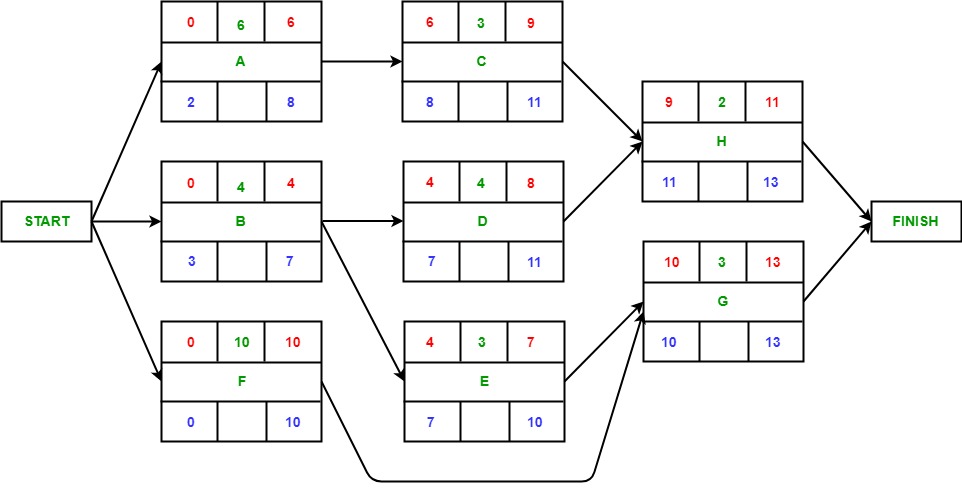
The backward pass is carried out to calculate the latest dates on which each activity may be started and finished without delaying the end date of the project. Assumption: Latest finish date = Earliest Finish date (of project).
Activity G's latest finish date is equal to the earliest finish date of the precedent activity of finish according to the assumption i.e. LF(G) = 13. It takes 3 weeks to complete its execution. Hence, the latest it can start is week 10 i.e. LS(G) = 10.
Activity H's latest finish date is equal to the earliest finish date of the precedent activity of finish according to the assumption i.e. LF(H) = 13. It takes 2 weeks to complete its execution. Hence, the latest it can start is week 11 i.e. LS(H) = 11.
The latest end date for activity C would be the latest start date of H i.e. LF(C) = 11. It takes 3 weeks to complete its execution. Hence, the latest it can start is week 8 i.e. LS(C) = 8.
The latest end date for activity D would be the latest start date of H i.e. LF(D) = 11. It takes 4 weeks to complete its execution. Hence, the latest it can start is week 7 i.e. LS(D) = 7.
The latest end date for activity E would be the latest start date of G i.e. LF(G) = 10. It takes 3 weeks to complete its execution. Hence, the latest it can start is week 7 i.e. LS(E) = 7.
The latest end date for activity F would be the latest start date of G i.e. LF(G) = 10. It takes 10 weeks to complete its execution. Hence, the latest it can start is week 0 i.e. LS(F) = 0.
The latest end date for activity A would be the latest start date of C i.e. LF(A) = 8. It takes 6 weeks to complete its execution. Hence, the latest it can start is week 2 i.e. LS(A) = 2.
The latest end date for activity B would be the earliest of the latest start date of D and E i.e. LF(B) = 7. It takes 4 weeks to complete its execution. Hence, the latest it can start is week 3 i.e. LS(B) = 3.
👁 Image Backward Pass in Critical path in project management
Identifying the Critical Path
The critical path is identified by calculating the float (slack) for each activity. Activity Float represents the amount of time an activity can be delayed without affecting the overall project completion date. It is calculated using either of the following formulas:
Float = LS − ES or Float = LF − EF
An activity with zero float is a critical activity, meaning any delay in that activity will directly delay the completion of the entire project. Activity float is calculated as:
Float = LS − ES = LF − EF
Activities with zero float are critical activities. In this project: