|
VOOZH | about |
|
VOOZH | about |
The Monitoring & Controlling Phase ensures the work is progressing correctly, efficiently, and within approved limits. It provides continuous oversight so that deviations are detected early and corrective action is taken before issues escalate.
Strong control practices consistently lead to:
This phase acts as the project’s control system, measuring performance, protecting approved baselines and enabling disciplined adaptation when change is necessary.
The objective is to safeguard project performance while enabling controlled flexibility.
Monitoring & Controlling is not a post-execution step. It runs continuously from the start of execution until project closure.
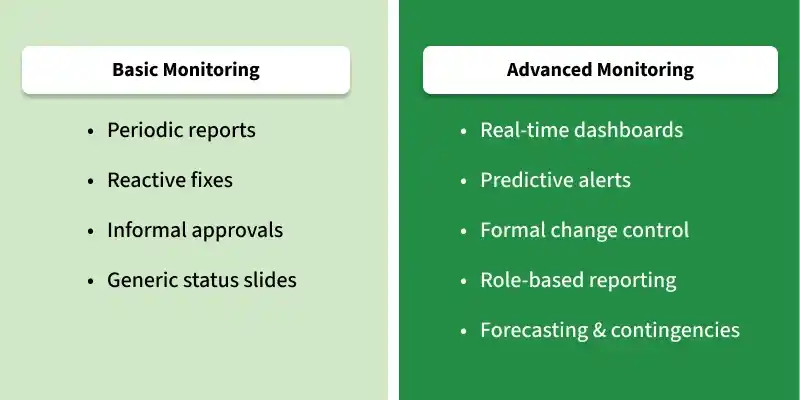
| Aspect | Average Practice | What you should aim for |
|---|---|---|
| Measurement frequency | Periodic status reporting | Continuous tracking + structured reviews |
| Variance detection | Reactive (after deviation) | Real-time & predictive alerts |
| Change handling | Informal approvals | Formal integrated change control |
| Performance focus | Schedule and cost only | Integrated scope, schedule, cost, quality, risk, benefits |
| Forecasting | Basic estimates | Scenario-based forecasting & contingencies |
| Stakeholder reporting | Generic updates | Role-specific dashboards & exception reports |
Monitoring & Controlling spans multiple dimensions of project performance, ensuring every critical area stays within approved thresholds.
Provides a consolidated view of project health by converting raw performance data into actionable insights and forecasts.
Ensures that every change is evaluated systematically so project stability is maintained while enabling necessary adaptation.
These controls protect the three core performance baselines and prevent uncontrolled deviation.
Scope Control: Ensures deliverables match approved requirements.
Schedule Control: Keeps timelines realistic and achievable.
Cost Control: Maintains financial discipline throughout execution.
Protects deliverable standards and ensures outputs meet regulatory and contractual expectations.
Maintains proactive awareness of uncertainties and active problems that could affect performance.
Ensures the project remains aligned with stakeholder expectations and intended business value.
Elite monitoring relies on analytical and visual tools that transform data into precise decision intelligence.
Early detection of control breakdowns helps prevent cascading project failure.
Strong leadership discipline ensures monitoring translates into timely action and sustained performance.