|
VOOZH | about |
|
VOOZH | about |
Question 1
For constants a ≥ 1 and b > 1, consider the following recurrence defined on the non-negative integers:
T(n) = a T (n/b) + f(n)
Which one of the following options is correct about the recurrence T(n) ?
GATE CSE 2021,SET2 - [2Marks] (MCQ)
f(n) is O(nlogb(a)-∈) for some ∈>0, then T(n) is T(n)=Θ(n logb (a))
If f(n) is n/log2 (n), then T(n) is Θ(log2(n))
If f(n) is Θ(nlogb (a)), then
T(n) is Θ(nlogb (a))
If f(n) is n log2(n), then T(n) is Θ(nlog2(n))
Question 2
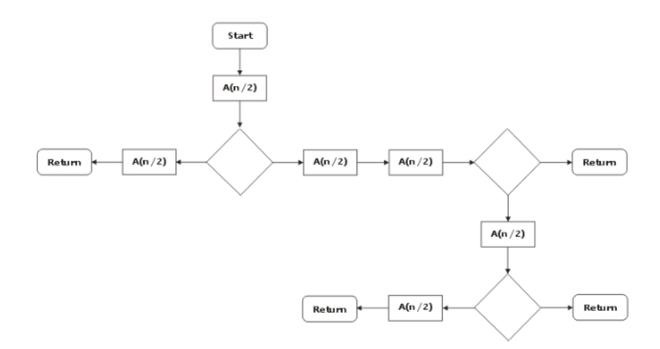
The given diagram shows the flowchart for a recursive function A(n). Assume that all statements, except for the recursive calls, have O(1) time complexity. If the worst-case time complexity of this function is O(nα ), then the least possible value (accurate up to two decimal positions) of α is _____.
Flowchart for Recursive Function A(n)
GATE CSE 2016,SET1 - [2Marks] (NAT)
2.32
Question 3
Let A be an array of 31 numbers consisting of sequence of 0’s followed by a sequence of 1’s. The problem is to find the smallest index i that A[i] is 1 by probing the minimum numbers of locations in A. The worst case number of probes performed by an optimal algorithm is _____.
GATE CSE 2017,SET1 - [2Marks] (NAT)
5
Question 4
Consider the following functions from positives integers to real numbers 10, √n, n, log 2 n, 100/n. The CORRECT arrangement of the above functions in increasing order of asymptotic complexity is:
GATE CSE 2017,SET1 - [1Marks] (MCQ)
log2n, 100/n, 10, √n, n
100/n, 10, log2n, √n, n
10, 100/n ,√n, log2n, n
100/n, log2n, 10 ,√n, n
Question 5
Consider the following C function
int fun(int n) {
 int i, j;
 for(i=1; i<=n; i++) {
 for (j=1; j<n; j+=i) {
 printf("%d %d", i, j);
 }
 }
}
Time complexity of fun in terms of θ notation is
GATE CSE 2017,SET2 - [2Marks] (MCQ)
θ ( n✓n )
θ(n2)
θ(n log n)
θ(n2 log n)
Question 6
Consider the recurrence function
T(n) = { 2 × T(√n) + 1, if n > 2
{ 2, if 0 < n ≤ 2
Then T(n) in terms of θ notation is
GATE CSE 2017,SET2 - [2Marks] (MCQ)
θ(log logn)
θ(log n)
θ( ✓n)
θ(n)
Question 7
For parameters a and b, both of which are ω(1), T(n) = T(n 1/a ) + 1, and T(b)=1. Then T(n) is:
GATE CSE 2020,SET1 - [1Marks] (MCQ)
θ(log ab n)
θ(log a log b n)
θ(log 2 log 2 n)
θ(log b log a n)
Question 8
Consider the following three functions.
f1 = 10n
f2 = n logn
f3 = n✓n
Which one of the following options arranges the function in the increasing order of asymptotic growth rate?
GATE CSE 2021,SET1 - [1Marks] (MCQ)
f 2 , f 1 , f 3
f 3 , f 2 , f 1
f 2 , f 3 , f 1
f 1 , f 2 , f 3
Question 9
Consider the following recurrence relation.
T(n) = { T(n/2) + T(2n/5) + 7n , if n>0
{ 1 , if n=0
which one of the following options is correct?
GATE CSE 2021,SET2 - [1Marks] (MCQ)
T(n) = Θ((log n) 5/2 )
T(n) = Θ(n)
T(n) = Θ(nlog n)
T(n) = Θ(n 5/2 )
Question 10
Let P be an array containing n integers. Let t be the lowest upper bound on the number of comparisons of the array elements, required to find the minimum and maximum values in an arbitrary array of n elements. Which one of the following choices is correct?
GATE CSE 2021,SET1 - [2Marks] (MCQ)
t > 2n – 2
t > ⌈ log (n) ⌉ and t <= n
t >= n and t <= 3 ⌈ n/2 ⌉
t > 3 ⌈ n/2 ⌉ and t <= 2n - 2
There are 40 questions to complete.