|
VOOZH | about |
|
VOOZH | about |
Question 1
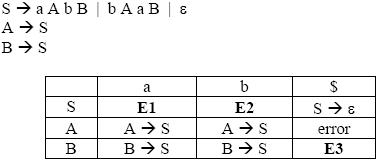
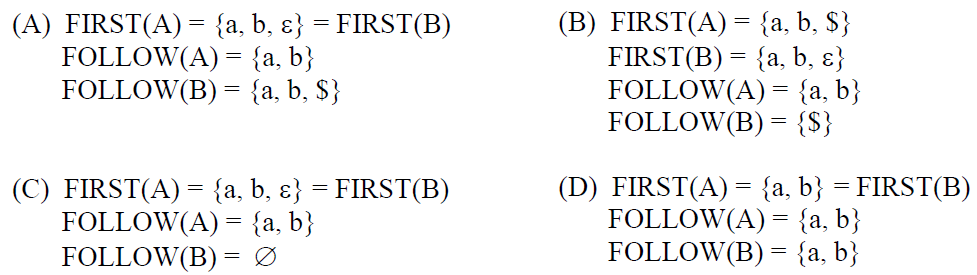
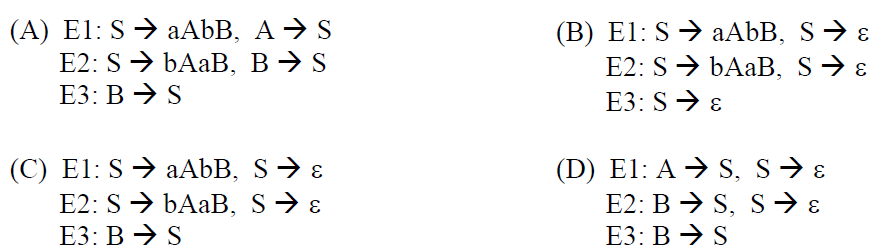
For the grammar below, a partial LL(1) parsing table is also presented along with the grammar. Entries that need to be filled are indicated as E1, E2, and E3. [Tex]\\epsilon[/Tex] is the empty string, $ indicates end of input, and, | separates alternate right hand sides of productions.
👁 CSE_2012_51
👁 CSE_GATE_20122
A
B
C
D
Question 2
A
B
C
D
Question 3
Consider the following two sets of LR(1) items of an LR(1) grammar.
X -> c.X, c/d
 X -> .cX, c/d
 X -> .d, c/d
 X -> c.X, $
 X -> .cX, $
 X -> .d, $
Which of the following statements related to merging of the two sets in the corresponding LALR parser is/are FALSE?
1 only
2 only
1 and 4 only
1, 2, 3, and 4
Question 4
What is the maximum number of reduce moves that can be taken by a bottom-up parser for a grammar with no epsilon- and unit-production (i.e., of type A -> є and A -> a) to parse a string with n tokens?
n/2
n-1
2n-1
2n
Question 5
The grammar S → aSa | bS | c is
LL(1) but not LR(1)
LR(1)but not LR(1)
Both LL(1)and LR(1)
Neither LL(1)nor LR(1)
Question 6
Match all items in Group 1 with correct options from those given in Group 2.
Group 1 Group 2
P. Regular expression 1. Syntax analysis
Q. Pushdown automata 2. Code generation
R. Dataflow analysis 3. Lexical analysis
S. Register allocation 4. Code optimization
P-4. Q-1, R-2, S-3
P-3, Q-1, R-4, S-2
P-3, Q-4, R-1, S-2
P-2, Q-1, R-4, S-3
Question 7
Which of the following statements are TRUE?
I. There exist parsing algorithms for some programming languages
 whose complexities are less than O(n3).
II. A programming language which allows recursion can be implemented
 with static storage allocation.
III. No L-attributed definition can be evaluated in The framework
 of bottom-up parsing.
IV. Code improving transformations can be performed at both source
 language and intermediate code level.
I and II
I and IV
III and IV
I, III and IV
Question 8
A CFG G is given with the following productions where S is the start symbol, A is a non-terminal and a and b are terminals.
S→aS∣A
A→aAb∣bAa∣ϵ
For the correct answer in Q75, how many steps are required to derive the string and how many parse trees are there?
6 and 1
6 and 2
7 and 2
4 and 2
Question 9
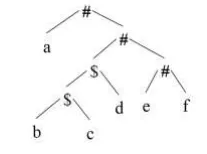
Consider the following parse tree for the expression a#b$c$d#e#f, involving two binary operators $ and #.
Which one of the following is correct for the given parse tree?
$ has higher precedence and is left associative; # is right associative
# has higher precedence and is left associative; $ is right associative
$ has higher precedence and is left associative; # is left associative
# has higher precedence and is right associative; $ is left associative
Question 10
Which phase of compiler generates stream of atoms?
Syntax Analysis
Lexical Analysis
Code Generation
Code Optimization
There are 85 questions to complete.