|
VOOZH | about |
|
VOOZH | about |
Question 1
A partial order ≤ is defined on the set S= {x, a1, a2,.....an, y} as x < ai for all i and ai ≤ y for all i, where n≥1. The number of total orders on the set S which contain the partial order ≤ is
n!
n+2
n
1
Question 2
Let (5, ≤) be a partial order with two minimal elements a and b, and a maximum element c.
Let P : S → {True, False} be a predicate defined on S.
Suppose that P(a) = True, P(b) = False and
P(x) ⇒ P(y) for all x, y ∈ S satisfying x ≤ y,
where ⇒ stands for logical implication.
Which of the following statements CANNOT be true ?
P(x) = True for all x ∈ S such that x ≠ b
P(x) = False for all x ∈ S such that x ≠ a and x ≠ c
P(x) = False for all x ∈ S such that b ≤ x and x ≠ c
P(x) = False for all x ∈ S such that a ≤ x and b ≤ x
Question 3
A partial order P is defined on the set of natural numbers as follows. Here x/y denotes integer division.
i. (0, 0) ∊ P.
ii. (a, b) ∊ P if and only if a % 10 ≤ b % 10 and (a/10, b/10) ∊ P.
Consider the following ordered pairs:
i. (101, 22)
ii. (22, 101)
iii. (145, 265)
iv. (0, 153)
Which of these ordered pairs of natural numbers are contained in P?
(i) and (iii)
(ii) and (iv)
(i) and (iv)
(iii) and (iv)
Question 4
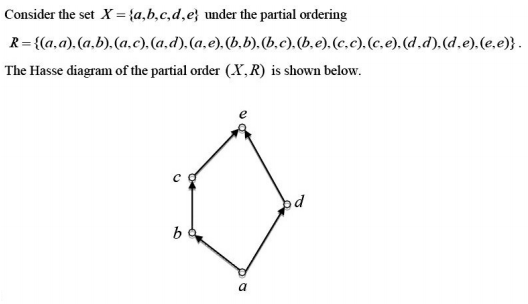
The minimum number of ordered pairs that need to be added to R to make (X, R) a lattice is _____.
0
1
2
3
Question 5
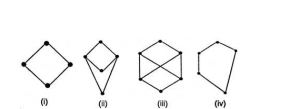
(i) and (iv) only
(ii) and (iii) only
(iii) only
(i), (ii) and (iv) only
Question 6
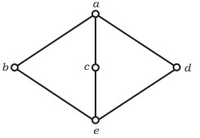
The following is the Hasse diagram of the poset [Tex]\left[\{a,b,c,d,e\},≺\right][/Tex]
The poset is
not a lattice
a lattice but not a distributive lattice
a distributive lattice but not a Boolean algebra
a Boolean algebra
Question 7
Which of the following statements is/are True for a group G?
If for all x, y ∈ G, (xy)² = x²y², then G is commutative.
If for all x ∈ G, x2 = 1, then G is commutative. Here, 1 is the identity element of G.
If the order of G is 2, then G is commutative.
If G is commutative, then a subgroup of G need not be commutative.
Question 8
Given a set of values R={1,2,3,4,5,6,7}, What is the number of relations on this set which is both partial-order and equivalence relation?
0
1
2
3
Question 9
Consider a partially ordered set (T, ≤) with two minimal elements, p and q, and a maximum element r. Let a predicate Q : T → {True, False} be defined on T such that:
Which of the following statements CANNOT be true?
Q(x) = True for all x ∈ T such that x ≠ q.
Q(x) = False for all x ∈ T such that x ≠ p and x ≠ r.
Q(x) = False for all x ∈ T such that q ≤ x and x ≠ r.
Q(x) = False for all x ∈ T such that p ≤ x and q ≤ x.
Question 10
Consider a partially ordered set (S, ≼) with two minimal elements, a and b, and a maximum element c. A predicate P : S → {True, False} is defined on S with the following rules:
Based on this, determine which of the following statements can be true:
P(s) = True for all s ∈ S such that s ≠ b.
P(s) = False for all s ∈ S such that s ≠ a and s ≠ c.
P(s) = False for all s ∈ S such that b ≼ s and s ≠ c.
P(s) = False for all s ∈ S such that a ≼ s and b ≼ s.
There are 10 questions to complete.