|
VOOZH | about |
|
VOOZH | about |
Question 1
Register renaming is done in pipelined processors
as an alternative to register allocation at compile time
for efficient access to function parameters and local variables
to handle certain kinds of hazards
as part of address translation
Question 2
Consider an instruction pipeline with five stages without any branch prediction: Fetch Instruction (FI), Decode Instruction (DI), Fetch Operand (FO), Execute Instruction (EI) and Write Operand (WO). The stage delays for FI, DI, FO, EI and WO are 5 ns, 7 ns, 10 ns, 8 ns and 6 ns, respectively. There are intermediate storage buffers after each stage and the delay of each buffer is 1 ns. A program consisting of 12 instructions I1, I2, I3, …, I12 is executed in this pipelined processor. Instruction I4 is the only branch instruction and its branch target is I9. If the branch is taken during the execution of this program, the time (in ns) needed to complete the program is
132
165
176
328
Question 3
Consider a hypothetical processor with an instruction of type LW R1, 20(R2), which during execution reads a 32-bit word from memory and stores it in a 32-bit register R1. The effective address of the memory location is obtained by the addition of a constant 20 and the contents of register R2. Which of the following best reflects the addressing mode implemented by this instruction for operand in memory?
Immediate Addressing
Register Addressing
Register Indirect Scaled Addressing
Base Indexed Addressing
Question 4
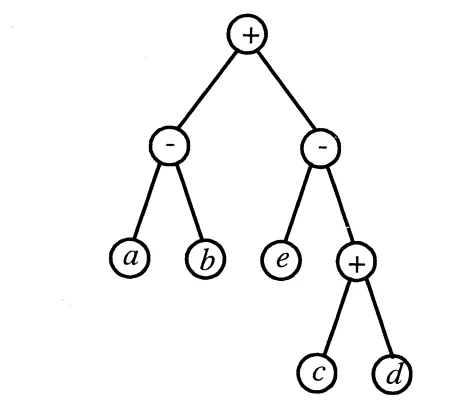
Consider evaluating the following expression tree on a machine with load-store architecture in which memory can be accessed only through load and store instructions. The variables a, b, c, d and e initially stored in memory. The binary operators used in this expression tree can be evaluate by the machine only when the operands are in registers. The instructions produce results only in a register. If no intermediate results can be stored in memory, what is the minimum number of registers needed to evaluate this expression?
2
9
5
3
Question 5
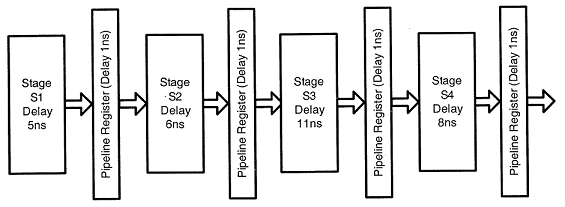
Consider an instruction pipeline with four stages (S1, S2, S3 and S4) each with combinational circuit only. The pipeline registers are required between each stage and at the end of the last stage. Delays for the stages and for the pipeline registers are as given in the figure:
👁 GATECS2011Q41
What is the approximate speed up of the pipeline in steady state under ideal conditions when compared to the corresponding non-pipeline implementation?
4.0
2.5
1.1
3.0
Question 6
A 5-stage pipelined processor has Instruction Fetch(IF),Instruction Decode(ID),Operand Fetch(OF),Perform Operation(PO)and Write Operand(WO)stages.The IF,ID,OF and WO stages take 1 clock cycle each for any instruction.The PO stage takes 1 clock cycle for ADD and SUB instructions,3 clock cycles for MUL instruction,and 6 clock cycles for DIV instruction respectively.Operand forwarding is used in the pipeline.What is the number of clock cycles needed to execute the following sequence of instructions?
 Instruction Meaning of instruction
 I0 :MUL R2 ,R0 ,R1	 R2 ¬ R0 *R1
 I1 :DIV R5 ,R3 ,R4 	 R5 ¬ R3/R4
 I2 :ADD R2 ,R5 ,R2	 R2 ¬ R5+R2
 I3 :SUB R5 ,R2 ,R6	 R5 ¬ R2-R6
13
15
17
19
Question 7
The program below uses six temporary variables a, b, c, d, e, f.
 a = 1
 b = 10
 c = 20
 d = a+b
 e = c+d
 f = c+e
 b = c+e
 e = b+f
 d = 5+e
 return d+f
Assuming that all operations take their operands from registers, what is the minimum number of registers needed to execute this program without spilling?
2
3
4
6
Question 8
Consider a 4 stage pipeline processor. The number of cycles needed by the four instructions I1, I2, I3, I4 in stages S1, S2, S3, S4 is shown below:
S1 | S2 | S3 | S4 | |
I1 | 2 | 1 | 1 | 1 |
I2 | 1 | 3 | 2 | 2 |
I3 | 2 | 1 | 1 | 3 |
I4 | 1 | 2 | 2 | 2 |
What is the number of cycles needed to execute the following loop? For (i=1 to 2) {I1; I2; I3; I4;}
16
23
28
30
Question 9
mov ax, 0h
mov cx, 0A h

doloop :
dec ax
loop doloop
What is the value of ax and cx registers after the completion of the doloop ?
Question 10
BYTE_VALUE DB 150 // A byte value is defined
WORD_VALUE DW 300 // A word value is defined
ADD BYTE_VALUE, 65 // An immediate operand 65 is added
MOV AX, 45H // Immediate constant 45H is transferred to AX
(P2) :
MY_TABLE TIMES 10 DW 0 // Allocates 10 words (2 bytes) each initialized to 0
MOV EBX, [MY_TABLE] // Effective Address of MY_TABLE in EBX
MOV [EBX], 110 // MY_TABLE[0] = 110
ADD EBX, 2 // EBX = EBX +2
MOV [EBX], 123 // MY_TABLE[1] = 123
Which of the following option is correct?
There are 94 questions to complete.