|
VOOZH | about |
|
VOOZH | about |
Question 1
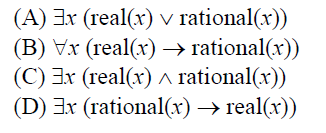
What is the correct translation of the following statement into mathematical logic? “Some real numbers are rational”
A
B
C
D
Question 2
What is the logical translation of the following statement?
"None of my friends are perfect." 👁 gatecs201311A
B
C
D
Question 3
Which one of the following is NOT logically equivalent to ¬∃x(∀y(α)∧∀z(β))?
∀x(∃z(¬β)->∀y(α))
∀x(∀z(β)->∃y(¬α))
∀x(∀y(α)->∃z(¬β))
∀x(∃y(¬α)->∃z(¬β))
Question 4
Which one of the following options is CORRECT given three positive integers x, y and z, and a predicate?
P(x) = ¬(x=1)∧∀y(∃z(x=y*z)⇒(y=x)∨(y=1))
P(x) being true means that x is a number other than 1
P(x) is always true irrespective of the value of x
P(x) being true means that x has exactly two factors other than 1 and x
P(x) being true means that x is a prime number
Question 5
Suppose the predicate F(x, y, t) is used to represent the statement that person x can fool person y at time t. which one of the statements below expresses best the meaning of the formula ∀x∃y∃t(¬F(x, y, t))?
Everyone can fool some person at some time
No one can fool everyone all the time
Everyone cannot fool some person all the time
No one can fool some person at some time
Question 6
Which one of the following is the most appropriate logical formula to represent the statement? "Gold and silver ornaments are precious". The following notations are used: G(x): x is a gold ornament S(x): x is a silver ornament P(x): x is precious
∀x(P(x)→(G(x)∧S(x)))
∀x((G(x)∧S(x))→P(x))
∃x((G(x)∧S(x))→P(x)
∀x((G(x)∨S(x))→P(x))
Question 7
Consider the following first order logic formula in which R is a binary relation symbol.
∀x∀y (R(x, y) => R(y, x))
The formula is
satisfiable and valid
satisfiable and so is its negation
unsatisfiable but its negation is valid
satisfiable but its negation is unsatisfiable
Question 8
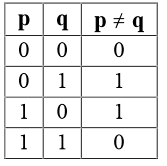
The binary operator ≠ is defined by the following truth table
Which one of the following is true about the binary operator ≠?
Both commutative and associative
Commutative but not associative
Not commutative but associative
Neither commutative nor associative
Question 9
Choose the correct choice(s) regarding the following proportional logic assertion S:
S:((P∧Q)→R)→((P∧Q)→(Q→R)) S is neither a tautology nor a contradiction
S is a tautology
S is a contradiction
The antecedent of S is logically equivalent to the consequent of S
Question 10
Let P, Q and R be three atomic prepositional assertions. Let X denote (P v Q) → R and Y denote (P → R) v (Q → R). Which one of the following is a tautology?
X ≡ Y
X → Y
Y → X
¬ Y → X
There are 41 questions to complete.