|
VOOZH | about |
|
VOOZH | about |
Question 1
Consider the following C function.
The return value of fun(5) is __________.
0
26
51
71
Question 2
Consider the below program, what operation is performed below:
Insertion Sort Recursively
Bubble Sort Recursively
Selection Sort Recursively
None
Question 3
Match the pairs in the following questions:
| List 1 | List 2 |
| A. Recursion | 1. Sorted Array |
| B. Binary Seach | 2. Recursion |
| C. Sorting | 3 Base case |
| D. Dynamic Programming | 4.O(NlogN) |
A – 2, B – 1, C – 4, D – 3
A – 3, B – 4, C – 1, D – 2
A – 3, B – 1, C – 4, D – 2
A – 2, B – 4, C – 1, D – 3
Question 4
Consider the below Program and identify the problem:
Selection Sort Recursive implementation
Bubble sort Recursive implementation
Finding Pair Recursive implementation
None of these
Question 5
What is the output of the following code for the input arr[]={1,2,3,4,5,6} N=6?
21
0
Runtime error
None
Question 6
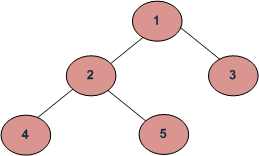
What is the output of the below program for the tree:
1 2 3 4 5
1 3 4 5 2
4 2 5 1 3
5 4 3 2 1
Question 7
What is the name of below recursive program?
N Queen Problem
Tower of Hanoi
M coloring Problem
None
Question 8
What is the output of the following program?
1 7
2 6
3 5
4 4
4 4
1 7
2 6
3 5
4 4
1 7
2 6
3 5
1 2
3 4
5 6
7 8
Question 9
Consider the code fragment below :
What does f(173) print?
010110101
010101101
10110101
10101101
Question 10
The function f is defined as follows:
Assuming that arbitrarily large integers can be passed as a parameter to the function, consider the following statements.
1. The function f terminates for finitely many different values of n ≥ 1.
ii. The function f terminates for infinitely many different values of n ≥ 1.
iii. The function f does not terminate for finitely many different values of n ≥ 1.
iv. The function f does not terminate for infinitely many different values of n ≥ 1.
Which one of the following options is true of the above?
(i) and (iii)
(i) and (iv)
(ii) and (iii)
(ii) and (iv)
There are 30 questions to complete.