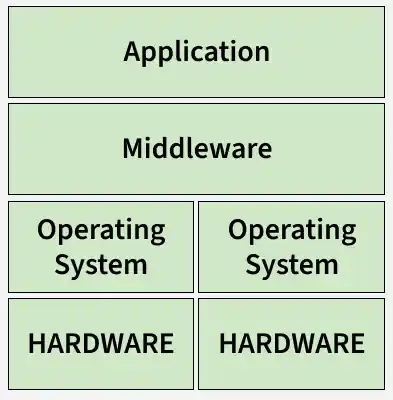
Middleware is software that acts as an intermediate layer between applications and the underlying operating system or network in a distributed system. It enables communication, coordination, and data exchange between distributed components.
Hides network communication complexity from developers Simplifies distributed application development 👁 appls Middleware in Distributed System Need for Middleware Heterogeneous Systems: Allows communication between systems running on different hardware, OS and programming languages. Network Communication Complexity: Hides low-level networking details like protocols, message passing, and connections. Resource Sharing: Provides unified access to distributed resources such as files, databases, and services. Transparency Requirements: Hides the distributed nature of the system from users and applications Core Functions of Middleware 1. Communication Management It manages communication between distributed components.
Remote Procedure Call (RPC): Allows a program to call a function on a remote system as if it were local. Message-Oriented Middleware (MOM): Enables communication through message queues. 2. Data Management It handles data exchange between systems.
Serialization/Deserialization: Converts data into a transferable format and restores it at the destination. Data Transformation: Adjusts data formats to ensure compatibility between different systems. 3. Service Coordination It coordinates distributed services.
Transaction Management: Ensures reliable execution of distributed transactions. Distributed Synchronization: Coordinates processes across multiple nodes. 4. Security Services It ensures secure communication and access.
Authentication: Verifies the identity of users or systems. Authorization: Controls access to resources. Types of Middleware 1. RPC-Based Middleware It allows a program to invoke a procedure on a remote system as if it were a local function.
Supports synchronous communication Hides network protocols and message formatting Uses stubs and proxies for remote calls Common in service-based architectures 2. Message-Oriented Middleware (MOM) It allows communication through message queues in place of direct function calls.
Supports asynchronous communication Decouples sender and receiver Ensures reliable message delivery Useful for event-driven systems 3. Object-Based Middleware This allows distributed objects to communicate across different systems.
Enables remote object invocation Manages object lifecycle and references Supports interoperability between platforms Common in enterprise distributed applications 4. Database Middleware It provides a layer between applications and distributed databases.
Manages database connections Supports distributed transactions Ensures data consistency across nodes Simplifies database communication 5. Web Middleware / Application Servers Supports web-based distributed applications and services.
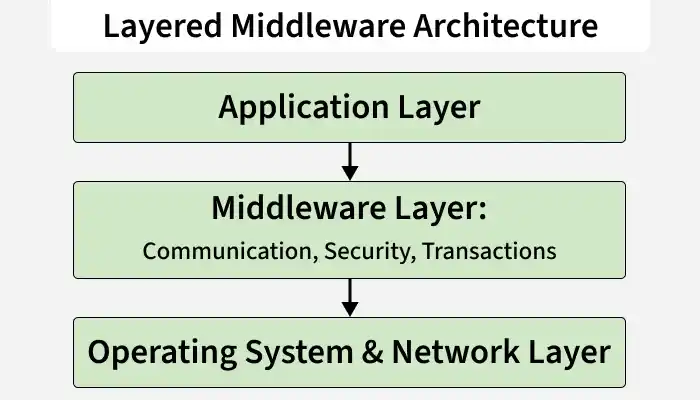
Handles HTTP request processing Manages sessions and authentication Supports business logic execution Enables scalable web services Architecture of Middleware 1. Layered View of Middleware Middleware follows a layered architecture where it acts as a bridge between applications and the underlying system infrastructure.
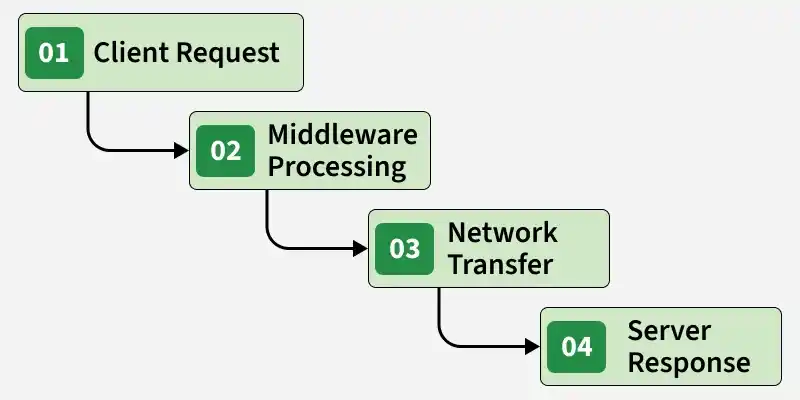
👁 layered_middleware_architecture Application Layer: Contains client and server applications. Applications do not directly handle networking details. Middleware Layer: Provides communication, security, transaction management, data transformation, and other distributed services. Operating System & Network Layer: Low-level tasks like memory management, process control, and network transmission are handled. 2. Interaction Flow Between Components Middleware controls how distributed components interact.
👁 client_request Step-by-step flow: The client application sends a request through middleware APIs. Middleware formats the request (serialization). It transmits the request over the network. The server-side middleware receives and processes it. The result is sent back through middleware to the client. Key Responsibilities During Interaction: Manages message passing Handles protocol conversion Ensures security (authentication, encryption) Manages errors and retries Maintains session or transaction state This process makes remote communication appear like a local interaction.
Advantages Hides the complex low-level networking and communication details, allowing developers to focus on application logic. Allow different systems, platform and programming lanugae work together. To handle workload, it supports load balancing and distributed processing. Provides mechanisms like transaction management and fault handling to ensure stable system operation. Disadvantages Performance Overhead: Additional processing layers can increase latency. Configuration Complexity: Setup and management can be complex in large systems. Security Risks: Improper configuration may expose vulnerabilities. Version Compatibility Issues: Updates or mismatched versions may cause integration problems. Real-World Examples 1. Java RMI (Remote Method Invocation) Allows Java programs to call methods on remote objects Used in distributed Java applications Supports object-based communication 2. CORBA (Common Object Request Broker Architecture) Enables communication between systems written in different languages Uses object request brokers (ORB) Supports cross-platform distributed applications 3. Apache Kafka Distributed event streaming platform Uses message queues for high-throughput data processing Common in real-time analytics and microservices 4. RabbitMQ Message-oriented middleware (MOM) Uses message queues for asynchronous communication Ensures reliable message delivery 5. gRPC High-performance RPC framework Supports multiple programming languages Uses Protocol Buffers for efficient data transfer