|
VOOZH | about |
|
VOOZH | about |
CBSE Previous Years' Question Paper for the subject of History is an essential learning source for the preparation of Class 12 Board Examinations. Students can refer to the pattern of below question paper, for understanding the question paper pattern. The previous years' question papers can be collected and practiced by the students during the revision. Certain key concepts related to the question paper patterns and marking schemes are cleared by the question paper.
With the help of CBSE Previous Years' Question Papers for History, students will understand if they are prepared for the examination completely or not and will be able to examine their knowledge about the subject and gain more confidence in answering the question paper. If any mistake is made while formulating the answers, they can concentrate more on such types of questions; so that mistakes can be reduced in the final examinations.
The statement "Gandhiji appeared to Indian peasants as a saviour", can be supported by:
- The peasants venerated Gandhiji as the "'Mahatma."They considered him a saviour, who would rescue them from high taxes and oppressive officials.
- Peasants belived that he was sent by the King for the redressal of the greivances of the farmers and also thought that he had the power for overruling all the local officials.
- They thought that Gandhiji would rescue them from high taxes and oppressive officials. Gandhiji appealed more to the people because of his ascetic lifestyle and by the use of dhoti and the charkha.
Subsidiary Alliance was introduced by Lord Wellesley in 1798, it is a system of land revenue. Under this, an Indian ruler who entered into Subsidiary Alliance with the British was to dissolve his own armed forces & accept British forces in his territory.
- The allies of the Indian states' rulers were compelled to accept the permanent garrison of the British army within their territories & to pay a subsidy for its maintenance.
- Without the prior approval of the British, the Indian rulers could not employ any European in their service.
- No negotiation with any other Indian ruler without consulting the Governor General.
- The stationing of a British resident in the Indian court.
The way how the ideas were propagated by the rebels of 1857:
- In 1857, the rebel proclamations appealed to all sections of the population, irrespective of their caste & creed.
- The British were condemned for the annexations & breaking up of treaties.
- Everything associated with the British rule or firangi raj was rejected by the proclamations.
Answer:
In 1813. the 'Fifth Report' was submitted to the British Parliament. It became basis for intense parliamentary debates because of the following reasons:
- It was the fifth series of reports about the administration & activities of the East India Company in India.
- Several incidents of the Company's misrule & maladministration were mentioned, like the greed & corruption of Company officials.
- The scale on which the zamindars were losing their lands was overestimated.
Jawaharlal Nehru essayed an important role in the Constituent Assembly of India as:
- The crucial '' OBJECTIVES RESOLUTION " was introduced by him on 13 December 1946, which proclaimed India to be an ''Independent Sovereign Republic.''
- It was a momentous resolution that outlined the defining ideals of the constitution of independent India.
- It was his idea that the National Flag of India should be a '' horizontal tricolour of saffron, white & dark green in equal proportion, " with a wheel in navy blue at the centre.
Suppressing the Revolt, was not an easy task for the Britishers due to the following reasons:-
- The British at first tried to pass a series of laws to help quell the insurgency. Troops were sent to reconquer North India.
- Now, law and trial processes were disregarded and only one punishment was set for rebellion- death.
- Reduction in the size of the British army as the Sepoys went against the British.
- In Awadh & other regions where the mutiny spread like Kanpur, Lucknow, Arrah, and Jhansi, it was seen that the Sepoys received help from the peasants & villagers.
- Their participation in the Revolt made it a limited mass movement.
- Also, certain zamindars & kings of aggrieved kingdoms revolted against the British.
The political history of Gandhiji can be reconstructed through various sources:
- The writings & speeches of Mahatma Gandhi & his contemporaries, associates & political adversaries. This gave us an idea of his public voice & private thoughts. For instance, in Harijan, his journal Gandhiji wrote about the letters that people wrote to him.
- Autobiographies are an important source in studying the life of an individual, however, one has to be careful while reading & interpreting them. As they tell us only what the author could recollect.
- Through police records: Government records are essential sources which were closely monitored by the British as they were critical of the government. They were kept a secret, but now we can access them via archives.
- Newspapers written in English & various Indian languages traced Gandhiji's movements, and his activities & also told about the opinion of the ordinary people about Gandhiji.
In a way, these ideas shaped the events & how these events were being reported, accounts published in a local newspaper varied from the report in an Indian nationalist paper.
OR
"The Non- Cooperation Movement was a training for self-rule.''
- Louis Fischer
- By combining Non-cooperation with Khilafat, Hindus and Muslims could together bring an end to British rule.People were asked to stop attending schools, colleges and law courts, and not pay taxes.
- Gandhiji was of the view that India could win swaraj within a year if non-cooperation was effectively carried out.
- Lawyers refused to attend court. The working class went on strike in many towns and cities.
- Satya, Satyagraha, Ahimsa, and Self-discipline were the main ideas behind the movement. Sometimes, these protest movements were carried out in defiance of the local nationalist leadership.
- The foundation of The British Raj was shaken. The non-cooperation movement, united people of all classes, castes & creeds from various parts of the country in fighting against the common enemy, the British.
- Hindu-Muslim unity, abolition of untouchability, a boycott of British goods & social reforms, and promotion of Khadi & village industries, was an essential part of the movement.
The Non- Cooperation was called off an after the Chauri Chaura incident in 1922.
Important features of the Mughal provincial administration were:
- Division of the Mughal state into different provinces called 'subas'. Subedar was the head of each suba & he directly reported to the emperor. These subas also had subordinates from corresponding ministers ( Diwan, Bakshi, Sadar).
- Further, the subas were divided into many ‘sarkars'. The jurisdiction of the subas & the faujadars overlapped.
- The Faujdars were provided with heavy cavalry and soldiers to enforce the laws by the king.
- The sarkars were divided into Parganas ( sub-districts ), which were administered by three semi-hereditary officers, Qanungo, Chaudhary & Qazi.
- Also, a large supporting staff of clerks, accountants and messengers were present in each department. Other technically qualified staff for diverse purposes were also there in the department.
- The main language of administration was Persian but at village levels, local languages were used.
Main features of the Mughal imperial household:
- Households of Mughal emperors consisted of their wives, concubines, mother, sisters, daughters, aunts, foster mothers, female slaves etc.
- The term used for a Mughal household was ‘Harem', a Persian word meaning haram which means a sacred place.
- In order to help and guard the ladies of the harem, Khwajaseras (eunuchs) were appointed.
- A clear distinction was seen between wives from noble & aristocratic backgrounds (begum) & other wives who were not noble by birth (agha). Even though concubines (aghacha) were the lowest in the hierarchy but they received monthly allowances & gifts according to their status.
- Depending on the husband’s will, the agha & aghachas could rise to the position of a begum.
- Numerous female & eunuch slaves were present to perform any type of work, apart from wives.
This is how Shah Jahan's jewelled throne (takht-i murassa) in the hall of a public audience in the Agra Palace is described in the Badshah Nama:
This gorgeous structure has a canopy supported by twelve-sided pillars and measures five cubits in height from the flight of steps to the overhanging dome. On His Majesty's coronation, he had commanded that 86 lakh worth of gems and precious stones, one lakh tolas of gold worth another 14 lakhs, should be used in decorating it...The throne was completed in the course of seven years, and among the precious stones used upon it was a ruby worth one lakh of rupees that Shah Abbas Safavi had sent to the late emperor Jahangir. And on this ruby were inscribed the names of the great emperors Timur Sahib-i qiran, Mirza Shahrukh, Mirza Ulugh Beg, & Shah Abbas as well as the names of the emperors Akbar, Jahangir, & of His Majesty himself.
Badshahnama.
Precious stones were used in making the throne, one of them being ruby on which the names of the great emperors Timur Sahib-i qiran, Mirza Shahrukh, Mirza Ulugh Beg, & Shah Abbas, as well as the names emperors Akbar, Jahangir, & that of His Majesty himself, were inscribed.
The jewelled throne was an example of the matchless skill of the artisans as it took 7 years to be completed, in which the artisans had elaborately decorated it as per the Majesty's demands.
The Indian Constitution, which came into effect on 26th January 1950, has the distinction of being the longest in the world. Its length and complexity are perhaps understandable when one considers the country's size and diversity. At Independence, India was not merely large and diverse, but also deeply divided. A Constitution designed to keep the country together, and to take it forward, had necessarily to be elaborate, carefully worked out, and painstakingly drafted document. For one thing, it sought to heal wounds of the past and the present, to make Indians of different classes, castes and communities come together in a shared political experiment. For another, it sought to nurture democratic institutions in what had long been a culture of hierarchy and deference. The Constitution of India was framed between December 1946 and December 1949. During this time its drafts were discussed clause by clause in the Constituent Assembly of India. In all, the Assembly held eleven sessions, with sittings spread over 165 days. In between the sessions, the work of revising and refining the drafts was carried out by various committees and sub-committees.
The Indian Constitution kept the country together by bringing Indians of different classes, castes and communities come together in a shared political experiment.
Keeping in mind, the country's size & diversity, Centralisation was considered necessary by the members of the Constituent Assembly in order to bring Indians of different classes, castes and communities come together & to nurture democratic institutions.
Constituent Assembly.
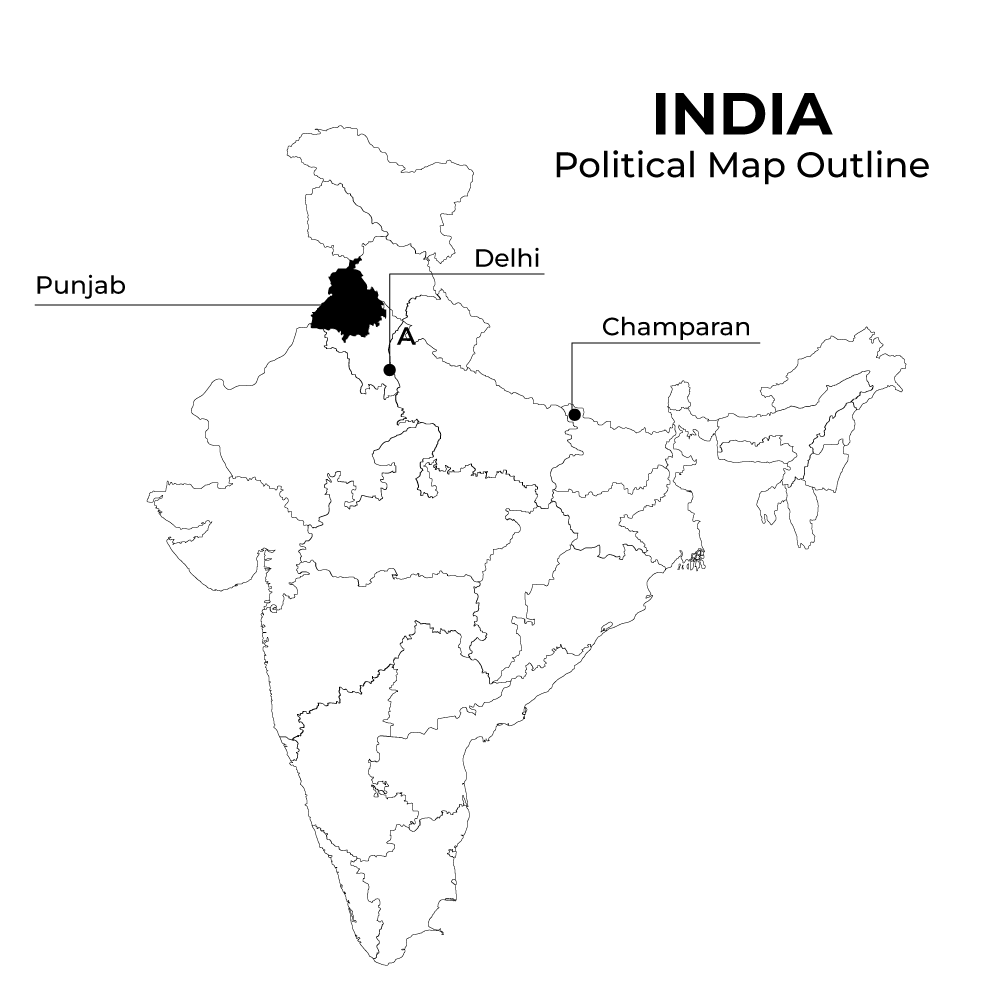
Punjab
OR
Champaran.
Delhi
Afghanistan to the Bay of Bengal and southward to the present Gujarat state and the northern Deccan region of India.
Delhi, Kanpur, Lucknow, Bareilly, Jhansi and Arrah. (mention anyone)
OR