|
VOOZH | about |
|
VOOZH | about |
Constitutional Rights in India:Articles 12-35 of the Indian Constitution are the all about fundamental rights which are essential human rights granted to every citizen of India. The fundamental rights in the Indian Constitution prevent discrimination based on race, religion, gender, and more. The Fundamental Rights in Indian constitution include important rights like the Right to Equality, Right to Freedom, Right to Education, and Freedom of Religion.
Fundamental Rights Latest News Update
In October 2023, Supreme Court of India ruled that same-sex marriage and civil unions are not covered as fundamental rights under the Indian Constitution. Five-judge panel Bench unanimously decided not to recognize same-sex marriages or 'civil unions' in India.
The term "Fundamental Rights" finds its roots in two fundamental principles:
In this article, we'll take a closer look at Articles 12-35 and understand why these rights are so important in building a fair and equal society.
Table of Content
Fundamental rights refer to the basic human rights which are enshrined in the Indian Constitution which came to guaranteed for all citizens and were applied without any discrimination on the basis of race, gender, religion etc. and significantly, the fundamental rights are enforceable by the courts, subject to certain conditions.
The Fundamental rights are called so because:
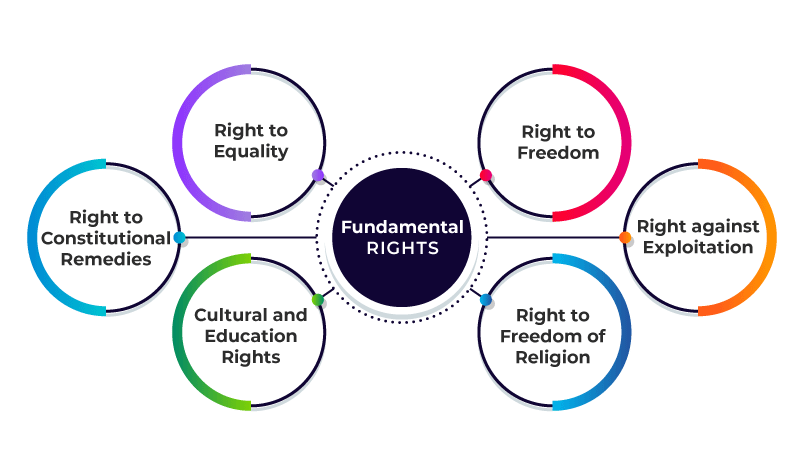
There are six fundamental rights in the Indian Constitution are:
Right to Property was also a fundamental right for Indian Constitution. This right was removed from the list of fundamental rights by the 44th Constitutional Amendment. This happened because this right came to be hindrance towards attainment of the goal for socialism and also redistribution of wealth, equitably among the various people.
Right to Propery is now a legal right and not a fundamental right.
Also Check:
Fundamental rights are essential for everyone's moral and intellectual growth. Fundamental rights are essential for an individual's growth. India's post-independence era has resulted in the addition of some extremely important fundamental rights in the Indian constitution. Every citizen of India is given certain rights by law. It's vital to know what they are so that no one's rights get infringed upon. The Indian Constitution Overview Indian Constitution states the following six fundamental rights for an Indian citizen:
The Indian constitution originally had seven essential rights, one of which was the right to property (Article 31), which was subsequently turned into a legal right by the "44 amendments" to the Indian constitution in 1978.
Equal legal rights for all citizens are completely safeguarded by the right to equality. Inequality based on caste, creed, religion, place of birth, race, or sex strictly is prohibited by the Right to Equality. It also guarantees equal opportunity in government employment and prevents the government from discriminating against anybody in the workplace merely based on religion, caste, race, gender, descent, place of birth, place of residence, or any of these considerations. Articles 14 to 18 provide for equality before the law. Equality before the law is guaranteed by the Constitution, which assures that all people are treated equally before the law. The state cannot discriminate against citizens based on their religion, caste, race, gender, or place of birth. To attain equality, this is necessary.
Example for the Right to Equality:
- Women are entitled to the same salary as men because there should be not any discrimination based on gender as per law.
- In the eyes of the law, every person in India is equal, regardless of their status, wealth, etc.
It can also be called as Right to Liberty. Every person's most treasured desire is for them to be free. Freedom of speech, expression of freedom, freedom of assembly without arms, freedom of movement throughout our country's territory, freedom of association, freedom to pursue any profession, and freedom to reside in any region of the country are just a few of the rights granted by the right to freedom. These rights, however, are subject to several restrictions.
Example for Right to Freedom:
- Any person is entitled to say anything he/she wants freely unless it is deemed to be derogatory or defaming against another person/community/organization.
- Indian citizens can freely relocate to any place in India.
Historically, the Indian society has been based hierarchically, which has resulted in all sorts of exploitation. It's important to realize that being exploited is the same as, if not worse than mistreated. This is a crucial Fundamental Right that ensures that no citizen is subjected to any form of forced labor. No one may be forced to labor against their will, even if money is provided. The Indian constitution prohibits any form of forced labor. If a lower-than-minimum wage is paid, it is considered forced labor. In addition, the article declares human trafficking to be unconstitutional. As a result, buying and selling men and women for unlawful and immoral purposes is prohibited. In addition, this article declares this 'bound labor' unconstitutional.
Examples of Rights Against Exploitation:
- Any Employer is expected to at least pay the minimum wage to his/her workers and provide rightful working conditions to his or her workers.
- Employers are not permitted to engage in the practice of employing underage or minor labor.
Cultural and educational rights give all members of society the right to preserve their cultural script or language. The image of Indian society that springs to mind is one of diversity. Our Constitution thinks that variety is our strength in such a diverse society. As a result, one of the fundamental rights of minorities is the right to preserve their culture. Minorities are ethnic or religious groups that share a common language or religion and live in a specific region of the country. Minority religious and linguistic groups can also establish their educational institutions. They will be able to preserve and develop their own culture in this way.
Democracy, as we all know, is the rule of the majority. Minorities, on the other hand, are critical to the organization's success. As a result, minorities' languages, cultures, and religions must be protected. This is necessary for minorities to not feel forgotten or undervalued under majority rule. Though individuals are proud of their own culture and language, our constitution provides for a particular right known as the Cultural and Educational Right.
Examples of Cultural and Educational Rights:
- Sikhs are allowed to take sharp objects such as Kirpan (a sharp object) in airports where any other sharp objects such as knives, daggers, etc are banned.
- Anyone in India can freely celebrate any religious or cultural festival unless it is in contradiction with Indian laws.
The Constitution declares India a "secular state" because it is a multi-religious country where Hindus, Christians, Sikhs, and many more communities coexist. It signifies that the Indian state does not have its religion or "national" religion. However, it gives all residents complete freedom to believe in any religion and worship whomever they want. However, this should not interfere with other people's religious views and/or practices. This liberty is also available to foreigners. No one shall be forced to pay any tax whose earnings are used only to pay for expenses made in the promotion or preservation of any particular religion or religious denomination. Through educational institutions, this article allows the dissemination of religious knowledge.
Examples of Freedom of Religion:
- Any citizen of India can follow or abide by any religion they feel fit to follow at any time they want.
- The Government of India cannot persecute any person just based on religion.
Examples of constitutional remedies:
- Every Citizen has the right to appeal to the court for remedies to the constitution either by approaching the Courts directly or by submitting a PIL.
Fundamental rights are different from ordinary rights as they are enforced and if legal rights are violated, the aggrieved person cannot directly approached the Supreme Court by passing from the lower courts. He or she has to approach the lower courts.
Some fundamental rights are available for all citizens while rest for all the people.
Here are some of the key reasons why fundamental rights are important
In conclusion, fundamental rights are the bedrock of a democratic society, ensuring the dignity, liberty, and equality of all citizens. These rights provide a framework for a just and equitable society, safeguarding individuals against any form of discrimination and state excesses. They empower citizens to participate actively in the democratic process, fostering a culture of mutual respect and understanding. By guaranteeing freedoms such as speech, expression, and belief, fundamental rights not only protect individual liberties but also nurture a healthy and vibrant democracy. As democracy evolves, these rights adapt and expand, reflecting the changing needs and values of society, thereby maintaining the dynamic and resilient nature of a democratic system.