|
VOOZH | about |
|
VOOZH | about |
Plateaus in India: Plateaus are elevated flat areas of land. They're the high tables on Earth's surface. People often live on plateaus, and they affect the weather and nature around them. This article explains plateaus—flat, elevated lands. It describes types, causes, and examples worldwide, focusing on the significance and characteristics of Indian plateaus.
The exploration of Plateaus in India falls within the purview of the Geography segment in the UPSC Syllabus. Plateaus constitute one of the four primary landforms, alongside mountains, plains, and hills. This article delves into the discussion of Plateaus in India, covering their types, formation, and more.
Table of Content
Plateaus are elevated flat or gently sloping areas of land that are characterized by their relatively high elevation compared to the surrounding terrain. These geographical features can be found all around the world and come in various types, each with distinct characteristics.
Features of Plateaus: The process of lithosphere thermal expansion, which is relatively straightforward, involves the lithosphere expanding due to heat. Additionally, there is the replacement of the cold mantle lithosphere by the asthenosphere.
Plateaus are flat, elevated areas of land that stand higher than the surrounding areas. Plateaus have relatively level surfaces, making them distinct geographical features, unlike mountains. They result from geological processes such as uplift, volcanic activity, or erosion. Plateaus can vary in size and are found all around the world. They play crucial roles in shaping landscapes and influencing climate patterns. Due to their elevated nature, plateaus often offer breathtaking panoramic views. Some plateaus are characterized by fertile soil supporting agriculture, while others may feature unique ecosystems.
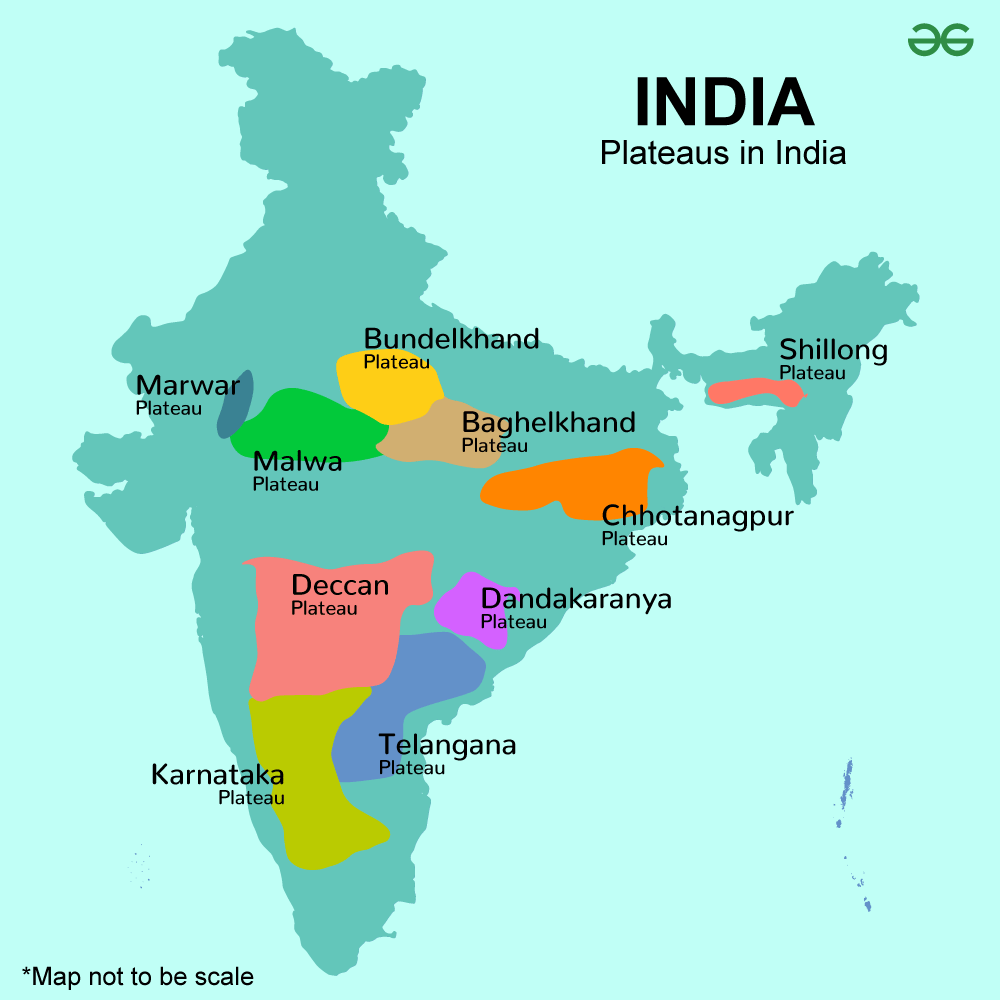
India is home to several significant plateaus that contribute to the country's diverse topography. These plateaus have played crucial roles in shaping the landscape, influencing agriculture, and contributing to historical and cultural developments.
Plateaus are elevated flat or gently sloping areas that are distinct from the surrounding terrain. They can be classified into various types based on their geological origin, location, and formation. Here are some common kinds of plateaus:
Check-out: Why Chota Nagpur plateau has huge concentration of steel?
The Indian Peninsular Plateau is a vast elevated region in South India, characterized by its flat-topped hills and tablelands. It spans major states like Maharashtra, Karnataka, and Andhra Pradesh. This plateau, also known as the Deccan Plateau, holds historical and geographical significance. Its landscape is shaped by volcanic activity, resulting in black soil conducive to agriculture. Rivers like the Godavari and Krishna originate here, enriching the fertile plains. The plateau hosts diverse flora and fauna, contributing to India's biodiversity. Its central location has made it a crossroads of cultural and trade routes throughout history, playing a vital role in the subcontinent's development.
Plateaus in India are important for the various reasons listed below:
Check-out: Geographical Location of India
A plateau is caused by different natural processes that shape the Earth's surface. Here are some simple explanations:
1. Volcanic Activity: Formed when hot lava from a volcano spreads out and cools, creating a flat surface.
2. Erosion: Gradual wearing away of land by wind, water, or ice shapes the ground into a flat and elevated area.
3. Tectonic Movements: Earth's crust movements uplift land, resulting in a high, flat region called a plateau.
4. Dissected by Rivers: Rivers and streams carve deep valleys into elevated land, forming a dissected plateau.
5. Lava Flow: Outpouring of lava, cooling, and solidifying lead to the creation of a flat and elevated landscape.
6. Glacial Activity: During ice ages, glaciers cover large areas; as they retreat, they leave behind flat terrain, forming an interglacial plateau.
Below is the table for the List of Plateaus in India:
| Plateau | Location (States) | Formation | Key Features | Significance |
|---|---|---|---|---|
| Deccan Plateau | Telangana, Maharashtra, Andhra Pradesh, Karnataka, Kerala, Tamil Nadu, Odisha (part), Madhya Pradesh (part) | Volcanic activity (Deccan Traps) | Largest plateau in India, diverse landscapes (hills, plateaus, mountains), fertile black soil, rich mineral resources, wildlife sanctuaries | Agriculture, mining, tourism, cultural heritage |
| Central Highlands | Madhya Pradesh, Maharashtra, Chhattisgarh, Rajasthan | Ancient tectonic movements | Two mountain ranges (Vindhyas & Satpuras), diverse ecosystems (forests, grasslands), historical sites, tribal communities | Mineral resources, wildlife tourism, cultural heritage |
| Chota Nagpur Plateau | Jharkhand, Odisha, Chhattisgarh | Upliftment and erosion of ancient rocks | Rich in mineral resources (coal, iron ore), rolling hills and valleys, tribal communities | Mining, agriculture, wildlife sanctuaries |
| Meghalaya Plateau | Northeast India (7 states) | Upliftment of ancient rocks | Rolling hills, lush greenery, unique rock formations, diverse ecosystems, tribal communities | Tourism, wildlife conservation, cultural heritage |
| Marwar Plateau | Western Rajasthan | Erosion of ancient rocks | Arid landscape, desert features, historical forts and palaces | Tourism, cultural heritage, traditional crafts |
| Bundelkhand Upland | Uttar Pradesh, Madhya Pradesh | Upliftment and erosion of ancient rocks | Rich in mineral resources (sandstone, limestone), hills and valleys, historical sites | Mining, agriculture, cultural heritage |
| Malwa Plateau | Madhya Pradesh, Rajasthan (part) | Upliftment and erosion of ancient rocks | Fertile black soil, rolling hills and valleys, historical sites | Agriculture, cultural heritage |
| Baghelkhand | Madhya Pradesh, Uttar Pradesh | Upliftment and erosion of ancient rocks | Dense forests, hills and valleys, waterfalls, rich biodiversity | Wildlife conservation, agriculture, tribal communities |
| Aravalli Range (Plateau Section) | Rajasthan, Gujarat (part) | Upliftment and erosion of ancient rocks | Rocky terrain, hills and valleys, desert features, historical sites | Wildlife conservation, cultural heritage, tourism |
| Chotanagpur Plateau Extension | West Bengal, Bihar | Upliftment and erosion of ancient rocks | Rich in mineral resources (coal, mica), rolling hills and valleys, tribal communities | Mining, agriculture, wildlife sanctuaries |
| Shillong Plateau (Meghalaya) Sub-plateaus | Meghalaya | Upliftment and erosion of ancient rocks | Garo Hills, Khasi Hills, Jaintia Hills (diverse landscapes, waterfalls, unique rock formations) | Tourism, wildlife conservation, cultural heritage |
| Deccan Plateau Sub-plateaus | Maharashtra, Kerala | Volcanic activity (Deccan Traps) | Mahabaleshwar Plateau, Panchmarhi Hills (scenic beauty, unique geological features) | Tourism, wildlife conservation, historical sites |
Check-out: What are the features of east and west flowing rivers?
India features seven Plateaus in India. These include the Marwar Plateau, Central Highland, Bundelkhand Upland, Malwa Plateau, Baghelkhand, Chota Nagpur Plateau, Meghalaya Plateau, Deccan Plateau, and Maharashtra Plateau.
The Deccan Plateau, found in central and southern India, is a large elevated area formed by ancient volcanic activity. It has a mix of fertile plains, rocky hills, and unique basaltic formations. Surrounded by the Western Ghats and Eastern Ghats, this plateau has a rich history, playing a key role in ancient civilizations and contributing to India's overall development.
The Central Highlands, spanning from Gujarat to Chhattisgarh, is a region of hills and plateaus in central India. It includes the Vindhya and Satpura ranges, influencing the flow of major rivers. This area has diverse landscapes and holds historical importance as the heart of India.
The Chota Nagpur Plateau, in eastern India (Jharkhand, Chhattisgarh, and Odisha), is known for its hills, valleys, and dense forests. Valuable for its coal and iron ore deposits, it's a significant industrial area contributing to India's mineral wealth.
Check-out: Which are the major physiographic divisions of India?
The Meghalaya Plateau in northeastern India, particularly Meghalaya state, is marked by heavy rainfall and lush greenery. Home to the Shillong Plateau, it's a biodiversity hotspot with unique flora and fauna, as well as diverse indigenous communities.
The Marwar Plateau in western Rajasthan has a semi-arid landscape with rocky terrain and sparse vegetation. Part of the Thar Desert, it greatly influences the region's climate and showcases adaptations to arid environments.
The Bundelkhand Upland, extending across parts of Uttar Pradesh and Madhya Pradesh, has a rocky terrain and historical significance. It has witnessed the rise and fall of ancient civilizations and supports agriculture in certain areas.
The Malwa Plateau in northwestern Madhya Pradesh is known for its fertile soil, making it suitable for agriculture. Bounded by the Aravalli Range, it's a crucial region for food production and holds historical and cultural importance.
Check-out: Write a short note on the Central Highlands
Baghelkhand, covering eastern Madhya Pradesh and parts of Chhattisgarh, features hills and plateaus. It's known for its forests and is used for agricultural activities, showcasing a mix of natural landscapes and human settlements.
The Aravalli Range, primarily a mountain range, includes sections with elevated plateaus. Stretching through Rajasthan, Haryana, and Gujarat, it influences the climate and ecology of the surrounding regions, playing a vital role in western India's geography.
An extension of the Chota Nagpur Plateau, this area in Bihar, Jharkhand, and Chhattisgarh shares characteristics with the main plateau. It contributes to the region's industrial and economic significance.
The Shillong Plateau in Meghalaya has undulating terrain and high rainfall. Comprising sub-plateaus, it's known for cultural diversity and unique biodiversity, with various indigenous communities residing there.
Check-out: Northern Plains of India
The Deccan Plateaus has sub plateaus, like the Malwa Plateau and Telangana Plateau, each with its own characteristics. These sub-plateaus within the broader Deccan Plateau influence agriculture, biodiversity, and human settlements.
Here are the features of the Peninsular Plateau (Deccan Plateau):
The Central Highlands form a vital part of India's landscape, stretching across several states in the central region. Here's a detailed look at its key features:
| Feature | Details |
|---|---|
| Location | Madhya Pradesh, Maharashtra, Chhattisgarh, Rajasthan |
| Area | Approximately 4 lakh sq km (154,000 sq mi) |
| Elevation | 300-900 meters (980-2,950 ft) |
| Topography | Plateaus, hills, valleys, two parallel mountain ranges: Vindhyas and Satpuras, separated by Narmada River valley |
| Geology | Ancient tectonic movements, exposed igneous and metamorphic rocks, rich in minerals (bauxite, coal, iron ore, limestone) |
| Ecology | Dry deciduous forests, grasslands, pockets of moist evergreen forests, diverse plant and animal species, endangered species (tiger, sloth bear, chital, gaur) |
| Protected areas | Kanha National Park, Satpura National Park, Pench National Park, numerous other sanctuaries |
| Culture | Diverse ethnic groups (Gond, Bhil, Baga, Korku, Malwi), unique traditions and languages, rich tribal art and crafts (Warli paintings, Dhokra metalwork) |
| Historical sites | Ancient forts, temples, rock-cut caves (Ajanta-Ellora) |
| Challenges | Deforestation, soil erosion, Naxalite-Maoist insurgency, tribal displacement, development project impacts |
| Significance | Ancient geological formations, diverse ecosystems, rich cultural heritage, mineral resources, wildlife tourism potential |
Check-out: Which physical feature of India is a flat land?
The Deccan Plateau is a vast and fascinating region in southern India, boasting a rich geological history, diverse ecosystems, and significant cultural and economic importance. Here's a breakdown of its key features:
| Feature | Description |
|---|---|
| Location | South India, covering parts of Maharashtra, Andhra Pradesh, Telangana, Karnataka, Kerala, and Tamil Nadu |
| Area | Over 500,000 square kilometers (approximately 27.7% of India's landmass) |
| Elevation | Average of 600 meters, sloping eastward with peaks exceeding 2,600 meters in the Western Ghats |
| Formation | Result of volcanic activity during the Cretaceous period (66 million years ago) |
| Landforms | Mostly Deccan Traps (basaltic lava flows), hills, valleys, plateaus, and plains |
| Rivers | Godavari, Krishna, Kaveri (Cauvery) - flow eastward from Western Ghats to Bay of Bengal |
| Climate | Tropical, with a drier interior and wetter coasts |
| Natural Resources | Rich in minerals like coal, iron ore, bauxite, and diamonds; fertile black soil in parts |
| Agriculture | Important crops include cotton, soybeans, pulses, rice, sugarcane, and fruits |
| Wildlife | Tigers, leopards, sloth bears, Indian elephants, gaur, chital, birds, and reptiles |
| Cultural Significance | Home to diverse cultures, languages, and historical sites like temples, forts, and caves |
| Economic Importance | Agriculture, mining, industries, tourism, hydroelectric power |
| Environmental Challenges | Soil erosion, deforestation, drought, water scarcity |
| Government Initiatives | Soil conservation programs, irrigation projects, sustainable development initiatives |
The Northeastern Plateaus, also known as the Shillong Plateau or the Assam Plateau, is a large plateau region in Northeast India. It consists of several smaller plateaus and hill ranges, including:
| Plateau | Location | Features |
|---|---|---|
| Garo Hills | Western Meghalaya | Dense forests, waterfalls, stunning scenery |
| Khasi Hills | Eastern Meghalaya | Rolling hills, lush greenery, unique rock formations |
| Jaintia Hills | Southern Meghalaya | Coal mines, waterfalls, orange orchards |
| Karbi Anglong Plateau | Central Assam | Rich biodiversity, wildlife sanctuaries, tribal culture |
| Patkai Hills | India-Myanmar border | Dense forests, bamboo groves, diverse wildlife |
Check-out: India and the World
For UPSC aspirants, understanding Plateaus in India is important for exams as they are integral to geography, history, and environmental science topics. Knowing their geographical features, historical importance, and socio-economic roles is essential for success in UPSC examinations.
Here are Five World Famous Plateaus that have captivated people's imaginations for centuries, each for different reasons:
The "Roof of the World", the Tibetan Plateau is the highest and largest plateau on Earth, covering over 2.5 million square kilometers. Its vast grasslands, snow-capped peaks like Mount Everest, and unique cultural heritage make it a truly awe-inspiring destination.
This iconic American plateau encompasses breathtaking canyons like the Grand Canyon, Zion National Park, and Monument Valley. Its colorful rock formations, diverse ecosystems, and rich Native American history attract millions of visitors each year.
Check-out: The Peninsular River System
The largest plateau in India, the Deccan is known for its ancient volcanic eruptions, fertile black soil, and diverse wildlife. It's home to iconic tiger reserves like Kanha National Park and ancient cave temples like Ajanta-Ellora.
This vast plateau stretching across Argentina and Chile boasts glaciers, windswept steppes, and stunning fjords. The Torres del Paine National Park and the Perito Moreno Glacier are just a few of its natural wonders.
Known as the "Roof of Africa", the Ethiopian Highlands offer stunning scenery with soaring mountains, ancient rock-hewn churches, and the source of the Blue Nile River. The Simien Mountains National Park is a UNESCO World Heritage Site renowned for its unique biodiversity.
Plateaus UPSC
The topic of Plateaus, a key part of the Geography section in the UPSC Syllabus, focuses on one of the four major landforms. Specifically, there are seven main types of Plateaus in India. For in-depth knowledge, candidates can consult Geography books for UPSC preparation. Additionally, reviewing the UPSC Prelims Previous Year Questions from the UPSC Prelims is beneficial for grasping the exam pattern.
In Conclusion, India's plateaus are important geographical features that have shaped the country's diverse landscape and influenced its development. Plateaus like the Deccan and Chota Nagpur have acted as natural barriers, supported biodiversity, and played a role in historical events. These elevated areas are vital for agriculture, sustaining the livelihoods of many people. Despite challenges like soil erosion, efforts are being made to use sustainable practices. In summary, India's plateaus tell a story of diversity, history, and agricultural importance. They remain crucial for the country's sustainable development and the balance between preserving nature and progressing as a society.