|
VOOZH | about |
|
VOOZH | about |
Role of Judiciary in India: The administrative system in India is guided by three pillars- Legislature, Executives, and Judiciary. There is an independent judiciary in India and other organs of the government are not allowed to interfere with the functioning of the system of judiciary. The judiciary plays a very important role in ensuring that both legislature and the executive do not exceed their constitutional boundaries and also preventing arbitrary exercise of powers. The Constitution of India guarantees that the judiciary remains independent of the influence of the legislature as well as the executive.
This article will help us to understand the hierarchy of courts in India and also its jurisdiction, powers as well and functions of different courts and also highlight certain hurdles that are faced presently by the judicial system.
Judiciary refers to the branch of government that interprets the law, settles disputes, and administers justice to all citizens. The Judiciary is referred to as the watchdog of democracy and also as the guardian of the constitution. For the effective functioning of the judiciary, it is important to have an independent judiciary.
The independence of courts and judges to carry out their responsibilities without interference or control from outside parties, whether public or private. The phrase is also used normatively to refer to the degree of independence that judges and courts ought to possess. It implies that:
An intriguing feature of the Indian constitution is how independent the court is under it. The judiciary is responsible for upholding the Constitution and defending the rights of the populace. The judiciary needs to be independent in order to carry out this function. The courts in India can play a significant role in ensuring that the legislative and the administration do not misuse their power thanks to the country's independent judiciary. There is an integrated judicial system in India, which suggests that decisions made by higher courts are binding on subordinate courts. In India, there is an appeals procedure that enables a person to take their case to a higher court if they believe the lower court's decision was unfair.
The constitution provides for a number of different provisions for ensuring the independence of the judiciary is maintained as well as protected.
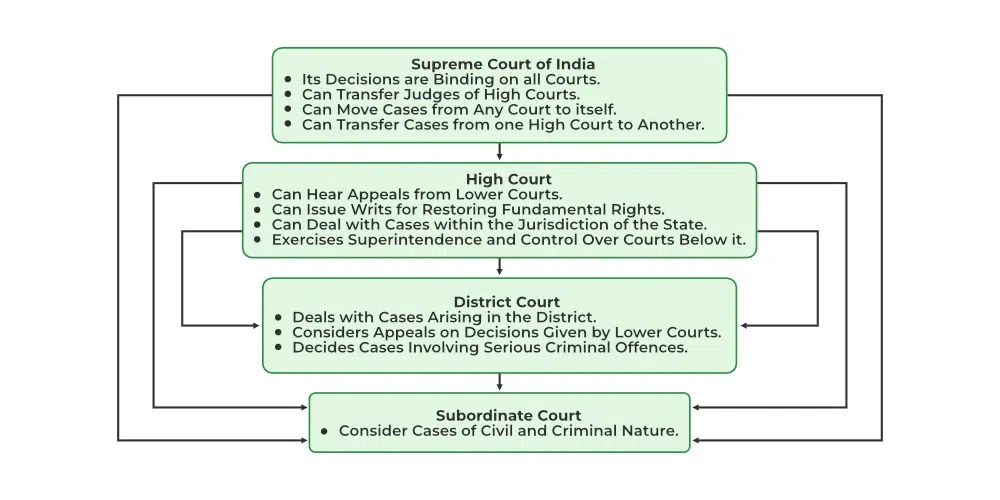
India consists of a single integrated judicial system and the system of the judiciary in India has a structure which is a pyramid structure with the Supreme Court at the top position. High courts are below the Supreme Court and below them are the district and subordinate courts. The lower courts are in direct superintendence of higher courts.
There are two branches of the legal system which can be understood from the above diagram:
The jurisdiction of the Supreme Court of India is mentioned in Articles 131, 133, 136, and 143 of the Constitution and has three types of jurisdictions- original, appellate, and advisory.
The important functions and roles of the judiciary include:
Civil cases are dealt with in the civil courts and civil law is referred to in almost all cases other than criminal cases. Criminal law is applicable in cases of murder, robbery, and so forth.
Civil law is applied in case of disputes; when one person sues the other person. A few examples of civil cases are eviction, consumer problems, debt, etc.
The Indian judiciary upholds the body of law derived from the British colonial legacy, which is based on documented court precedents. The Supreme Court of India, the High Courts, and the District, Municipal, and Village Courts make up the Indian judicial system. India's judiciary is regarded as a hybrid of autonomous and integrated judiciaries.
It was founded on January 28, 1950, and it is the highest court in the state. It is the highest court of appeal and hears both initial lawsuits and appeals against High Court rulings. The Chief Justice of India and other judges chosen by the parliament make up the Supreme Court. Articles 124 to 147 of the Indian Constitution define the Supreme Court's authority.
At the state level, the High Courts have the most judicial power. The High Courts' authority is outlined in Article 214. There are 25 High Courts in India. Only when the State's inferior courts are unable to hear the case do the High Courts have civil or criminal jurisdiction. Additionally, appeals from subordinate courts may be heard by the High Courts. The Chief Justice of India, the Chief Justice of the High Court, and the Governor of the State shall consult before the President of India appoints the judges of the High Court.
Depending on the volume of cases and population density, state governments in India formed district courts for each district or group of districts. The High Courts directly manage the District Courts, and they are bound by their rulings. Each district typically has two different sorts of courts: civil and criminal. District Judges preside over district courts. Based on a caseload, additional district judges and assistant district judges may be appointed. The High Court hears appeals against decisions rendered by the District Court.
An essential component of the Indian government is the judiciary. The judiciary is in charge of handling any friction between the State and the Center. It is the only entity that arbitrates disputes and renders all rulings. It makes sure that the country's Constitutional provisions always take precedence and that they are regarded as the real protectors of the Constitution. The judiciary is therefore the most significant section of the Indian Constitution. It defends all laws and civil rights, renders judgment in court proceedings, and serves as the protector of our Constitution.
The judicial system of India faces the following hurdles, some of which is mentioned below: