|
VOOZH | about |
|
VOOZH | about |
Databases manage data efficiently, and NoSQL systems provide scalable and flexible solutions for modern applications handling diverse data.
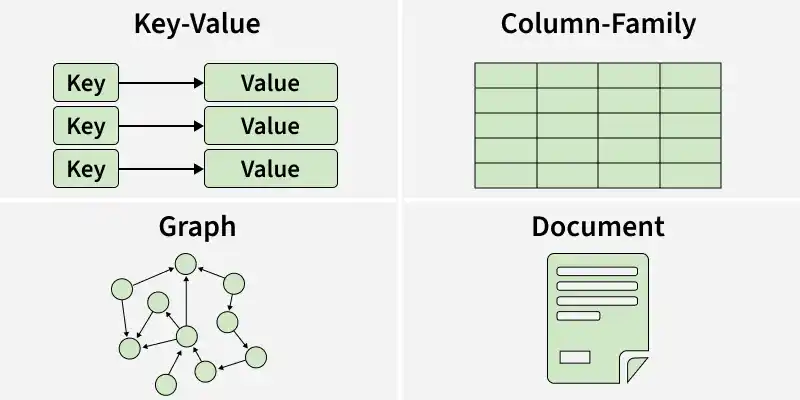
NoSQL databases can be classified into four main types, based on their data storage and retrieval methods:
Each type has unique advantages and use cases, making NoSQL a preferred choice for big data applications, real-time analytics, cloud computing and distributed systems.
A document-based database is a non-relational database that stores data as documents, offering flexible schemas and efficient access aligned with application data models.
Features of document database
Here are some features of document databases:
Popular Document Databases & Use Cases
| Database | Use Case |
|---|---|
| MongoDB | Content management, product catalogs, user profiles |
| CouchDB | Offline applications, mobile synchronization |
| Firebase Firestore | Real-time apps, chat applications |
A key-value store is a non-relational database that stores data as simple key–value pairs, enabling fast and efficient data access.
Features of the key-value store
Here are some features of key-value store:
Popular Key-Value Databases & Use Cases
| Database | Use Case |
|---|---|
| Redis | Caching, real-time leaderboards, session storage |
| Memcached | High-speed in-memory caching |
| Amazon DynamoDB | Cloud-based scalable applications |
A column-oriented database is a non-relational database that stores data by columns rather than rows, enabling efficient analytics and fast data retrieval.
Features of Columnar Oriented Database
Here are some features of columnar oriented database:
Popular Column-Oriented Databases & Use Cases
| Database | Use Case |
|---|---|
| Apache Cassandra | Real-time analytics, IoT applications |
| Google Bigtable | Large-scale machine learning, time-series data |
| HBase | Hadoop ecosystem, distributed storage |
Graph-based databases store data as nodes and relationships, making them ideal for managing and querying complex, interconnected data.
Features of Graph Database
Popular Graph Databases & Use Cases
| Database | Use Case |
|---|---|
| Neo4j | Fraud detection, social networks |
| Amazon Neptune | Knowledge graphs, AI recommendations |
| ArangoDB | Multi-model database, cybersecurity |
The table below compares different NoSQL database types based on their data models, use cases, performance, scalability, and examples.
| Feature | Document-Based | Key-Value Store | Column-Oriented | Graph-Based |
|---|---|---|---|---|
| Data Model | JSON-like documents | Key-Value pairs | Columns instead of rows | Nodes & Relationships |
| Best Use Case | Semi-structured data | Fast lookups & caching | Analytics & big data | Relationship-heavy data |
| Query Performance | Moderate | Fast | High for analytics | Optimized for relationships |
| Schema | Flexible | Dynamic | Semi-structured | Flexible / Optional |
| Scalability | Horizontal | High horizontal | Highly scalable | Scales with relationships |
| Examples | MongoDB, CouchDB | Redis, DynamoDB | Cassandra, HBase | Neo4j, Amazon Neptune |