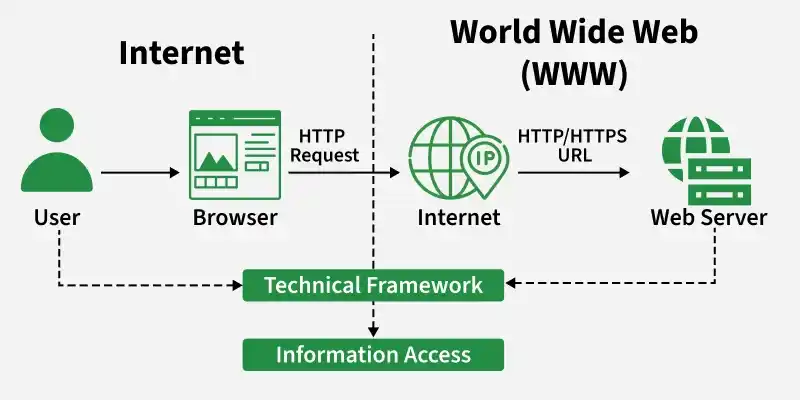
Global connectivity and easy access to information across interconnected networks and web pages are made possible through the Internet and World Wide Web (WWW).
Internet provides the basic infrastructure for communication.
World Wide Web (WWW) runs on the Internet.
Internet connects networks worldwide.
Web allows access to information using web pages and hyperlinks.
WWW is user-friendly and accessed through web browsers.
👁 419253539 Browser communication over the Internet to access WWW resources.
Internet
A global network of interconnected networks that enables computers and servers worldwide to communicate using standardized communication protocols is known as the Internet, initially developed in the 1960s by the U.S. Department of Defense to facilitate information sharing among researchers. Its key features are:
A network of private, public, academic, business, and government networks
Uses standardized protocols for data communication
Supports services such as email, file transfer, forums, and databases
Connects devices using wired, wireless, and optical technologies
Internet Protocol Suite (TCP/IP Model)
The Internet follows a layered architecture known as the Internet Protocol Suite, which includes:
Application Layer: Handles user data such as URLs and web content (HTTP, HTTPS)
Transport Layer: Ensures end-to-end communication (TCP, UDP)
Network Layer: Responsible for routing data packets (IP)
World Wide Web (WWW)
A system of interlinked documents and resources accessed over the Internet is known as the World Wide Web (WWW), invented in 1989 by Tim Berners-Lee to simplify information sharing among scientists. Its characteristics are:
Consists of web pages stored on web servers
Documents are written in HTML (HyperText Markup Language)
Uses hyperlinks to connect documents
Accessed using web browsers
Components Required for the Web
HTML: to format web documents
HTTP/HTTPS: to transfer web data
URL: to locate web resources
Internet vs World Wide Web
Feature
Internet
World Wide Web
Meaning
Network of networks
Collection of interconnected websites
Purpose
Data transport and communication
Information access and sharing
Access
Via various devices and services
Through web browsers
Protocols
TCP/IP, FTP, SMTP, POP3
HTTP, HTTPS
Infrastructure
Routers, switches, servers
Web servers and browsers
Creator
No single creator
Tim Berners-Lee
URI and URL
URI (Uniform Resource Identifier): Identifies a resource by name, location, or both
URL (Uniform Resource Locator): A subset of URI that specifies the location of a resource
Structure of a URL
protocol://websiteName.topLevelDomain/path
Protocol: HTTP or HTTPS
Website Name: e.g., google, geeksforgeeks
Top-Level Domain: .com, .edu, .in
Path: Specific resource location
Internet Governance
The Internet has no single governing authority. Its development and standardization are guided by international organizations:
Internet Society: Promotes global Internet development
Internet Architecture Board: Oversees Internet standards and architecture
Internet Engineering Task Force: Develops and maintains Internet protocols
Uses of Internet and Web
Communication: Email, video calls, social media
Information Sharing: News, research articles, digital libraries