NOAA - Great Lakes Environmental Research Laboratory
 |
VOOZH | about |
|
VOOZH | about |
Understanding the major effect of ice on the Great Lakes is crucial because it impacts a range of societal benefits provided by the lakes, from hydropower generation to commercial shipping to the fishing industry. The amount of ice cover varies from year to year, as well as how long it remains on the lakes. Studying, monitoring, and predicting ice coverage on the Great Lakes plays an important role in determining regional weather patterns, lake water levels, water movement patterns, water temperature structure, and spring plankton blooms.
NOAA-GLERL has been exploring the relationships between ice cover, lake thermal structure, and regional weather for over 30 years through development, maintenance, and analysis of historical model simulations and observations of ice cover, surface water temperature, and other variables. Weekly ice cover imaging products produced by the Canadian Ice Service started in 1973. Beginning in 1989, the U.S. National Ice Center produced Great Lakes ice cover charts that combined both Canadian and U.S. agency satellite imagery. These products are downloaded at GLERL by our Coastwatch program, a nationwide NOAA program within which the GLERL functions as the Great Lakes regional node. In this capacity, GLERL obtains, produces, and delivers environmental data and products for near real-time observation of the Great Lakes to support environmental science, decision making, and supporting research. This is achieved by providing access to near real-time and retrospective satellite observations and in-situ Great Lakes data.
Click here for larger animation with interactive controls
CoastWatch is a nationwide National Oceanic and Atmospheric Administration
(NOAA) program within which the Great Lakes Environmental Research Laboratory (GLERL) functions as the Great Lakes regional node. In this capacity,
GLERL obtains, produces, and delivers environmental data and products for near real-time observation of the Great Lakes to support environmental science,
decision making, and supporting research. This is achieved by providing access to near real-time and retrospective satellite observations and in-situ Great Lakes data.
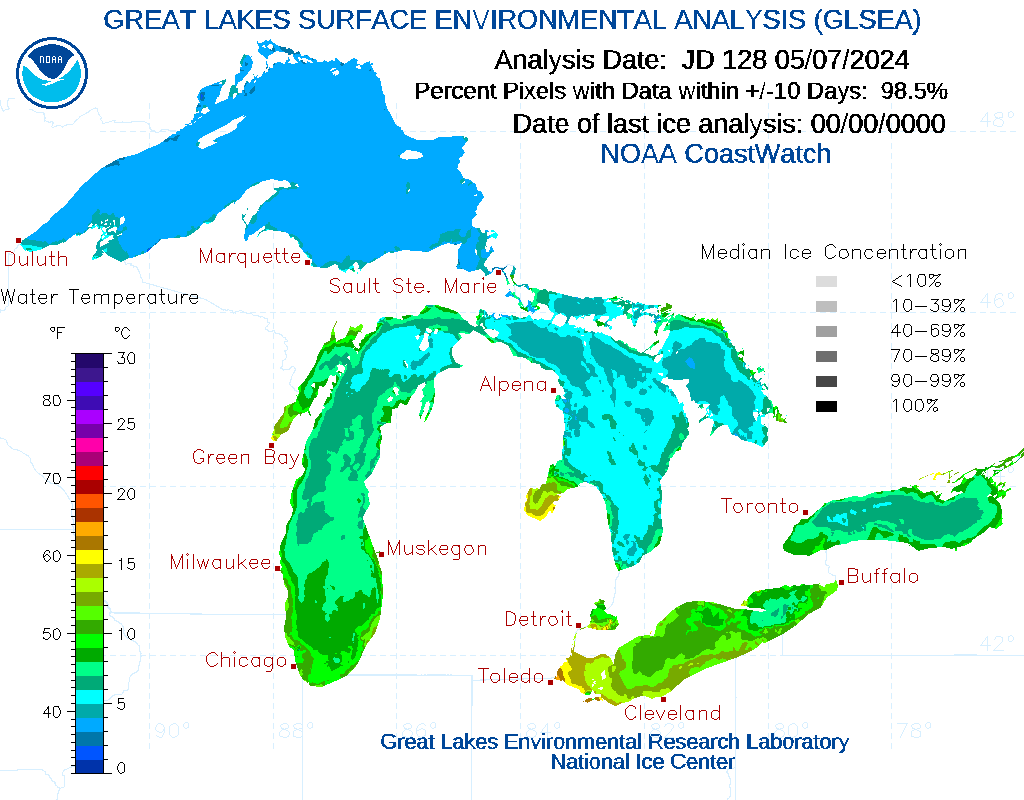
GLSEA (The Great Lakes Surface Environmental Analysis) is a digital map of the Great Lakes surface water temperature and ice cover which is produced daily at GLERL.
The lake surface temperatures are derived from NOAA polar-orbiting satellite imagery.
The addition of ice cover information was implemented in early 1999, using data provided by the US National Ice Center (USNIC). Lake surface temperatures are updated daily with information from the cloud-free portions of the previous day's satellite imagery. If no imagery is available,
a smoothing algorithm is applied to the previous day's map.
|
Superior % |
Michigan % |
Huron % |
Erie % |
Ontario % |
Great Lakes % |
|
👁 Image |
👁 Image |
👁 Image |
👁 Image |
👁 Image |
👁 Image |
NOAA/GLERL has been monitoring and documenting Great Lakes ice cover since the early 1970's using the ice products developed by the U.S. National Ice Center and the Canadian Ice Service. Research conducted on hydrometeorological processes and regional weather trends has led to models of lake thermal structure that play an integral role in ecosystem forecasting.
Click image to enlarge:
Data files:
This database simplifies access to Great Lakes ice cover data by bringing the basic units of data together for the entire time period, 1973-present. The (now retired) Great Lakes Ice Atlas summarized ice cover for the period 1973-2002, with addendums in a separate report for 2003-2005, in addition to providing a number of statistical products. Using the same methods, the original ice charts for 2006 through present were processed and added to this database. In 2020, the entire dataset (1973 - present) was standardized to the newer, high resolution grid and is described in Yang et al. 2020.
About the raw data:
Original ice charts are provided in three forms: asci grid files, jpeg image files, and ArcGIS shapefiles. From 1973 through 1988, the source was
the Canadian Ice Service. Beginning with 1989, the source was the
U.S. National Ice Center, (NIC). Data from both Canadian and U.S.
sources is combined in NIC's daily products.
Files that align ascii grid data with location
and lake are here: geographic metadata
| 1973 - 1979 | 1980 - 1989 | 1990 - 1999 | 2000 - 2009 | 2010 - 2019 | 2020 - 2025 |
|
grid files shapefiles jpg files |
grid files shapefiles jpg files |
grid files shapefiles jpg files |
grid files shapefiles jpg files |
grid files shapefiles jpg files |
grid files shapefiles jpg files |
| Basinwide |
Lake Superior |
Lake Michigan |
Lake Huron |
Lake Erie |
Lake Ontario |
| Data | Reference |
| 1973-2002 |
A Great Lakes Ice Cover Digital Data Set for Winters 1973-2000 (Assel et al., 2002) |
| 2003-2005 |
Great Lakes Ice Cover Climatology Update: Winters 2003, 2004, and 2005 (Assel, 2005) |
| 2006-2017 |
Temporal and Spatial Variability of Great Lakes Ice Cover, 1973-2010 (Wang et al., 2012) Great Lakes ice climatology update: Winter 2006-2011. Description of the digital ice cover dataset (Wang et al., 2012) Analysis of Great Lakes ice cover climatology: Winters 2006-2011 (Assel et al., 2013) Great Lakes Ice Climatology Update of Winters 2012-2017: Seasonal Cycle, Interannual Variability, Decadal Variability, and Trend for the Period 1973-2017 (Wang et al., 2017) Analysis of Great Lakes Ice Cover Climatology: Winters 2012-2017 (Wang et al., 2017) |
| 2020-present | A consistent Great Lakes ice cover digital data set for winters 1973-2019 (Yang et al. 2020) |
GLERL conducts research on ice cover forecasting on two different time scales: short-term (1-3 days) and seasonal. GLERL's short-term ice forecasting is part of the Great Lakes Coastal Forecasting System, a model used by the National Ocean Service to predict wind, waves, currents, and more. These ice nowcast and forecast products (concentration, thickness, velocity, and vessel icing) are still experimental but being transitioned to operations. GLERL's seasonal ice cover forecast is based on statistical and physical analysis and is also experimental.
Great Lakes Coastal Forecasting System (GLCFS) is a short-term physical modeling framework for predicting waves, currents, water temperature, and ice. GLCFS uses observed and forecasted atmospheric conditions to predict ice conditions up to 3 days in the future. Ice forecast products under development include ice thickness, vessel icing, and ice velocity. The ice concentration output has been validated extensively against avaiable observations
(Anderson et al. 2019.)
The following links to the
pages which contain visual summaries of current Great Lakes ice conditions.
Research at NOAA’s Great Lakes Environmental Research Laboratory (GLERL) has shown that the interannual variability of Great Lakes ice cover is heavily influenced by four global weather patterns referred to as teleconnections: the North Atlantic Oscillation (NAO), the Atlantic Multidecadal Oscillation (AMO), the El Nino/Southern Oscillation (ENSO) and the Pacific Decadal Oscillation (PDO). These teleconnection patterns impact Great Lakes regional weather and ice cover by influencing the location of the westerly jet stream over North America (Wang et. al, 2018; Bai and Wang 2012). The position of the jet stream largely dictates the origin of the air masses (e.g. North Pacific or the arctic) that will reach the Great Lakes region as weather systems move across the continent. The temperature and moisture content of these air masses play a key role in determining ice cover.
Note: For official NOAA ice cover forecasts on seasonal to sub-seasonal scales, see the US National Ice CenterGraphic displaying the current Great Lakes surface water temperatures and extent of ice cover as observed by NOAA Coastwatch's Great Lakes Surface Environmental Analysis (GLSEA). GLSEA is a digital map of the Great Lakes surface water temperature and ice cover which is produced daily.
View the records* for Great Lakes Annual Ice Cover (percent) from 1973-2018 below:
Highest Annual Maximum Ice Cover (%) |
Year |
Lowest Annual Maximum Ice Cover (%) |
Year |
|
| Basin | 94.7 | 1979 | 11.9 | 2002 |
| Superior | 100 | 1996 | 8.5 | 2012 |
| Michigan | 93.1 | 2014 | 12.4 | 2002 |
| Huron | 98.2 | 1994 | 22.8 | 2012 |
| Erie | 100 | 1978, 1979, 1996 | 5.4 | 1998 |
| Ontario | 86.2 | 1979 | 1.9 | 2012 |
*See Table 1 from: Wang, J., J. Kessler, F. Hang, H. Hu, A.H. Clites, and P. Chu. Analysis of Great Lakes ice cover climatology: Winters 2012-2017. NOAA Technical Memorandum GLERL-171. NOAA Great Lakes Environmental Research Laboratory, Ann Arbor, MI, 24 pp. (2017). http://www.glerl.noaa.gov/pubs/tech_reports/glerl-171/tm-171.pdf
from: Wang, J, J. Kessler, F. Hang, H. Hu, A.H. Clites, and P. Chu. Great Lakes Ice Climatology Update of Winters 2012-2017: Seasonal Cycle, Interannual Variability, Decadal Variability, and Trend for the Period 1973-2017 http://www.glerl.noaa.gov/pubs/tech_reports/glerl-170/tm-170.pdf
Lake Ontario's extreme depth (86 m average; 244 m maximum) translates to tremendous heat storage capacity. It also has a smaller surface area for heat loss. In addition, cold air outbreaks from the northwest and west are moderated by the waters of Lakes Superior, Michigan, and Huron. These factors combine to keep ice cover on Lake Ontario at a relatively low level most years.
Maximum ice cover on the lower lakes (like Lake Erie) normally occurs between mid-February and end of February. Maximum ice cover on the upper lakes (like Lake Superior) normally occurs between end of February and early March.
The relationship between ice cover, evaporation, and water levels is complex. Data on modeled evaporation shows that this process peaks in the fall, before ice cover formation. In a severe ice cover year such as 2014, the thermal structure of the lake could be impacted for the rest of the year, potentially reducing evaporation from the lakes next fall. Evaporation and precipitation are the major drivers of seasonal water level changes in the Great Lakes.
Ice extent plays a part in determining water temperature in the lakes later in the year, as incoming heat will have to melt the ice before it warms the water below. However, meteorological conditions and heat storage in the lakes are also critical components to the thermal cycle in the lakes.
Sometimes blue ice develops on the Great Lakes. This is an unusual phenomenon in the Great Lakes that is usually short-lived.
What causes blue ice?
| Additional Resources: | |
|---|---|
| Great Lakes Ice Images Great Lakes Ice Brochure US National Ice Center |
National Snow and Ice Data Center Environment and Climate Change Canada Daily Great Lakes Ice Charts |
| Contact: | |||
|---|---|---|---|
| Media Inquiries Monica Allen 202-379-6693 |
General Information 734-741-2235 |
Ice-Climate Modeling/Forecasting Jia Wang 734-741-2281 |
Ice Cover Data James Kessler 734-265-0887 |