

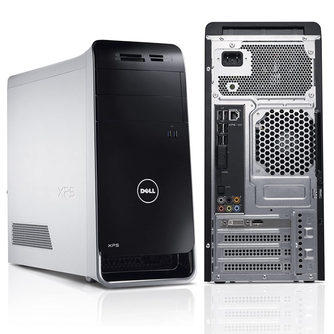
Dell XPS 8500
Specification and Upgrade Options
The Dell XPS 8500 is a scalable home and gaming desktop designed for heavy office workloads, content creation, and home flexibility. First released in 2012, it is built on the H77 chipset and supports 3th gen Intel Core processors and up to 32GB of DIMM DDR3-1333/1600 memory. Thanks to its larger chassis, it accommodates dedicated graphics cards, making it an excellent candidate for a gaming PC conversion or a high-performance workstation.
If you are looking for a system with maximum upgradability, Dell XPS 8500 is a good option. Models in this category usually have 4x PCIe slots, several drive bays and better cooling.
Can you upgrade Dell XPS 8500 to play games?
Yes, Dell XPS 8500 is a home and gaming machine pre-assembled with dictated graphics card. You can easily play games and upgrade it with better hardware components. Processors, memory modules, and storage devices are easy to install. However, these PCs sometime have proprietary elements like the power supply unit, the chassis or the power connector, which can make it difficult for users to install aftermarket PSUs to support better GPUs.
Does Dell XPS 8500 support Windows 11?
No, Dell XPS 8500 does not meet the Windows 11 hardware requirements. According to Windows 11 specification, all models with Intel 7th Gen CPU or older are not officially supported. Processor with TPM 2.0 and a UEFI Secure boot BIOS is also required in order to upgrade from Windows 10 to Windows 11 through Windows Update.
However, anyone with PC that does not pass the upgrade test can download the official Windows 11 ISO, make a bootable flash drive, and install the OS manually.
Processor
The Dell XPS 8500 supports Gen3 Intel Core technology on a H77 chipset. 3rd generation Intel Core CPUs (Ivy Bridge) offer modest efficiency and performance improvements over Sandy Bridge. Performance depends heavily on the installed CPU model. Higher-end variants are suitable for office work, software development, light virtualization, and basic homelab usage. Entry-level emulation works well, while more demanding emulation (such as PS3) is only feasible on top-tier SKUs and remains limited.
Best CPUs for Dell XPS 8500 upgrade:
| Model | Cores (Threads) | Base frequency | Turbo |
|---|---|---|---|
| Core i5 3550 | 4(4) | 3.3 GHz | 3.7 GHz |
| Core i7 3750 | 4(4) | 3.4 GHz | 3.8 GHz |
| Core i7 3770 | 4(8) | 3.4 GHz | 4.9 GHz |
GPU upgrade
Dell XPS 8500 is a gaming computer and comes assembled with a dedicated graphics card. According to the specification the best possible GPU you can use with it is GeForce GTX 1650 Super. You can upgrade Dell XPS 8500 graphics card, but you should select a model that requires 460 W or less.
GPU upgrade options for Dell XPS 8500 with the stock 460W power supply:
| GPU | Power consumption | Memory | Req. |
|---|---|---|---|
| AMD RX 6600 | 160 W | 8 GB DDR6 | *Dual SATA to PCIe adapter |
| NVIDIA RTX 2060 | 170 W | 6 GB DDR6 | *Dual SATA to PCIe adapter |
| AMD RX 6600 XT | 165 W | 8 GB DDR6 | *Dual SATA to PCIe adapter |
| NVIDIA RTX 2070 | 175 W | 8 GB DDR6 | *Dual SATA to PCIe adapter |
| NVIDIA RTX 3060 | 170 W | 8 GB DDR6 | *Dual SATA to PCIe adapter |
| NVIDIA RTX 2070 Super | 215 W | 8 GB DDR6 | *Dual SATA to PCIe adapter |
| NVIDIA RTX 2080 | 220 W | 8 GB DDR6 | *Dual SATA to PCIe adapter |
Please note that upgrading to a more power-hungry GPU requires a better PSU. However, in most cases, this may not be possible because most OEM pre-built PCs have motherboards that use a proprietary power connector. Nevertheless, this problem can be solved by using a power adapter. The more challenging problem arises when the model has a non-standard chassis or power supply, in which case upgrading the PSU becomes much harder.
Memory
Dell XPS 8500 supports up to 32 GB of DIMM DDR3-1333/1600 RAM across four DIMM slots, with memory speeds up to 1600 MT/s and dual-channel support depending on the installed configuration.
Actual supported memory capacity and memory channels may vary depending on the installed CPU and chipset.
Typical Dell XPS 8500 memory configurations include 8 GB for everyday productivity and 16 GB for gaming, heavier multitasking, or professional workloads.
Wi-Fi Support
Dell XPS 8500 doesn't come with any on-board Wi-Fi support. In that case, you have two options to upgrade this model with Wi-Fi. You either use an external USB Wi-Fi adapter (wireless network dongle) or a PCIe-based wireless adapter.
The USB dongle is much more convenient and easy to install, but has less space for a decent antenna and can have thermal problems. On the other hand, the PCIe based adapter is much more powerful, more reliable, and has better antenna, but it is harder to install.
Wi-Fi and Bluetooth wireless adapter upgrades for Dell XPS 8500:
| Model | Speed | Frequency | Interface |
|---|---|---|---|
| WiFi 6E (Gig+) Kit | 3000 Mbit/s | 2.4GHz / 5GHz | NGFF M.2 A/E Key |
| Rekong AX210 | 3000 Mbit/s | 2.4GHz / 5GHz | NGFF M.2 A/E Key |
| Gigabyte GC-Wbax200 | 2400 Mbit/s | 2.4GHz / 5GHz | PCIe |
| TP-Link Archer TX50E | 2400 Mbit/s | 2.4GHz / 5GHz | PCIe |
| TP-Link Archer T9UH | 1300 Mbit/s | 2.4GHz / 5GHz | USB 3.0 |
Ports
Dell XPS 8500 provides a fixed set of external I/O ports for connecting peripherals and displays. Port availability and versions determine supported data transfer speeds and display capabilities.
USB ports
Dell XPS 8500 includes nine USB ports in total in the following configuration - (8x) USB-A 2.0; USB 3.0; with no USB 3.1 ports available.
Video ports
Dell XPS 8500 does not include a DisplayPort output.
HDMI output is provided via one HDMI 1.2 port.
Motherboard video outputs require a CPU with integrated graphics. Systems equipped with a dedicated GPU must use the video ports on the graphics card instead.
SSD storage - M.2 sockets and SATA ports
The Dell XPS 8500 comes with four SATA port(s) for connecting storage devices.
Unfortunately, the Dell XPS 8500 has no M.2 PCIe soket and you have to rely on the available SATA ports to connect your drives.
The M.2 PCIe SSD connector in combination with an NVMe drive allows for higher transfer rates, compared to the old SATA interface. In some situations, NVMe device connected to the M.2 PCIe socket can be more than 5 times faster.
*Keep in mind that some M.2 connectors may not support SATA SSDs. Check the motherboard manual to confirm compatibility.
Power Supply
The Dell XPS 8500 comes with a 460 Watt PSU. Having a power supply with high power rating is important, especially if you are doing upgrade with addtional components, like dedicated GPU and more HDDs. Will this 460 W be enough, it all depends on your specific use. Please keep in mind that some models might have more than one PSU option. Whenever possible get the most powerful one, as it might make future upgrades easier.
