

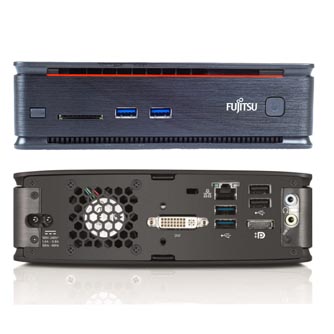
Fujitsu Esprimo Q920
Specification and Upgrade Options
The Fujitsu Esprimo Q920 is a micro-form-factor business desktop designed to disappear onto the back of a monitor or sit unobtrusively on a desk. First available in 2014, this unit relies on the Q87 chipset to run 4th gen Intel Core processors and up to 16GB of SODIMM DDR3-1600 memory. It is the ideal choice for strictly business environments or home media centers where physical space is the primary concern, rather than raw graphical expansion.
This device is easy to upgrade with additional RAM and storage. Usually models with this chassis have an optional Wi-Fi and Bluetooth module and an M.2 slot for an SSD drive.
Can you upgrade Fujitsu Esprimo Q920 to play games?
Fujitsu Esprimo Q920 is a business desktop computer in micro form factor. It is using a processor that provides both the CPU and GPU functionality. While integrated GPUs are sufficient for basic gaming, they are not powerful enough to run demanding games. Fujitsu Esprimo Q920 has no space for dedicated graphics card.
Micro desktop machines like Fujitsu Esprimo Q920 are usually used as home theater PCs (HTPC), in home lab projects or a as home automation servers.
Does Fujitsu Esprimo Q920 support Windows 11?
No, Fujitsu Esprimo Q920 does not meet the Windows 11 hardware requirements. According to Windows 11 specification, all models with Intel 7th Gen CPU or older are not officially supported. Processor with TPM 2.0 and a UEFI Secure boot BIOS is also required in order to upgrade from Windows 10 to Windows 11 through Windows Update.
However, anyone with PC that does not pass the upgrade test can download the official Windows 11 ISO, make a bootable flash drive, and install the OS manually.
Processor
The Fujitsu Esprimo Q920 supports Gen4 Intel Core technology on a Q87 chipset. 4th generation Intel Core CPUs (Haswell) introduced meaningful IPC gains and improved power efficiency. Lower-end models are appropriate for office productivity and programming tasks, while higher-end i7 CPUs can support moderate virtualization, homelab environments, and light gaming. Emulation performance improves over previous generations, with demanding emulators still requiring high-end SKUs.
Best CPUs for Fujitsu Esprimo Q920 upgrade:
| Model | Cores (Threads) | Base frequency | Turbo |
|---|---|---|---|
| Core i5 4690 | 4(4) | 3.5 GHz | 3.9 GHz |
| Core i7 4770 | 4(8) | 3.4 GHz | 3.9 GHz |
| Core i7 4790 | 4(8) | 3.6 GHz | 4.0 GHz |
GPU upgrade
It is not possible to upgrade Fujitsu Esprimo Q920 with a dedicated GPU due to the lack of space and absence of a PCIe slot. However, you can still use the integrated graphics processor for gaming. There are number of games you can enjoy with an Intel HD and UHD iGPU.
Memory
Fujitsu Esprimo Q920 supports up to 16 GB of SODIMM DDR3-1600 RAM across two DIMM slots, with memory speeds up to 1600 MT/s and dual-channel support depending on the installed configuration.
Actual supported memory capacity and memory channels may vary depending on the installed CPU and chipset.
Typical Fujitsu Esprimo Q920 memory configurations include 8 GB for everyday productivity and 16 GB for gaming, heavier multitasking, or professional workloads.
Wi-Fi Support
Fujitsu Esprimo Q920 doesn't come with any on-board Wi-Fi support. In that case, you have two options to upgrade this model with Wi-Fi. You either use an external USB Wi-Fi adapter (wireless network dongle) or a PCIe-based wireless adapter.
The USB dongle is much more convenient and easy to install, but has less space for a decent antenna and can have thermal problems. On the other hand, the PCIe based adapter is much more powerful, more reliable, and has better antenna, but it is harder to install.
Wi-Fi and Bluetooth wireless adapter upgrades for Fujitsu Esprimo Q920:
| Model | Speed | Frequency | Interface |
|---|---|---|---|
| WiFi 6E (Gig+) Kit | 3000 Mbit/s | 2.4GHz / 5GHz | NGFF M.2 A/E Key |
| Rekong AX210 | 3000 Mbit/s | 2.4GHz / 5GHz | NGFF M.2 A/E Key |
| Gigabyte GC-Wbax200 | 2400 Mbit/s | 2.4GHz / 5GHz | PCIe |
| TP-Link Archer TX50E | 2400 Mbit/s | 2.4GHz / 5GHz | PCIe |
| TP-Link Archer T9UH | 1300 Mbit/s | 2.4GHz / 5GHz | USB 3.0 |
Ports
Fujitsu Esprimo Q920 provides a fixed set of external I/O ports for connecting peripherals and displays. Port availability and versions determine supported data transfer speeds and display capabilities.
USB ports
Fujitsu Esprimo Q920 includes six USB ports in total in the following configuration - (4x) USB-A 3.0; (2x) USB-A 2.0 with no USB 3.1 ports available.
Video ports
Fujitsu Esprimo Q920 features one DisplayPort 1.2 output, suitable for modern digital displays.
No HDMI output is available on the motherboard.
Motherboard video outputs require a CPU with integrated graphics. Systems equipped with a dedicated GPU must use the video ports on the graphics card instead.
SSD storage - M.2 sockets and SATA ports
The Fujitsu Esprimo Q920 comes with two SATA port(s) for connecting storage devices.
Unfortunately, the Fujitsu Esprimo Q920 has no M.2 PCIe soket and you have to rely on the available SATA ports to connect your drives.
The M.2 PCIe SSD connector in combination with an NVMe drive allows for higher transfer rates, compared to the old SATA interface. In some situations, NVMe device connected to the M.2 PCIe socket can be more than 5 times faster.
*Keep in mind that some M.2 connectors may not support SATA SSDs. Check the motherboard manual to confirm compatibility.
Power Supply
The Fujitsu Esprimo Q920 comes with a 65 Watt PSU. Having a power supply with high power rating is important, especially if you are doing upgrade with addtional components, like dedicated GPU and more HDDs. Will this 65 W be enough, it all depends on your specific use. Please keep in mind that some models might have more than one PSU option. Whenever possible get the most powerful one, as it might make future upgrades easier.
