|
VOOZH | about |
|
VOOZH | about |
10 min
read
Decide between a no-code agency or freelancer with our guide. Explore costs, expertise, workflow, and ongoing support to make the best choice
By
Jesus Vargas
Updated on
May 29, 2026
.
Reviewed by
Real-World Experience with No-Code Tools: With over 320 apps built, we know firsthand what works—and what doesn't—when using no-code platforms like Glide, Bubble, FlutterFlow and Webflow.
Expert Team with 40+ Years of Combined Experience: Our team has deep technical knowledge, with experts who use no-code tools to solve real-world problems for clients every day, ensuring our advice is actionable and reliable.
Detailed Guides Based on Actual Projects: We don’t just talk about no-code; we use it daily to solve real business problems for our clients, from MVPs to complex automations.
Take a deeper look at our editorial guidelines
There is a popular myth that freelancers always cost less and agencies always deliver more. Neither is consistently true in the no-code world.
The real answer depends on your project scope, your risk tolerance, and what kind of support you need after launch day. This guide breaks down exactly when each option wins and what the true trade-offs look like before you commit.
Strategic Technology Partner
We Help You Win Long-Term
We don’t just deliver software—we help you build a business that lasts.
The fundamental difference is capacity and coverage. A freelancer is one person. An agency is a system built around delivering projects reliably at scale.
When you hire a freelancer, you get their individual skills, availability, and judgment. When you hire an agency, you access a structured team with defined roles and proven processes.
A freelancer is often the right choice for focused, short-term work. An agency becomes the right choice when your project requires more than one person can reliably deliver. Reviewing the best no-code agencies helps you understand what a structured agency relationship actually looks like.
The sticker price of a freelancer almost always looks lower than an agency quote. The total cost of delivery tells a very different story.
Hidden costs accumulate quickly with freelancer engagements: project management time, scope gaps, rework, and onboarding new people if the first hire does not work out.
| Factor | Agency | Freelancer | Best Choice For |
|---|---|---|---|
| Hourly rate | $100–$200/hr blended | $50–$250/hr | Freelancer (simple builds) |
| Project management | Included | Your responsibility | Agency |
| Design coverage | Included in most agencies | Extra hire required | Agency |
| QA and testing | Included | Often skipped or extra | Agency |
| Ongoing support | Structured retainer | Ad hoc availability | Agency |
| Risk of abandonment | Low (team redundancy) | High (one person) | Agency |
For a $5,000 project, a freelancer may quote $3,500 and an agency $6,000. But if the freelancer requires two rounds of rework and three weeks of delays, the agency was cheaper in practice.
Get line-item quotes from both options before deciding. The difference between "design included" and "design extra" alone can flip the cost comparison entirely.
Not every project needs an agency, and not every project is safe to hand to a single freelancer. Matching the engagement type to the project type matters.
The clearest signal is complexity. Simple, well-defined builds suit freelancers. Ambiguous, multi-phase, or high-stakes builds suit agencies with a proven delivery structure.
For a deeper look at how this comparison plays out with traditional development teams, explore this breakdown of no-code agency vs in-house team trade-offs.
Every hiring decision carries risk. Understanding the specific risk profile of each option lets you mitigate problems before they appear in your project.
The risks are different in nature, not just in magnitude. Agency risks center on fit and cost. Freelancer risks center on reliability and coverage.
The no-code agency vs traditional agency comparison surfaces some of these risks in a different context and is worth reviewing before you finalize your approach.
The assumption that freelancers move faster than agencies is often wrong. Speed depends on workstream management, not headcount alone.
A freelancer working sequentially on design, then build, then QA will almost always be slower than an agency running those phases in parallel with a coordinated team.
For a typical MVP build, a strong agency often delivers in six to ten weeks. A skilled freelancer working alone on the same scope typically takes eight to fourteen weeks.
Three questions cut through most of the noise when you are making this decision. Answer them honestly and the right choice usually becomes clear.
Start with scope clarity, then assess your own capacity to manage the engagement, then consider what happens after the initial build is complete.
A useful framework: if you can describe exactly what you need in a one-page brief with clear acceptance criteria, a freelancer can likely deliver it. If you cannot, start with an agency. Visit LowCode Agency's no-code development services to understand what a full-service engagement looks like in practice.
Strategic Technology Partner
We Help You Win Long-Term
We don’t just deliver software—we help you build a business that lasts.
Most agencies push you toward the most expensive option regardless of fit. We do not operate that way.
At LowCode Agency, we function as a strategic product team, not a vendor trying to maximize your invoice. We have delivered over 350 no-code and low-code projects for clients including Medtronic, American Express, Coca-Cola, Zapier, and Sotheby's. We have seen every project type and know exactly when a focused freelancer is right and when a full team is necessary.
Whether you are deciding between agency and freelancer or already committed to an agency model, the right partner makes all the difference.
Talk to LowCode Agency about your project and get an honest recommendation for your specific situation.
Last updated on
May 29, 2026
.
Jesus Vargas
-
Founder
Jesus is a visionary entrepreneur and tech expert. After nearly a decade working in web development, he founded LowCode Agency to help businesses optimize their operations through custom software solutions.
Custom Automation Solutions
Save Hours Every Week
We automate your daily operations, save you 100+ hours a month, and position your business to scale effortlessly.
Our AI — trained on 300+ shipped products — tells you what to build, what to skip, and what it'll actually cost. No fluff.
Assess My Idea"Working with LowCode Agency was the best decision I made in 2025"
Franklin Frith
CEO at HRM
While agencies charge more than freelancers ($7,000-$40,000 vs $1,000-$5,000 per project), they offer significant value through dedicated project management, quality testing, and ongoing support. The investment pays off for complex projects needing multiple experts, structured development processes, and guaranteed delivery timelines. You get a reliable team focused on building solutions that work for the long term.
Freelancers are ideal for straightforward projects with clear requirements and limited budgets. They work well when you need a simple landing page, basic automation workflow, or small application that takes 1-2 weeks to complete. If you have technical knowledge and can manage the project directly, a freelancer's personal attention and lower rates make them a practical choice.
Check their portfolio and client reviews specifically related to your needed platform. Set clear project requirements, deadlines, and deliverables in writing before starting. Schedule regular progress updates and define specific testing points throughout development. Request references from past clients and establish a clear payment structure tied to quality milestones.
Agencies provide better scaling capabilities through their team structure. While freelancers work alone and have limited time, agencies can assign multiple specialists to work on different parts simultaneously. When your project grows, they add team members without disrupting development. This allows faster delivery of new features and handles increasing complexity effectively.
Agencies offer higher reliability through built-in redundancy. If one team member becomes unavailable, others can continue your project without delays. They maintain detailed documentation, follow established quality processes, and provide consistent support. With scheduled maintenance and dedicated project managers, agencies ensure continuous progress and long-term stability for your project.
No-code/Low-code
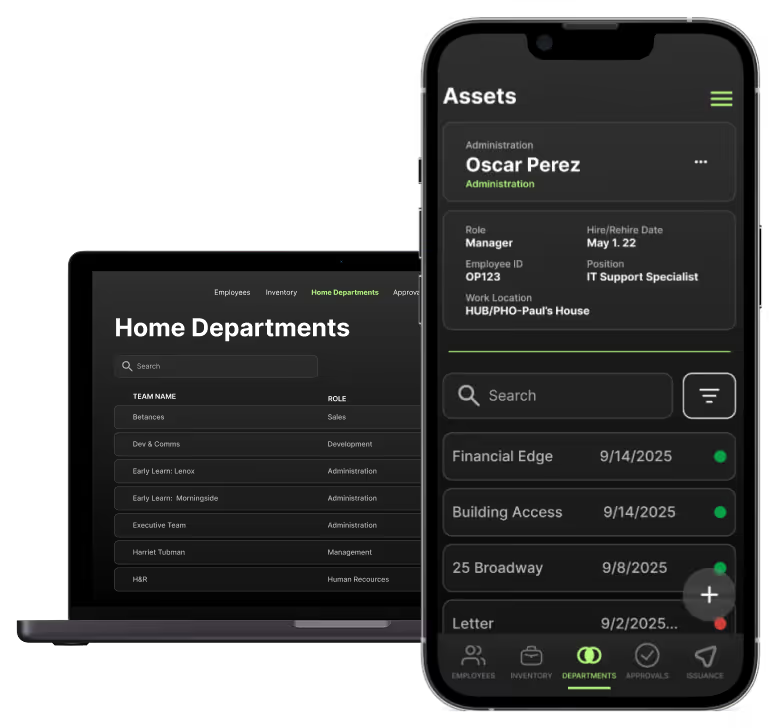
What Are Low-code Applications? [Detailed Guide]
Understand what low-code applications are, how they work, and where they’re used. A simple guide with examples, benefits, and common use cases.
Mobile App Development
No-code/Low-code
No-code Mobile App Development (Build, Launch, and Scale)
Learn how to build no-code mobile apps step by step, choose the right tools, avoid mistakes, and scale your app without coding in 2026.
MVP
No-code/Low-code
No-code MVP Development (How to Build, Validate, and Scale)
Learn how to build a no-code MVP step by step, validate your idea, reduce costs, and scale your product with the right strategy in 2026.
No-code/Low-code
12 Questions to Ask Before Hiring a No-code Agency
Ask these 12 questions before hiring a no-code agency to ensure project success, platform expertise, and effective communication and support
No-code/Low-code
No-code CRM (Build vs Buy, Benefits, Limits Explained)
Learn how no-code CRM works, when to use it, and its limits. Compare build vs buy, risks, scalability, and best use cases before choosing.
No-code/Low-code
Benefits of No-code Development: Why It’s Worth It
Discover the real benefits of no-code development, from faster builds to lower costs, and learn when it’s the right choice for your business.





![👁 What Are Low-code Applications? [Detailed Guide]](https://cdn.prod.website-files.com/61cbe22a00483909d327afc6/69de878d902970291a8e40e7_69b2c801e7ca826265eea676_what-are-low-code-applications.avif)