|
VOOZH | about |
|
VOOZH | about |
13 min
read
Discover the real benefits of no-code development, from faster builds to lower costs, and learn when it’s the right choice for your business.
By
Jesus Vargas
Updated on
May 29, 2026
.
Reviewed by
Real-World Experience with No-Code Tools: With over 320 apps built, we know firsthand what works—and what doesn't—when using no-code platforms like Glide, Bubble, FlutterFlow and Webflow.
Expert Team with 40+ Years of Combined Experience: Our team has deep technical knowledge, with experts who use no-code tools to solve real-world problems for clients every day, ensuring our advice is actionable and reliable.
Detailed Guides Based on Actual Projects: We don’t just talk about no-code; we use it daily to solve real business problems for our clients, from MVPs to complex automations.
Take a deeper look at our editorial guidelines
No-code development has moved from a shortcut for simple tools to a legitimate product strategy for founders, operators, and growing businesses in 2026.
Teams ship real products faster, validate ideas cheaper, and operate without the engineering dependency that slowed every decision in traditional development cycles.
This guide covers the real benefits of no-code development, where they compound, and where they start to break down so you can make the decision with full information.
Bubble App Development
Bubble Experts You Need
Hire a Bubble team that’s done it all—CRMs, marketplaces, internal tools, and more
The right question is not whether no-code is good. It is whether it helps you build faster and make better decisions at your specific product stage.
What no-code actually is and how it differs from traditional development gives the foundational context for evaluating every benefit that follows.
No-code delivers three compounding advantages that affect every aspect of early-stage product development simultaneously.
These three benefits compound most powerfully at the validation stage when the cost of moving slowly exceeds the cost of platform limitations by a wide margin.
The most expensive mistake in product development is building the wrong thing with confidence. No-code reduces this risk by making validation fast enough to happen before significant investment is committed.
The clearest financial benefit of no-code validation is spending $10,000 to discover whether users want a product rather than $100,000 to build one they do not.
No-code removes the technical barrier that previously made product building exclusively dependent on engineering skill and developer availability.
This accessibility changes the economics of early-stage product development fundamentally for the majority of founders who previously could not build without a technical co-founder or a significant developer budget.
No-code delivers productivity benefits that extend beyond the build phase into the ongoing operational efficiency of every team that uses the tools it creates.
The benefits of no-code automation specifically compound most clearly for operations teams where repetitive structured workflows represent the largest share of weekly team time.
Developer dependency is one of the most significant operational bottlenecks in growing businesses. Every product change, internal tool update, and workflow improvement waiting in a development queue costs more in delayed execution than the development time itself.
The ability to change a product quickly in response to user feedback is as valuable as the ability to build it quickly in the first place. No-code delivers both.
No-code platforms do not just build apps in isolation. They connect existing tools, automate data flow between systems, and create unified operational infrastructure that replaces the manual coordination between disconnected tools.
Visual development environments change how business and product teams communicate about what is being built and why.
The cost of being wrong about a product idea is the primary constraint on how much experimentation teams are willing to attempt. No-code reduces that cost enough to change the experimentation calculus fundamentally.
Managed infrastructure removes the technical overhead that consumes significant engineering time in custom development without adding direct product value.
Custom code accumulates maintenance requirements that grow proportionally with codebase complexity. No-code platforms manage the infrastructure layer that creates the largest share of ongoing maintenance burden in custom systems.
The less discussed benefits of no-code compound over time in ways that affect how teams think about building, not just how fast they build.
The benefits of no-code are real and significant within their applicable range. Understanding where they stop applying prevents the expensive mistake of choosing no-code for product types where its limitations create more problems than its speed advantage solves.
Every no-code benefit comes with a specific trade-off worth understanding explicitly before committing to the approach.
The long-term impact of no-code extends beyond individual product builds into how the entire business approaches building, iteration, and operational improvement.
No-code use cases across every business function show how the long-term operational impact compounds as automation, internal tools, and product infrastructure built on no-code replace manual processes throughout the organization.
Bubble App Development
Bubble Experts You Need
Hire a Bubble team that’s done it all—CRMs, marketplaces, internal tools, and more
At LowCode Agency, we design, build, and evolve no-code products and automation systems for growing SMBs and startups who want the speed benefits of no-code without the architectural mistakes that create expensive rebuilds.
We have shipped 350+ products across 20+ industries. Clients include Medtronic, American Express, Coca-Cola, and Zapier.
If you are serious about building faster without the mistakes that slow you down later, let's talk.
Last updated on
May 29, 2026
.
Jesus Vargas
-
Founder
Jesus is a visionary entrepreneur and tech expert. After nearly a decade working in web development, he founded LowCode Agency to help businesses optimize their operations through custom software solutions.
Custom Automation Solutions
Save Hours Every Week
We automate your daily operations, save you 100+ hours a month, and position your business to scale effortlessly.
Our AI — trained on 300+ shipped products — tells you what to build, what to skip, and what it'll actually cost. No fluff.
Assess My Idea"Working with LowCode Agency was the best decision I made in 2025"
Franklin Frith
CEO at HRM
The main benefits are faster development measured in weeks rather than months, lower cost at 60 to 80 percent less than custom development, accessibility for non-technical founders, faster idea validation through cheap MVP builds, reduced developer dependency, and built-in infrastructure management that removes technical overhead.
Yes. No-code development costs 60 to 80 percent less than equivalent custom development across every product category. The saving comes from eliminating engineering overhead, infrastructure setup, and deployment complexity. Costs still depend on product complexity, integration requirements, and platform tier at target user volume.
Yes. Modern no-code platforms use visual builders that non-technical founders, operations teams, and product managers learn in days rather than months. Authentication, payments, workflows, and integrations all configure without code. Some planning discipline around data architecture is required but no programming knowledge is necessary.
Yes. Platform limitations on customization, scalability ceilings at high user volume, vendor lock-in with no code export, and dependency on platform provider decisions are the main downsides. These limitations are acceptable trade-offs for most early-stage products and become genuine business constraints for complex, high-scale, or compliance-heavy systems.
Choose no-code when you need to validate an idea quickly, launch with limited budget, build without a technical team, or create internal tools and automation systems. It is especially valuable for startups, small businesses, and teams where speed of learning matters more than architectural perfection at the current product stage.
No-code accelerates execution across every team, reduces early-stage hiring dependency, and shifts organizational thinking toward product outcomes rather than implementation complexity.
No-code/Low-code
How to Publish a Low-code Mobile App on the App Store
Learn how to publish a low-code mobile app on the App Store. Covers Apple review rules, certificates, testing, common rejections, and launch tips.
No-code/Low-code
The top 5 no-code tools for marketplaces
Explore the top 5 no-code marketplace tools and find your perfect fit
No-code/Low-code
Low-code Employee App Development Guide
Low-code employee app development guide covering features, use cases, tools, costs, and best practices to build internal apps faster and scale teams.
No-code/Low-code
What Are Low-code Tools? [Features, and Examples]
Learn what low-code tools are, how they work, and see real examples used to build apps faster. A clear guide covering features, use cases, and benefits.
No-code/Low-code
Low-code vs No-code [Key Differences Explained]
Learn the real differences between low-code and no-code platforms. See how they work, where each fits, and which one is right for your project.
No-code/Low-code
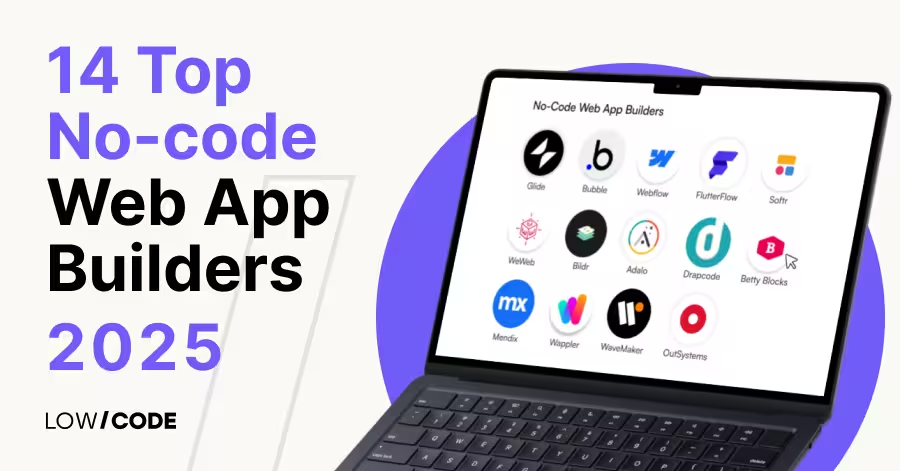
Top no-code web app builders for 2026
Discover the ultimate curated list of top no-code web app builders, empowering you to build web apps without coding.









![👁 What Are Low-code Tools? [Features, and Examples]](https://cdn.prod.website-files.com/61cbe22a00483909d327afc6/69de878d902970291a8e40ea_69b2c0ed22d1ae8689dc9420_what-are-low-code-tools-.avif)
![👁 Low-code vs No-code [Key Differences Explained]](https://cdn.prod.website-files.com/61cbe22a00483909d327afc6/69de878c902970291a8e4079_69b2c832a1606ed9c53e2e83_low-code-vs-no-code.avif)