|
VOOZH | about |
|
VOOZH | about |
13 min
read
Not sure if hiring a mobile app agency is the right move? Compare your options and find the best path for your project and budget.
By
Jesus Vargas
Updated on
May 29, 2026
.
Reviewed by
Real-World Experience with No-Code Tools: With over 320 apps built, we know firsthand what works—and what doesn't—when using no-code platforms like Glide, Bubble, FlutterFlow and Webflow.
Expert Team with 40+ Years of Combined Experience: Our team has deep technical knowledge, with experts who use no-code tools to solve real-world problems for clients every day, ensuring our advice is actionable and reliable.
Detailed Guides Based on Actual Projects: We don’t just talk about no-code; we use it daily to solve real business problems for our clients, from MVPs to complex automations.
Take a deeper look at our editorial guidelines
You have a mobile app idea and budget. Now you need to decide who builds it. The choice between a mobile app agency, freelancers, or an in-house team shapes your cost, timeline, quality, and risk.
Deciding whether to hire a mobile app agency or choose an alternative depends on your project complexity, budget, timeline, and long-term plans. Each option carries trade-offs that affect your product for years after launch. This guide compares every path so you can pick the right one.
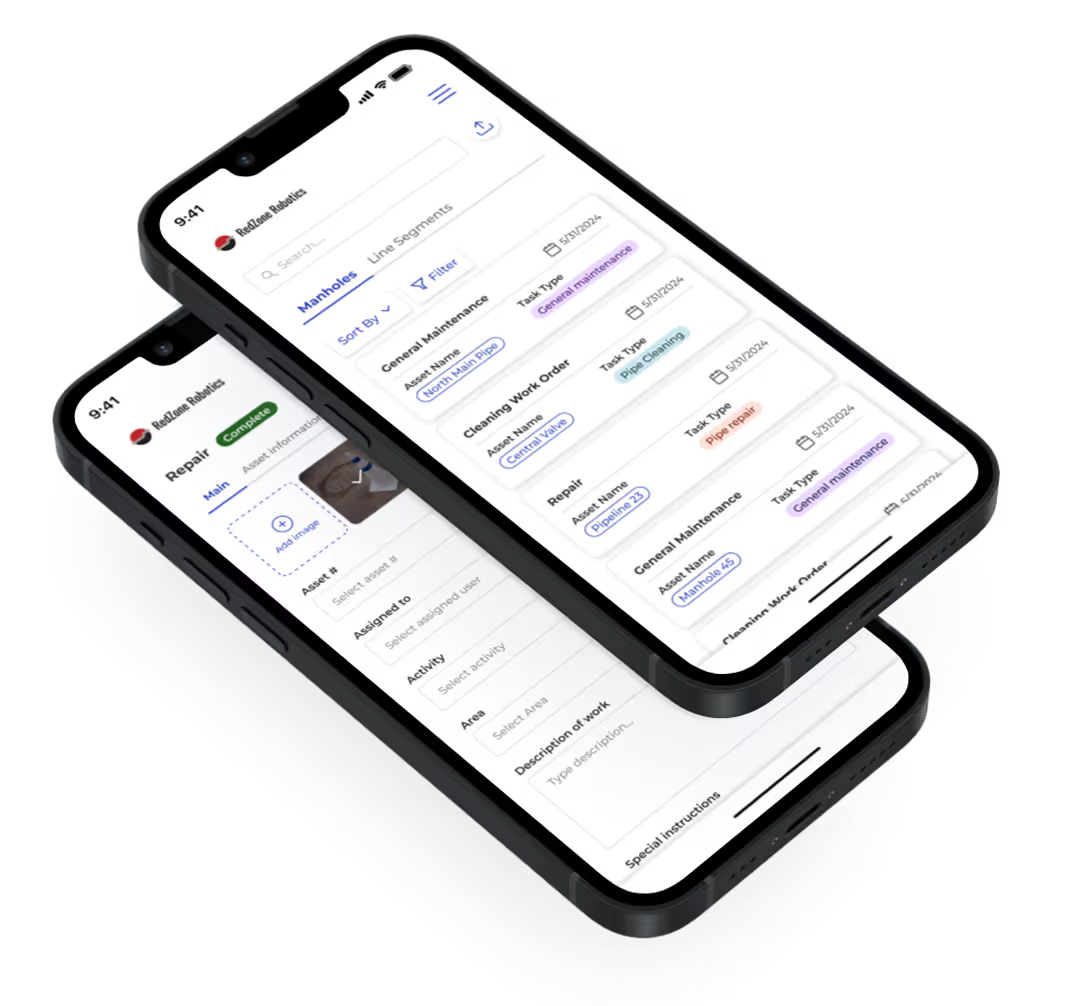
Mobile App Development Services
Apps Built to Be Downloaded
We create mobile experiences that go beyond downloads—built for usability, retention, and real results.
A mobile app agency provides end-to-end product development including strategy, design, development, QA testing, deployment, and post-launch support through a coordinated team that has built dozens or hundreds of similar products.
When you hire a mobile app agency, you are buying a system, not just developers. Agencies have refined their processes across hundreds of projects, which means they anticipate problems you have never encountered.
When you hire a mobile app agency, you trade a higher price tag for lower risk. The premium you pay covers the systems, processes, and collective experience that reduce the chance of project failure.
A mobile app agency costs 2-3x more than freelancers per hour but delivers faster timelines, lower project risk, broader expertise, and built-in project management that freelancers require you to provide yourself.
The comparison between hiring a mobile app agency versus freelancers comes down to how much management overhead you are willing to absorb. Freelancers are cheaper individually but require you to be the project manager.
| Factor | Mobile App Agency | Freelancer |
|---|---|---|
| Hourly rate | $100-$250 | $40-$150 |
| Project management | Included | You manage |
| Design capability | In-house team | Separate hire needed |
| QA testing | Dedicated process | Developer self-tests |
| Availability risk | Low (team backup) | High (single person) |
| Scalability | Can add resources | Limited to one person |
| Post-launch support | Structured retainers | Best-effort basis |
| Knowledge continuity | Team-based | Single point of failure |
If you have strong technical leadership internally, freelancers can work well for defined, smaller projects. For complex apps where you need a team to own the outcome, the case to hire a mobile app agency is much stronger.
Build an in-house team when your mobile app is your core product, you need continuous iteration beyond the initial build, and you can justify the cost of 3-5 full-time specialists including a designer, iOS and Android developers, and a QA engineer.
In-house mobile app development only makes financial sense when you have enough continuous work to keep a full team productive. Hiring developers for a single app project and then having them idle is the most expensive path available.
For most companies, the decision to hire a mobile app agency makes more financial sense than building in-house until the app generates enough revenue to justify a permanent team.
No-code and low-code platforms like FlutterFlow and Bubble can replace or supplement a mobile app agency for apps with straightforward functionality, reducing both and timeline by 40-60%.
The no-code versus custom development decision depends on your app's complexity. Many apps that used to require full custom development can now be built faster and cheaper with low-code platforms.
Many founders hire a mobile app agency that specializes in low-code to get the speed benefits of the platform with the strategic guidance of experienced builders. The combination delivers faster, cheaper, and more reliably than either approach alone.
Evaluate a mobile app agency by reviewing their portfolio of similar projects, checking client references, understanding their development process, reviewing , and confirming their post-launch support offerings.
The difference between a great mobile app agency and a mediocre one is not their marketing. It is their process, their portfolio, and what their past clients say about working with them.
Hire a mobile app agency that treats your project as a product partnership, not a transaction. Agencies that ask deep questions about your business during sales are the ones that deliver the best outcomes.
A mobile app agency typically charges $30,000-$300,000 for the initial build depending on complexity, with monthly maintenance retainers ranging from $1,500 to $10,000 for ongoing support and iteration.
The cost to hire a mobile app agency varies widely based on app complexity, agency location, technology stack, and the level of strategy and design included in the engagement.
| Project Type | Agency Cost Range | Timeline |
|---|---|---|
| MVP or proof of concept | $15,000-$40,000 | 4-8 weeks |
| Standard mobile app | $40,000-$100,000 | 3-5 months |
| Complex multi-feature app | $100,000-$200,000 | 5-8 months |
| Enterprise mobile platform | $200,000-$400,000 | 6-12 months |
When you hire a mobile app agency, the quoted price should include strategy, design, development, QA, deployment, and a warranty period. If any of these are listed as extras, factor them into your comparison.
Choose a mobile app agency when you need to ship quickly without building a team, and choose a when you need long-term technical leadership and plan to build an in-house development team eventually.
The CTO versus agency decision is fundamentally about time horizon. A CTO is a long-term investment in technical leadership. An agency is an immediate investment in delivery capacity.
The best approach for many companies is to hire a mobile app agency to build version one while simultaneously searching for the right CTO. The agency's work gives the CTO a functioning product to inherit rather than starting from zero.
Watch for agencies that guarantee fixed timelines without understanding your requirements, refuse to share client references, lack published apps in their portfolio, and cannot explain their development process clearly.
Spotting red flags before you hire a mobile app agency prevents the expensive mistake of working with a partner who cannot deliver. These warning signs indicate an agency that prioritizes sales over execution.
Ask tough questions during the evaluation process. A good mobile app agency welcomes detailed inquiry because it demonstrates you are a serious, well-informed client they want to work with.
Transition from a mobile app agency to in-house by overlapping teams for 4-6 weeks, requiring comprehensive documentation throughout the engagement, and conducting recorded knowledge transfer sessions before the agency transitions off.
Many companies hire a mobile app agency for the initial build and then bring development in-house once the product generates enough revenue to justify a full-time team. Planning this transition from the start prevents the costly knowledge gaps that derail in-house takeovers.
The best time to plan an agency-to-in-house transition is before you hire a mobile app agency. Agencies that know you plan to transition eventually structure their work for clean handoffs rather than vendor lock-in.
Ask about their experience with similar projects, their development and communication process, how they handle scope changes, what post-launch support looks like, and who owns the intellectual property upon project completion.
The questions you ask before you hire a mobile app agency reveal more about the agency's capabilities than their sales pitch does. Specific, detailed answers indicate experience. Vague, generic answers indicate they are figuring it out as they go.
The answers to these questions help you hire a mobile app agency that matches your expectations for communication, quality, and long-term partnership.
Whether you hire a mobile app agency, choose freelancers, or build in-house depends on your project complexity, budget, timeline, and how much management overhead you can absorb. For most companies building their first mobile app, an agency provides the lowest-risk path to a quality product.
Watch for red flags during evaluation, ask hard questions about process and references, and evaluate based on relevant portfolio work and post-launch support, not just price.
Mobile App Development Services
Apps Built to Be Downloaded
We create mobile experiences that go beyond downloads—built for usability, retention, and real results.
Picking the wrong development partner costs more than the app itself. LowCode Agency is a strategic product team, not a dev shop. We combine agency reliability with startup speed using the right tools for each project.
Over 350 projects delivered for clients including Medtronic, American Express, Coca-Cola, Zapier, and Sotheby's.
Start your project conversation. LowCode Agency is the mobile app agency that treats your product like our own.
Last updated on
May 29, 2026
.
Jesus Vargas
-
Founder
Jesus is a visionary entrepreneur and tech expert. After nearly a decade working in web development, he founded LowCode Agency to help businesses optimize their operations through custom software solutions.
Custom Automation Solutions
Save Hours Every Week
We automate your daily operations, save you 100+ hours a month, and position your business to scale effortlessly.
Our AI — trained on 300+ shipped products — tells you what to build, what to skip, and what it'll actually cost. No fluff.
Assess My Idea"Working with LowCode Agency was the best decision I made in 2025"
Franklin Frith
CEO at HRM
Alternatives include hiring freelancers, building an in-house team, using no-code platforms, hiring a dedicated developer through staff augmentation, or working with a product studio.
A mobile app agency makes the most sense when you need a full team quickly, lack internal technical expertise, have a defined budget, and need accountability with a formal engagement structure.
Agencies typically cost more per hour but often deliver better project management, accountability, and quality control — which can make them cheaper overall when avoiding rework and delays.
Without an agency, you may face coordination challenges, inconsistent quality, lack of formal process, no defined accountability, and difficulty managing multiple freelancers across design, development, and QA.
For very simple use cases, yes. But no-code platforms hit a ceiling quickly in terms of features, performance, and scalability. A mobile app agency is necessary for anything requiring custom logic or advanced functionality.
Consider your timeline, budget, technical knowledge, and long-term needs. If you need a polished, scalable mobile app built to specification with clear ownership and accountability, an agency is usually the right choice.
Mobile App Development
Mobile App Contract Terms You Need to Know
Before signing a mobile app development contract, know what every clause means. Learn the key terms to protect your project and IP.
Mobile App Development
How to Scale Mobile App Users and Revenue
Built your mobile app — now what? Learn the strategies that actually grow users, improve retention, and increase revenue over time.
Mobile App Development
Mobile App Team Change Risk: How to Prepare
What happens if your mobile app development team changes mid-project? Learn how to protect yourself and keep your project on track.
Mobile App Development
How to Build a Social Media App with No-code
Learn how to build a social media app without coding using top no-code tools. Fast, affordable, and perfect for startups in 2025
AI
Mobile App Development
How to Build AI-Powered Mobile Apps in 2026
Learn how to build AI-powered mobile apps in 2026 using no-code tools like Bubble, FlutterFlow, and Glide. Explore features, real-world use cases, and common mistakes to avoid
Mobile App Development
Mobile App Testing & QA Process: Full Guide
Skipping QA is how mobile apps fail at launch. Learn how the testing and quality assurance process works and what it should include.