|
VOOZH | about |
|
VOOZH | about |
We use cookies to improve your experience on our site. By using our site, you are agreeing to the collection and use of data as described in our Privacy Policy.
Cookie Settings×Table of contents
As your organization adopts a growing number of cloud applications, you’ll likely need to integrate them in order to remove data silos, improve employee productivity, and minimize human errors.
Similarly, as your clients use more cloud applications, they'll likely need to integrate a growing number of them with your product.
To help you accommodate either scenario successfully, we’ll break down several internal and customer-facing cloud API integrations. We’ll also go deeper on the benefits of implementing cloud integrations.
But to start, let’s align on the definitions of both cloud APIs and cloud API integration.
It’s a collection of endpoints that a cloud application offers. Building to any of these endpoints allows other cloud applications and on-premise services to access specific data from the API provider and build a wide range of syncs.
It’s the end-to-end process of connecting a cloud application with another or with an on-prem system. These integrations can either be built between the applications you’re using internally or between your product and clients’/prospects’ applications.
Related: How endpoints and webhooks differ
Let’s look at a few internal and customer-facing cloud integrations you can build:
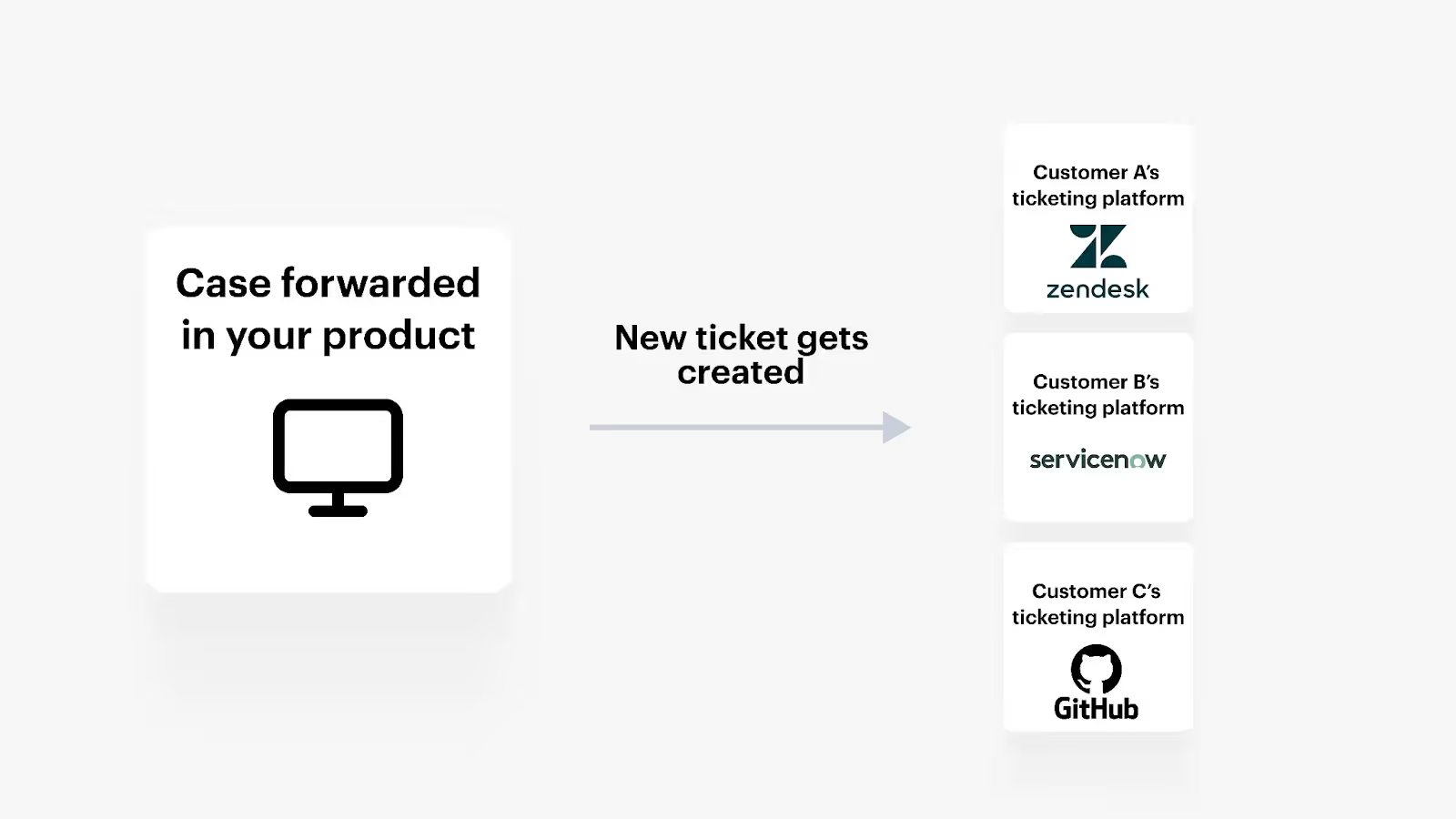
Say you offer an internal help desk that lets your clients’ HR and IT teams discover employee issues and create cases for them.
Your larger clients likely use enterprise-grade, cloud-based ticketing systems (e.g., Jira) to manage these internal work streams.
You can enable these clients to find, work on, and resolve tickets in these ticketing tools with ease by integrating your product with these tools and building the following bidirectional flow: any time a ticket is marked as escalated, a ticket gets created in the ticketing tool, which includes all the pertinent information; all the while, your product gets updated based on changes made in the ticketing tool.
Related: A look at several popular cloud integrations
To help you auto-provision and deprovision users in your product—in the hopes of increasing user growth and adoption—you can integrate your product with clients’ cloud-based HRIS solutions and build the following flow: Any time a client adds, updates, or removes an employee in their respective HRIS, the corresponding changes take place in your product.
As your customer-facing employees work with clients, they’ll likely collect a wide range of important documents, such as signed NDAs and fully-executed contracts.
To ensure that every document is easy to access and is kept secure, you can integrate your file storage application (e.g., Box) with your CRM (e.g., Salesforce) and build the following flow: once a document gets added to an opportunity or client in the CRM, it’s automatically uploaded to the associated folder in the file storage application.
Your customer success managers likely have dozens of accounts to manage, which can make it difficult for them to keep tabs on each one as well as prioritize the activities they take.
To make their lives easier, you can automatically flag clients with overdue invoices by implementing the following sync: Once an invoice is overdue (according to your ERP system), a notification gets sent to the associated customer success manager in your business communications platform. The notification can include information on the client and details on the issue itself, all but ensuring the customer success manager can follow-up with the client swiftly.
Cloud API integrations can help you improve employee productivity, minimize significant human errors, elevate your close rate, increase retention, and more.
Let’s take a closer look at these benefits.
Since cloud API integrations can help employees access the data they need within the applications they’re already using, they’re able to avoid data entry-related tasks and hopping between applications to find information.
They can focus instead on projects that are more impactful to the business and that they enjoy more.
Related: The benefits of API-led integration
Data entry tasks are naturally error-prone. And making a minor mistake, like adding the wrong name or number on a document, can have significant consequences—whether that’s sending the wrong client an invoice, delivering an offer letter with an inflated salary, etc.
Since cloud API integrations streamline data entry tasks, your team can avoid performing this work and facing the adverse outcomes they can cause.
By increasing the volume of integrations you offer, you’re—all else equal—more likely to win competitive deals.
Our research proves this out: Nearly 3 in 5 organizations that offer product integrations cite improved close rates as a benefit.
Since product integrations allow your platform to collect and update data with ease as well as initiate critical workflows automatically, they’ll likely provide more value to your customers.
Over time, this should lead to higher customer retention and even customer upsells/cross-sells.
As you look to break into specific markets—whether that’s a certain region, company size, or industry—you’ll likely find that the organizations within them use a certain set of applications. For instance, an enterprise organization may use an HRIS like Workday, while a smaller company may be more likely to use an HRIS like Gusto.
If you can offer integrations with the applications these organizations use, you’ll be more likely to get traction in the market, quickly.
Merge, the leading unified API solution, lets you add hundreds of integrations to your product through a single unified API.
The platform also provides Integration Observability tooling for your customer-facing team and integration maintenance support on your engineering team’s behalf—all but ensuring that you’re able to provide reliable and performant integrations.
You can learn more about Merge by scheduling a demo with one of our integration experts

.avif)








.png)