
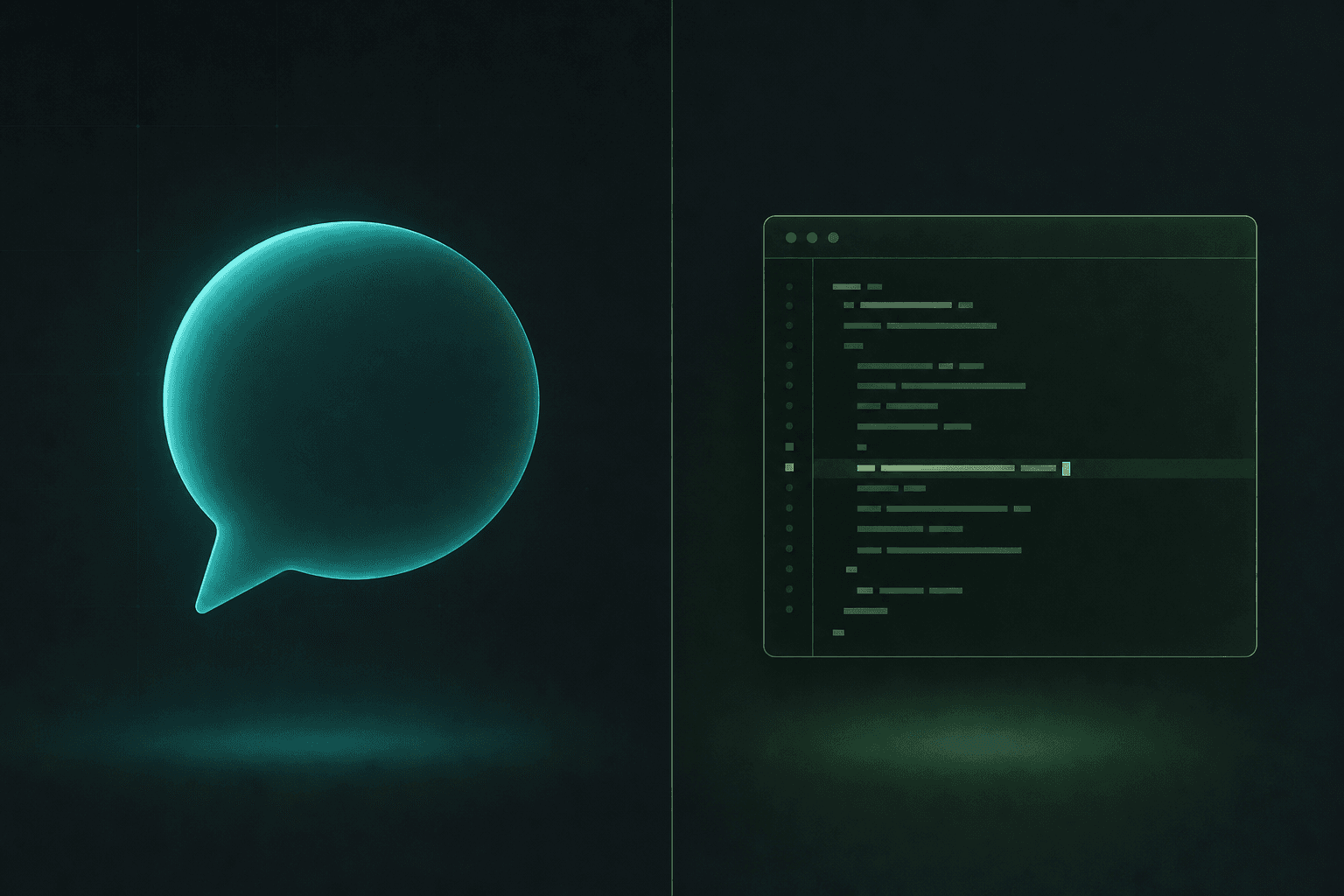
ChatGPT and Codex run on the same OpenAI account. On Plus and Pro they share one rolling 5-hour usage window. The difference is the loop: ChatGPT is a chat box you copy code out of; Codex is an agent that reads your repo, edits files, and runs commands. Codex CLI with GPT-5.5 is number one on Terminal-Bench 2.1 at 83.4%.
The Difference Is the Loop, Not the Account
ChatGPT is conversational. You describe a problem, it returns code, you paste it into your editor, run it, and paste errors back. That loop is fast for small things and good for learning, but it has no awareness of your actual files, dependencies, or how a change behaves when run.
Codex is an agent with four surfaces: a CLI, an IDE extension for VS Code, Cursor, and Windsurf, a cloud agent at chatgpt.com/codex, a desktop app, and iOS. The cloud side adds automatic code review and a Slack integration. Each surface reads your repository, makes edits to real files, runs commands and tests, and iterates on the results. Because it works against the truth of your codebase, it catches integration issues a chat box cannot see. For the agent-vs-agent breakdown, see Codex vs Claude Code.
Same intelligence, different leverage
Both can run GPT-5.5. The leverage difference comes from access: Codex can read, edit, and run your code across files; ChatGPT can only talk about a snippet you paste in.
Pricing: Plus Includes Both
You do not buy Codex separately. The same ChatGPT subscription that powers the chat box also powers Codex. The $100/mo Pro tier launched April 9, 2026 as a middle option, with the $200/mo Pro tier remaining the ceiling.
| Plan | Price | Codex access | Codex local messages / 5h |
|---|---|---|---|
| Free | $0 | No Codex | n/a |
| Go | $8/mo | No Codex | n/a |
| Plus | $20/mo | Included | 15 to 80, plus 5 cloud tasks, 5 reviews |
| Pro 5x | From $100/mo | Included | 80 to 400 |
| Pro 20x | $200/mo | Included | 300 to 1,600 |
| Business | Pay-as-you-go | Plus-level limits | 15 to 80 |
Plus and Pro users who hit the limit can buy additional credits. Business is pay-as-you-go at Plus-level limits, and Enterprise and Edu plans have flexible pricing with no fixed rate limits. Full numbers across coding agents are on our Codex pricing breakdown and Morph pricing.
Usage Limits and the Shared Window
The query that drives most confusion: do ChatGPT and Codex eat from the same allowance? On Plus and Pro, yes. Plus and Pro share one combined 5-hour window across local and cloud Codex usage, and that is the same subscription window your ChatGPT chats draw from. A heavy Codex session reduces what is left for chat in that window.
| Plan | Local messages | Cloud tasks | Code reviews |
|---|---|---|---|
| Plus ($20/mo) | 15 to 80 | 5 | 5 |
| Pro 5x (from $100/mo) | 80 to 400 | Higher | Higher |
| Pro 20x ($200/mo) | 300 to 1,600 | Higher | Higher |
Credit rates explain why the message range is wide. GPT-5.5 usage averages 5 to 45 credits per message, so a window of long agent runs burns faster than one of short edits. Credit rates per 1M tokens: GPT-5.5 is 125 input / 12.5 cached / 750 output; GPT-5.4 is 62.5 / 6.25 / 375; GPT-5.3-Codex is 43.75 / 4.375 / 350.
Install Codex
ChatGPT needs no install; it runs in the browser and apps. Codex CLI is a separate binary. Mac or Linux:
curl -fsSL https://chatgpt.com/codex/install.sh | sh
# or
npm install -g @openai/codex
# or
brew install --cask codex
On Windows: powershell -ExecutionPolicy ByPass -c "irm https://chatgpt.com/codex/install.ps1 | iex". Then run codex and choose "Sign in with ChatGPT". The CLI is open source under Apache-2.0 at github.com/openai/codex, which has 89,991 stars.
Models and Benchmarks
Both products default to GPT-5.5. Codex CLI adds the /model command to switch between GPT-5.4, GPT-5.3-Codex, and others, with adjustable reasoning levels. Pro plans get the GPT-5.3-Codex-Spark research preview. You can also auth Codex with an OpenAI API key and pay per-token API rates, though API-key mode drops the cloud features.
| Agent + model | Score | Notes |
|---|---|---|
| Codex CLI + GPT-5.5 | 83.4% | Number 1 overall |
| Claude Code + Opus 4.8 | 78.9% | Number 2 overall |
| Terminus 2 + GPT-5.5 | 78.2% | Number 3 |
| Gemini CLI + Gemini 3.1 Pro | 70.7% | |
| Claude Code + Opus 4.7 | 69.7% |
On the agentic-coding benchmark that measures the terminal loop Codex was built for, Codex CLI with GPT-5.5 leads. For the model-only view, GPT-5.5 scores 58.6% on SWE-bench Pro versus Claude Opus 4.8 at 69.2%, so model choice still matters per task. See Gemini CLI vs Codex for the third option.
When ChatGPT Fits
Quick snippets
A function, a regex, a config block you will paste yourself.
Explanations and learning
Understand a concept, an error, or an unfamiliar API.
Brainstorming
Explore approaches before committing to an implementation.
When Codex Fits
Multi-file changes
Edits applied across your real repository, not pasted by hand.
Run and verify
Runs commands and tests in the CLI, iterates on the actual results.
Cloud tasks and reviews
Delegate to the cloud agent at chatgpt.com/codex, with automatic code review.
Running Open Models for Codegen
Neither ChatGPT nor Codex lets you swap in an open-source model; both are tied to OpenAI weights on the OpenAI account. If you want to run DeepSeek or another open model for codegen, the constraint that matters is activation precision. Most serverless providers quantize activations to fp8 to cut cost, which degrades output. Morph serves DeepSeek with 16-bit (bf16) activations, no fp8 or int8 quantization, so responses match the reference weights, which is what you want when output fidelity matters.
For coding specifically, Morph runs codegen-tuned speculative decoding (draft and ngram tuned on code) plus custom low-level kernels, which makes it the fastest and highest-quality option for coding agents rather than a general menu. morph-dsv4flash (DeepSeek V4 Flash) is $0.139 per 1M input tokens and $0.278 per 1M output tokens. See Open Source Models and pricing.
Decision Framework
| Your task | Best fit | Why |
|---|---|---|
| A quick snippet or regex | ChatGPT | Fast, you paste it yourself. |
| Understand an error or concept | ChatGPT | Conversational explanation. |
| Change code across files | Codex | Edits real files directly. |
| Run tests and iterate | Codex | Executes and verifies against your code. |
| Delegate and review later | Codex cloud | Cloud tasks plus automatic code review. |
Frequently Asked Questions
What is the difference between ChatGPT and Codex?
Both are OpenAI on the same account, often the same model. ChatGPT is a chat box you copy code in and out of; Codex is an agent (CLI, IDE extension, cloud) that edits your repo and runs commands.
Is Codex free with ChatGPT Plus?
Yes. Plus at $20/mo includes Codex: 15 to 80 local messages, 5 cloud tasks, and 5 code reviews per 5-hour window. The free ChatGPT tier does not include Codex.
Do they share the same usage limit?
On Plus and Pro, yes. One combined 5-hour window covers local and cloud Codex usage on the same subscription you use for ChatGPT.
Do they use the same model?
Often GPT-5.5. Codex CLI can switch models with the /model command. Codex CLI with GPT-5.5 is number one on Terminal-Bench 2.1 at 83.4%.
Which should I use?
ChatGPT for snippets and learning; Codex for multi-file changes, running tests, and end-to-end tasks. Most developers use both since they bill against one plan.
Related comparisons
ChatGPT vs Claude Code
Copy-paste chat vs a codebase-aware terminal agent for real engineering work.
ChatGPT vs Gemini
GPT-5.5 vs Gemini 3.1 Pro: benchmarks, pricing, multimodal, and when to route to each.
ChatGPT vs Microsoft Copilot
Copilot runs on OpenAI models inside Microsoft 365. Where the wrapper helps and where it taxes you.
ChatGPT vs Grok
GPT-5.5 vs Grok: real-time X data and fewer guardrails vs ecosystem maturity.
ChatGPT vs Perplexity
General assistant vs answer engine: cited search vs open-ended generation.
ChatGPT vs DeepSeek
Frontier polish vs open-weight, dramatically cheaper inference.
WarpGrep Makes Coding Agents Find the Right Files
WarpGrep v2 adds 2 to 3 points on SWE-bench Pro to every model tested. It runs as an MCP server inside Codex, Claude Code, Cursor, and any tool that supports MCP. Free for 100k requests, then $1 per 1M. Better search means better context means better code.