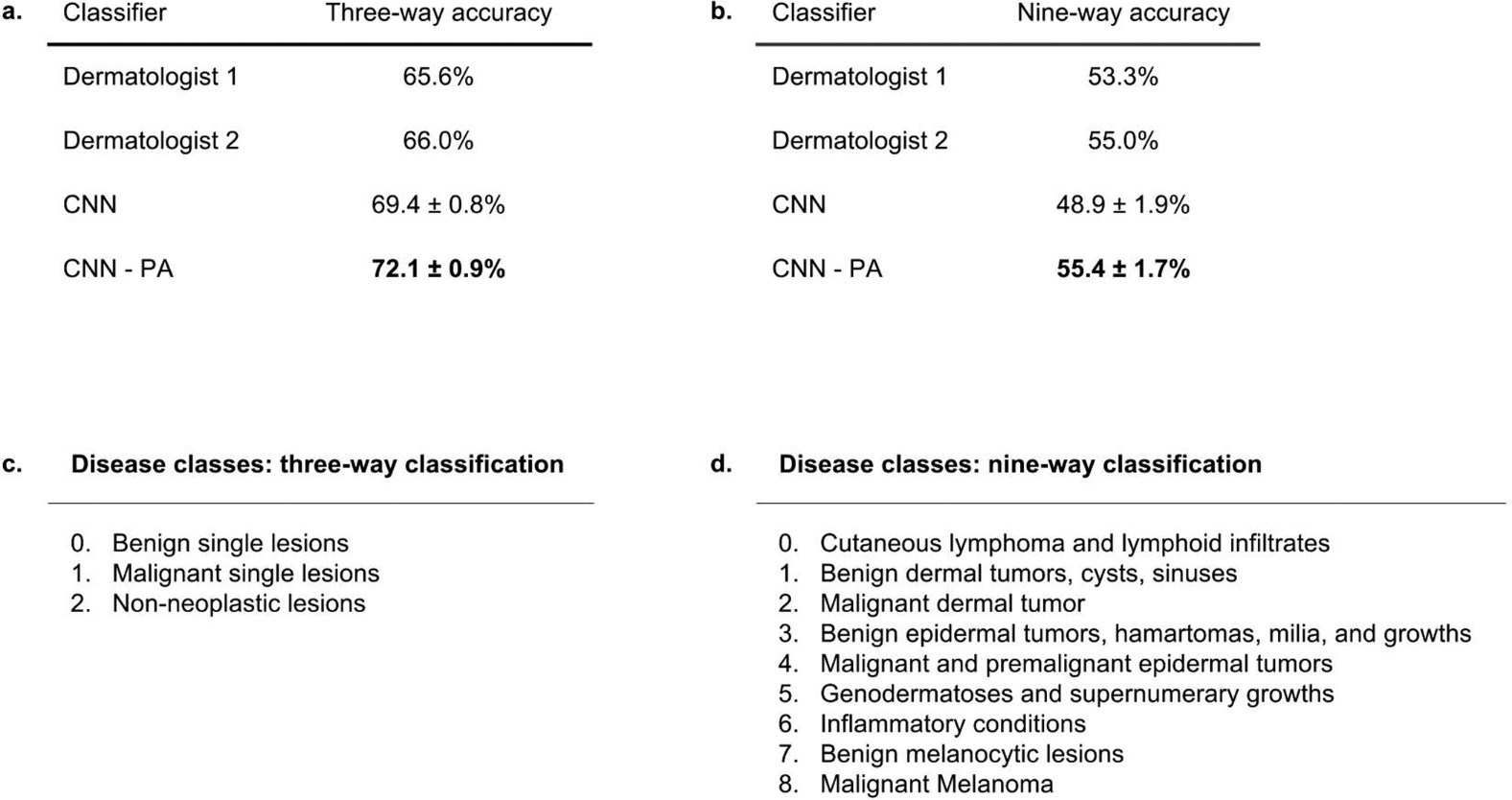
- Here we show ninefold cross-validation classification accuracy with 127,463 images organized in two different strategies. In each fold, a different ninth of the dataset is used for validation, and the rest is used for training. Reported values are the mean and standard deviation of the validation accuracy across all n = 9 folds. These images are labelled by dermatologists, not necessarily through biopsy; meaning that this metric is not as rigorous as one with biopsy-proven images. Thus we only compare to two dermatologists as a means to validate that the algorithm is learning relevant information. a, Three-way classification accuracy comparison between algorithms and dermatologists. The dermatologists are tested on 180 random images from the validation set—60 per class. The three classes used are first-level nodes of our taxonomy. A CNN trained directly on these three classes also achieves inferior performance to one trained with our partitioning algorithm (PA). b, Nine-way classification accuracy comparison between algorithms and dermatologists. The dermatologists are tested on 180 random images from the validation set—20 per class. The nine classes used are the second-level nodes of our taxonomy. A CNN trained directly on these nine classes achieves inferior performance to one trained with our partitioning algorithm. c, Disease classes used for the three-way classification represent highly general disease classes. d, Disease classes used for nine-way classification represent groups of diseases that have similar aetiologies.
 |
VOOZH | about |
