

Education
-
MBA
Columbia Business School, 1997 -
BSc Biology
Tel Aviv University, 1994 -
Awards & Certifications
- Great Entrepreneurs Top 25 HealthTech Entrepreneurs of New York, 2025
- Techonomy/Worth “AI & Health Access Pioneer Award”, 2025
- The Healthcare Technology Report’s Top 25 Healthcare Software Executives, 2024
- Slice of Healthcare Top 35 Digital Health Leaders of 2023
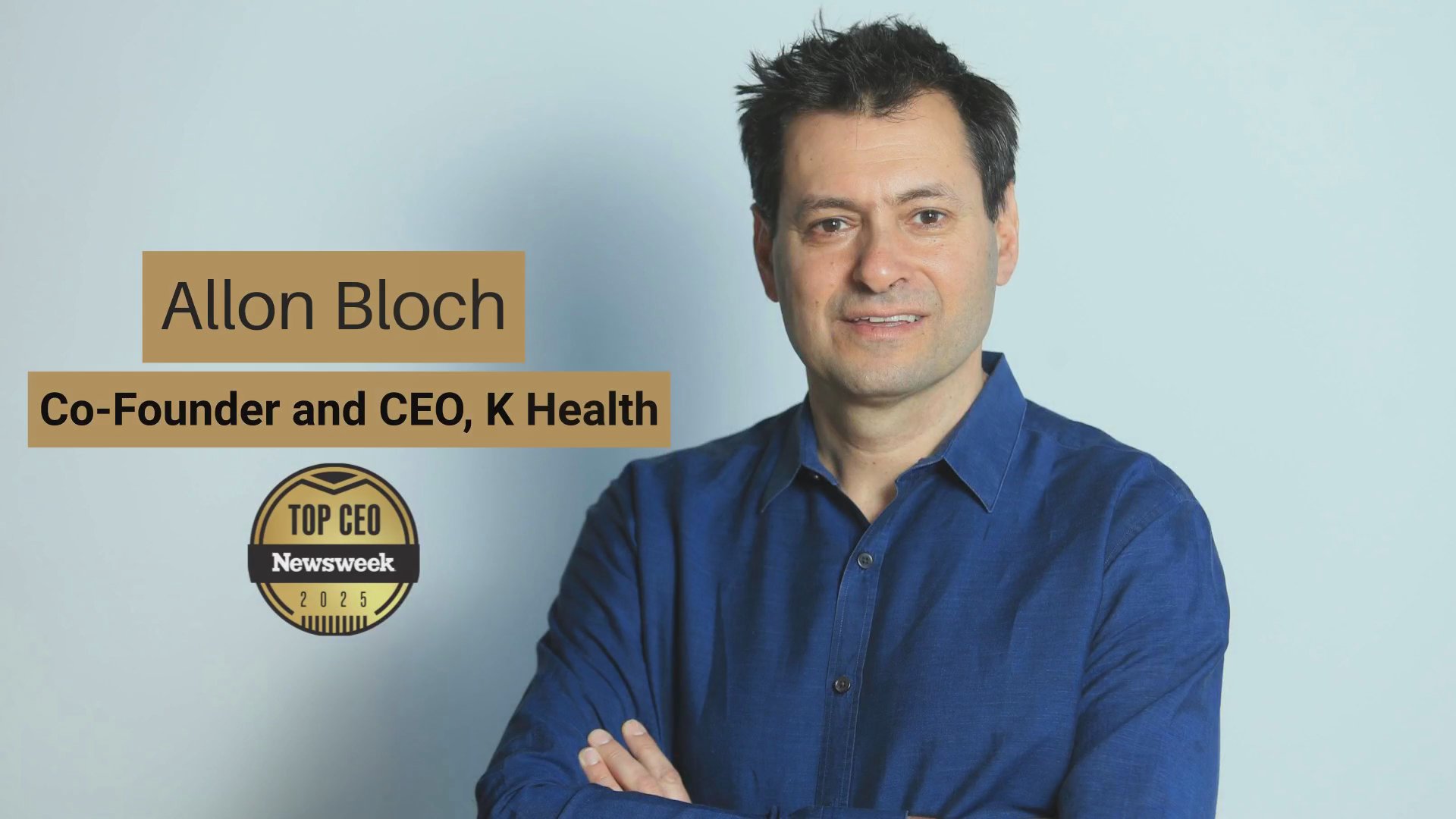
Allon Bloch is the co-founder and CEO of K Health, a leading clinical AI company based in New York City.
Can you describe the problem that K Health set out to solve?
K Health is the clinical AI engine and co‑pilot that sits inside health systems, trained on massive real‑world datasets and integrated with EMRs, to help doctors deliver better, cost effective primary care at scale.
The original problem that K Health tackled was providing people with access to high quality medical information and enabling them to act on that—two separate domains that typically existed in two different places. When we started building the company in 2016 people turned to Dr. Google or WebMD with their symptoms. With the rise of AI, today they turn to ChatGPT, but little has changed - they get an answer that may be right or wrong, but one that is not integrated for how they actually access health care, which is through doctors, tests, labs, specialists, primary care, et cetera.
We wanted to merge information and care together because all this medical expertise sits in the heads of physicians and specialists, but it is not accessible to people. As a clinical AI company, we integrate AI as part of the care team. This enables higher quality medicine at a lower cost, because if machines intelligently engage with humans and follow up with them, that's where we fix quality and access.
When patients engage with our partners' AI powered front doors, they share their questions or symptoms, and K automatically pulls their EMR, their insurance, and converses in natural everyday language. Our patients never hit a dead end, they get routed to the appropriate doctor and care immediately. We move people from information to resolution, orchestrating the whole health system around the patient's needs.
What drew you to the health care industry?
My dad had AFib, which is heart arrhythmia. It's a very common condition that affects about five percent of the population, especially aging populations, but he had it from a young age.
He was taking coumadin, a blood thinner, and every six weeks he'd go and measure his INR, which is a metric that looks at the effectiveness of the coumadin. It's impacted by what you eat, which is three times a day, assuming that's how often you eat. And yet, the device sat at this health care system as opposed to at home.
If you're lucky enough to take care of your aging parents and see the issues that they face, you start asking yourself, "Okay, how do they take care of themselves? How do doctors help them?" And I was, frankly, disappointed by a lot of the decision-making. It seemed to be more anecdotal and more artisanal. It wasn't data-driven enough, and there wasn't one place where you could look at all the information that the physician needed.
I realized, along the way, that health care does, on one hand, an amazing job. On the other hand, it's failing us.
What was it like to join the industry as an outsider?
By the time I came into health care and medicine, I had a long career in technology innovation. I helped build Wix and Vroom, taking both companies public. In Silicon Valley, innovation and disruption is expected. What I learned in the early years of thinking about and building K Health, was that the healthcare establishment was so insulated, that outsiders weren't necessarily welcomed. The conversations were what I call, "The horse should be perfected."
If you went back to 1880 and asked people in the equestrian industry, "What should we do about transportation?" They'd say, "Gee, I want my horse to be ten percent faster. I want them to need less water and less sleep. I want the carriage to be more comfortable." Nobody would have said, "Hey, I want a rocket ship — or a plane or a car," because you wouldn't be able to necessarily think that way.
The ability to come with the mindset of an outsider is a huge plus. But of course, you need to understand how this industry works. You need to have respect for medicine. You need to have respect for health care and how health care is run. You need to understand that this is a very complex industry.
Can you tell us what it was like to launch K Health?
We started K Health around a bet that if we got hold of a big enough and rich enough dataset, we could demystify medicine. We could teach a machine the language of medicine and add a layer of intelligence into what we do.
There are a million clinicians in America. There's about 500,000 primary care doctors. But there's not enough to cover what everybody needs.
We started with acute care because that is a gateway to health care. We wanted to ambitiously focus on that core layer of access. How do we give people access? How do we make it ready and high quality? How do we make it so that it's not cost prohibitive to do that? It needed to be not only more intelligent, but also more efficient than the existing systems today.
What was the initial feedback on K Health?
In the early days we would hear from some doctors I hadn't run a major health system and wasn't a physician myself. There was a sense that what healthcare needed was incremental improvements, and that the existing systems, while imperfect, were fundamentally working.
I understand where that perspective comes from. In any industry, there's a natural tendency to protect what's already in place. But I felt strongly, and still do, that the healthcare system needs more than just small tweaks. There's real room for major changes.
The advance of AI helped people realize that health care just doesn't make sense. If it was expensive but amazing across the board, we'd be fine. But it's expensive and we don't always get what we need, not because people are not trying hard, but because it's not set up with enough intelligence at the entry point. It was set up in a different era for a different need.
What are the key metrics that you evaluate success by?
We look at both tangible and intangible metrics. We look at patients coming in, repeat patients, patient satisfaction, doctor satisfaction, growth in our clinics, and hiring of doctors. We are always looking at our health system partners' ability to make a larger scale population impact, and their ability to care for more people.
You've talked about how much you enjoy reading patient stories. Are there any that exemplify why you started K Health?
Somebody told me a story that, to me, shows the limitations of health care.
It was of an executive living in a big city, who came home one day and found their high schooler, the captain of the football team, with serious abdominal pain. It was a Friday night, so they didn't want to go to the ER. They waited until the next day to go and waited there for ten hours. It turned out to be appendicitis.
They asked me how I would go and resolve the ER wait time. I said to them, "My problem is not the ER wait time. That's a big problem in and of itself, but it's not a problem that I'm personally solving. My problem is that on a Friday night, your child had appendicitis that could have ruptured, and your child was at home. You needed triage. You needed to be in front of information and a doctor."
To me, that's what people often miss. That story was about an executive who has money and insurance. So, what about everybody else? There just isn't enough access.
You describe your vision of care as being proactive rather than being reactive. What does that look like in practice, and what role does AI play in making that possible?
If somebody's pre-diabetic and you want to make sure that their lifestyle or maybe medication is managed very carefully, that is something that's very hard to do without AI, without intelligence because it just takes too long.
Doctors cannot see you once a week. There's just not enough room in their schedules. They're already busy. So, the ability to use intelligent agents that can understand what you might have, understand your vitals and integrate this into health care, all while using your insurance—I think that's a holy grail of how all of this will work.
What do you see as the most exciting or transformative possibility that AI could unlock in medicine in the next five years?
I think two things are going to happen. I think everybody's going to have access to really high-quality medicine, not only information, but also doctors, labs, tests, procedures.
The other thing I predict is that a certain amount of medicine is going to be fully automated. When we have proven that our AI is exceptionally good in understanding the patients, understanding the rollouts, understanding the risks of the patient and potential diagnosis, it could go all the way to automation of certain prescriptions and certain conditions. Imagine you can get a prescription in a matter of minutes. That could be immensely powerful. We're not there yet, but I think we're marching towards it.
How would you describe yourself as a leader?
My leadership style is open and curious. I love to discuss and debate. I love the ability to challenge people. I like that people challenge me. And I try to change my mind as much as possible.
We encourage people to speak up about anything that they see, because we want to be challenged. We want to think about how to do things better. And so, we try to make it less hierarchical and to enable people to speak their minds. It doesn't matter if they're senior or junior, if they joined us yesterday or five years ago.
