
Robert Stone
City of Hope
Chief Executive Officer, Helen and Morgan Chu Chief Executive Officer Distinguished Chair
👁 Image
About
Robert Stone is the CEO of City of Hope, one of the largest cancer research and treatment organizations in the U.S. It is ranked among the Top 5 cancer institutions and is a National Cancer Institute-designated comprehensive cancer center with the highest “exceptional” ranking. Stone, recognized as one of the most influential figures in U.S. healthcare, played a key role in transforming City of Hope into a national cancer research and treatment network. Under his leadership, the organization expanded into five major metropolitan areas, serving over 160,000 patients annually. This expansion significantly improves access to advanced treatments, clinical trials, and critical programs like bone marrow transplants and CAR T therapy. Known for its groundbreaking biomedical innovations, City of Hope is also the birthplace of biotech that has had a life-changing impact on millions worldwide.
Education
-
Juris Doctorate
University of Chicago Law School -
Bachelor's Degree
Political Science, University of Redlands
Awards & Certifications
-
Modern Healthcare 2024
Most Influential People in U.S. Healthcare -
Los Angeles Business Journal 2023
Hospital CEO of the Year -
Los Angeles Business Journal 2023
Top 500 Business Leaders
Philanthropic Endeavors
- City of Hope’s philanthropic foundation is a powerful force driving its vision to end cancer and related diseases. Thanks to generous support, innovative treatments like immunotherapies reach cancer patients months or even years ahead of schedule. Philanthropy is also vital in attracting and sustaining top clinicians and visionary scientists who are pioneering breakthrough cancer research. Furthermore, through philanthropy, City of Hope strengthens its commitment to underserved communities, ensuring broader access to prevention, early diagnosis and life-saving treatments.
Links to Rankings during tenure
Past Rankings Appearances
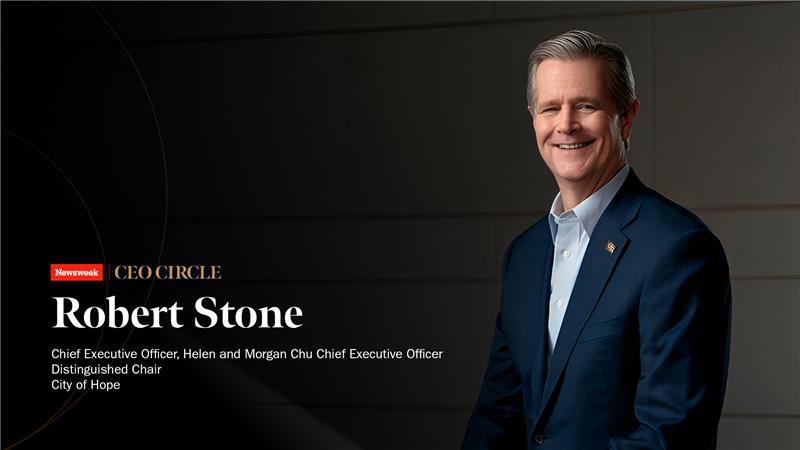
I'm Robert Stone, CEO of City of Hope, and I'm coming to you from Duarte, California.
Is there story that started to steer you in this direction of health care leadership?
I grew up in Whittier, California, which is very near City of Hope's Duarte, California campus. I spent my childhood in Southern California in and around City of Hope, and there were many lessons that I've learned. Two of which stand out.
One, I was an athlete when I was younger, or at least I viewed myself as an athlete. And athletics teach you the importance of, it's not about the individual, it's about being prepared. Tenacity, motivation. When I became CEO, I harkened back to my college basketball coach Gary Smith, and thought about how do we take lessons from each day and carried them forward into the next. So certainly from my childhood athletics rule one.
The second is that everyone needs a support system. Very early on in my tenure, a nurse said to me, oncology is very rewarding, but it's very difficult. For me, my support system is what I watched my parents be each other's support system. For me, it's my wife, Charlotte, who serves as my muse and is the smartest individual I know and keeps me grounded. Our two children, Ellie and Thomas, that's the support system.
What started to steer you specifically into health care?
City of Hope was founded in 1913 as a tuberculosis sanitarium, and everyone was treated for free. It was a charity first, which is relevant because I didn't join health care. I joined a place to help people. That just so happened its focus was on cancer. I remember very early in that interview, I walked around campus and I saw a nurse pulling a red wagon with a young child, four or five years old, no hair, smiling at the sunshine.
And what got me was not the young child. What got me was the mother who was standing a few feet behind the wagon pushing an IV pole, and she was crying. To this day, I don't know if she was crying because she was happy her son or daughter was out in the sunlight or was crying because it was so overwhelming the journey with cancer that they were having.
At that moment, I knew City of Hope was a place where I could make a difference.
Do you have any other patient stories from your tenure that personify why you do what you do as well as why City of Hope does what it does?
A few years ago, I was introduced to a pancreatic cancer patient who had two reasons to be thankful. One was she'd been diagnosed a year before. Our physicians and scientists had come up with a unique treatment option that only applied to her, and a year later she was still with us. Second thing she wanted to do was tell me that when she came that first time, a year before, a young woman had met her at the front gate and helped her find her way to her appointment, and that woman gave her flowers. For no reason other than to make her feel good. And as she went home that night, she started crying because she finally found a place that gave her hope.
I have a plaque on my desk that I look at every day. It says, 'How many lives did you change today?' And at the end of the day, that's what leadership at City of Hope is all about. How can you positively change lives?
What are the markers that you had a successful day?
There are tangible and intangible ways. Tangible ways include the outcomes patients want. They want quality of life. They want survival. They want to go back to the way they were, your patient experience.
There are also intangible ways of looking at it. Are we staying true to our mission? Are we living our values? The patient who had pancreatic cancer was an example of success.
They beat their cancer or unfortunately they don't beat their cancer. But how do we care for them on that journey and how do we care for their family? I remember a moment very early in my tenure here. I went to see our most well-renowned physician, a hematologist named Steve Foreman, and waited outside of his office. A few minutes later, he came out with a woman who he gave a hug to, and it clearly had been an emotional moment. I asked him, 'What was that about?' And Steve told me, 'Well, that was the daughter of a long-time patient who passed away two years ago. And on the anniversary, she comes to see me.'
Cancer doesn't just touch the patient. Cancer touches the family and everybody around the patient, and to the extent we can support them, that's success.
What's your evolution been as a leader?
When I became CEO, I had two fundamental goals in mind. While the organization has changed over the intervening 12 years, these are still the two goals for me. One is to remain true to our mission and our values, or now evolve them. We don't want to be caught in the past.
We want to stand on the shoulders of the giants who came before us. If those three pioneers walk through the doors of our campus today, I would want them to recognize the soul of City of Hope. Goal one is maintaining that link to the past.
Goal two was how to take that plaque that sits on my desk that says, 'How many lies have you changed today?' and expand it so that City of Hope impacted as many people as possible, that we didn't wait for patients to come to one of our campuses, which really meant that one of two things.
Either we were limited to patients who lived in Southern California, or people had to travel. Leave their support system, leave their lives behind while they got cancer treatment. I was convinced then, as I am now, that too many people don't have access to world-class care and that we can take the care that happens at a City of Hope campus and make it available to people where they live.
We were one hospital when I became CEO. We now have five hospitals. We were one metropolitan area. We're now in five metropolitan areas. 86 million people live within driving distance of a City of Hope facility. We've created a model that isn't bound by geography. It's only bound by our mission, our values, and our innovation.
How would you describe the culture City of Hope, and what do you do to foster and maintain and encourage that culture?
Maintaining the culture is both extremely easy and very difficult. People get into oncology and they joined City of Hope because it's a calling and they want to do well by others. Cancer touches everyone.
The hard part is twofold. One, when you have people who really believe in culture and really believe in the humility, in the caring, in treating people the way they would want to be treated, they run the risk of not being willing to change.
Right now, the organizations in this environment that are going to do well are those that embrace change. That don't like bureaucracy, they don't like things that are slow, they realize wait is a four-letter word for a cancer patient. Culture, in strange ways, can become almost a shield that stops change because people love it so much.
When I became CEO, we were largely one campus. You lived the culture every day because you showed up to work every day in a single location where you saw cultural icons and you just followed their lead, which leads to the second reason.
It has to be intentional about culture and making sure that culture evolves, that culture continues to grow and to do it over four states, five hospitals across the country.
What would you say has been the biggest challenge in leading this transformation into a national care organization?
I would say that integrating our multiple hospitals across the country so that we can export the expertise and deliver that subspecialty care, that academic medicine in a community environment near where people live, has been the first challenge.
We have a system where patients in any location can benefit from the research and care expertise throughout the system. To do so, we've done things like enhance our capabilities so we can deliver bone marrow transplantation and CAR T therapy at any of our locations. We're the largest bone marrow transplant cancer center in the country. We've launched our unique national clinical trial network, which we call Hope Pathways, and it's a tool that allows clinical trials to open fast to have patients accrue to those trials and allow us to deliver top-tier cancer treatment and care across the system.
Patients want clinical trials, and they want to be treated with dignity. That's where we started on learning what it means to lead a system. And that leads to the third and final thing of what we've had to focus on as we became this national system.
One of the challenges many successful organizations have is that they get satisfied with what they've done. If you want to define what changes, what the best treatment plan is what the best care is. Well, you run the risk of falling behind. And for us, it's keeping the cancer patient and their family at the center of all that you do, and you'll realize that there's so much more.
Staying hungry to make that difference rather than being satisfied with where we are is something I spend a lot of time on.
How do you vet innovation and vet new technology to make sure that it is consistent with your mission?
We should try to continually innovate and do that work better. You don't want everyone going off on their own merry adventure and defining what is innovation and how does it fit. There are groups that come together to test, to bring outside ideas in, to not just look at what our own pathway is, but to look at how other organizations are doing it. What's newest?
Think of AI and machine learning right now, as a great example. We are part of that evolution because we have the benefit of just focusing on cancer patients. We have data, we have pathways. We have followed the journey of cancer patients through the years.
That really is valuable to train new AI, to train those machines. But we don't do it ourselves. We partner with others. That's in a long-winded way of saying to your question, how do we make sure that the right innovation happens? Start with a funnel where everybody takes ownership of it.
How're you currently leveraging AI, machine learning or robotics to increase positive patient outcomes?
We're using AI in a number of ways and some of the AI technology is homegrown. Some of it is in partnership. Everything from cancer prevention and early detection will be an increasing area of focus due to advanced analytics. Unlocking the human genome has been able to provide an unimaginable amount of information.
We're identifying patients at risk for complications so that we can intervene earlier so that those complications don't happen. We are using pathology. We've become a national system across the country, but we don't want to replicate all of the expertise. We want to leverage and lean in.
Can you discuss the broader societal and economic value provided by comprehensive cancer centers like City of Hope?
There's a lot of talk of value in health care, and that usually involves complex equations where dollars is the primary variable and, and cost is important. We believe that value is something that is not just cost. There's more value and benefit to society in saving a life.
If you are someone for whom cancer has touched, your definition of value is going to be based on survival. It's going to be based on quality of life, on getting back to the life you had before you heard the diagnosis of you have cancer.
Lifesaving care at a comprehensive cancer center is high-value care that can save lives and it can reduce long-term costs. If we benefit the patient the first time, they get the right care the first time, that's their best chance of survival and we can reduce inpatient stays, hospital readmissions, ICU stays.
All of that's true and important and goes to cost. For me, it's the improvement of the quality of life and ultimately survival and the outcomes. Research has shown a significant difference in outcomes. If a patient is seen at an NCI designated Comprehensive Cancer Center, or is seen at by a general oncologist at a community hospital, who with the pace of change is likely to struggle to keep up with the newest treatment options in for their patient in all cancers, and I'll say it again, by getting treatment right the first time, we generate long-term value for society.
Could you highlight an exciting initiative currently underway at City of Hope that aligns with your vision of expanding optimal cancer care?
One thing we are incredibly proud of is Access Hope, which is a company we founded a few years ago, and the concept was unique at the time. Four out of every five cancer patients get their care in the community, and NCI Centers have spent years trying to figure out how we get those patients to come to our centers. Even if there was no barrier to travel to access, we couldn't handle that volume collectively for all the cancer patients. We came up with Access Hope. How do we export our expertise?
We collaborate and have foundational partners in that effort. Other cancer centers like Dana-Farber in Boston, Northwestern, Johns Hopkins, Emory, the Fred Hutchins, Seattle University of Texas Southwestern.
These are groups who came together to support community oncologists without the idea that cancer patients will have to come to us. If you have a complex case and you need a subspecialist, you have access to experts at any of those centers, now you do it through your employer. The company has grown through partnership between Access Hope and employers, and we now have 9 million people who have the benefit of Access Hope through more than 700 employer partners, including 70 Fortune 500 companies.
That's a way of growing something from an idea, taking an innovative idea. Growing it to something that actually benefits people and doing it in a way that recognizes cancer isn't about one organization. It's about what we can collectively do to beat this terrible disease.
