|
VOOZH | about |
|
VOOZH | about |
When you think about AWS Spot instances in EKS, the first thing that comes to mind is interruption. But in reality, Spot can be as reliable as On-Demand — with discounts reaching up to 90%!
At nOps, we process $1.5+ billion of AWS spend; needless to say, we have a mission-critical workload. And we regularly save 50-60%+ of our own Kubernetes cost using Spot.
Find out how you can, too. In this blog post, we’ll walk you through the node refresh lifecycle (what happens when Spot refresh occurs for EKS clusters), and how to handle these refreshes to confidently and reliably run workloads on Spot.
In any computing environment, machines and services can fail; networks can go offline; and sometimes machines have to be taken offline for maintenance. Accordingly, most commercial software packages (i.e. databases and applications) are designed to be tolerant to shutdown and restart, without loss of data.
In a cloud environment, compute vendors offer steep discounts for using interruptible resources, otherwise known as “Spot”, to even out demand spikes. In AWS, this is available on a market, where the fungible nature of the compute instances allows AWS to set prices through competitive bidding between users. While this can enable significant cost savings, it also introduces the possibility that an instance will be interrupted. Let’s talk about what happens when this occurs.
In the event of a Spot Instance interruption, the default AWS behavior is to notify you 2 minutes in advance via EventBridge, allowing an installed Node Termination Handler to cordon and drain any affected node.
In addition, AWS can issue Instance Rebalance and AZ Rebalance notifications, to give advanced warning when trend lines indicate that either an instance type or an AZ are expected to see a pricing spike.
Let’s discuss what happens to workloads in the unlikely event of a node recall, because it’s a very carefully controlled process that is designed to give processes every opportunity to gracefully shut down and preserve data.
When we talk about disruptions, we have to acknowledge that some are totally unavoidable. Among those are system crashes, kernel panics, OOM events, or network partitions.
There’s not much we can do about those, but fortunately they’re very rare in practice. What we can do is turn an involuntary disruption into a voluntary one using our ML Spot Termination Prediction algorithm.
This allows us to identify nodes that will be lost due to Spot market identifications early, while there’s time to safely store any critical data or drain remaining connections. However, we must also provide some information to the API server to make sure it knows which pods to evict in what order. The primary tool we can use to manage voluntary evictions is the Pod Disruption Budget. Let’s talk about how to use these effectively.
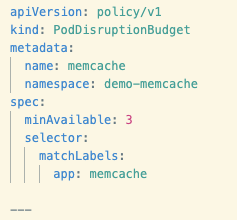
The core component of a PDB is the policy itself, specified as the spec map. The optional keys for this map are either maxUnavailable or minAvailable which describe either the max that the number of deployed pods that can be missing or the minimum that must always be present respectively for a voluntary eviction call to be processed. If the specification is not met, then the eviction call will be refused and the caller will be asked to retry later. But PDBs are a powerful tool, and it’s important to be careful about how we use them.
When writing up your own PDBs, it’s important to consider the following:
In addition, it’s important to remember these caveats:
A two-minute warning may not be adequate for many workloads. That’s why nOps used statistical analysis and Machine Learning to build an early warning system that detects price anomalies and can predict preemption in the dynamic Spot market with more than a 60-minute notice.
Using this system, we’re able to guarantee that the availability of services running in AWS Spot-backed clusters can be assured. In the event of a predicted price spike, our agent will cordon and drain nodes that are at an elevated risk of interruption during the next hour.
| Without nOps | With nOps |
| You only have a 2-minute Spot termination warning | Copilot’s ML automatically predicts Spot termination 60 minutes in advance |
| Your containers must be able to sustain sudden Spot termination with zero impact | Copilot continually moves your workloads onto diverse instance types, gracefully draining nodes in the process |
| Spot market pricing & availability is constantly changing | Copilot automatically selects the safest, cheapest Spot instances for you, or On-Demand if needed |
Last Updated: February 9, 2026, Spot
Last Updated: February 9, 2026, Spot