|
VOOZH | about |
|
VOOZH | about |
(RIs) allow you to commit to using specific AWS compute resources for a 1-year or 3-year term, offering savings up to 75% compared to On-Demand pricing. They are similar to , but Savings Plans (SPs) provide broader flexibility across instance types, operating systems, and regions. Reserved Instances are more targeted and work best for fixed, predictable workloads. For more about how RIs and SPs work and how to combine them as part of a broader cost-saving strategy, you can check out the .
There are two types of RIs:
Convertible Reserved Instances allow you to maximize your savings on AWS while minimizing your financial risk. In this article, we’ll explain what Convertible RIs are, how and when to use them, as well as advanced strategies for getting the most out of your discounts when it comes to both cost savings and flexibility.
Let’s simplify Convertible RIs by thinking of them as a flexible cloud subscription that grows with your needs. Imagine you start off small, like renting a compact car for a road trip. As more people join your journey, you trade up to a spacious SUV or even a bus, without needing to cancel your original booking or start over.
This is analogous to a business that initially starts small, such as a startup with limited traffic using t3.medium instances. As the startup scales up due to growing customer demand, they can exchange their Convertible RIs for more powerful m5.large instances. Similarly, a large enterprise with seasonal workloads can adapt Convertible RIs to match peak traffic periods by switching instance types to scale up and down. This flexibility allows the business to meet evolving needs while maintaining cost efficiency.
Key Point: Even when you “convert” or exchange your RI, it retains its original expiration date. This means the term (e.g., 3 years) doesn’t reset after an exchange—it keeps ticking from the date you first bought it ( unless you “squish” it — we’ll cover this later in the article). This is part of what makes Convertible RIs so valuable.
Workload requirements evolve—whether through scaling, architecture changes, or new applications. Convertible RIs allow you to adjust instance sizes, types, or other configurations over time, ensuring flexibility even as your needs shift.
Switching workloads from Windows to Linux—or vice versa—often occurs during cost or architecture optimization initiatives. Convertible RIs provide the flexibility to adjust your reservations for a new operating system, avoiding any unnecessary costs during these transitions.
| Advantages | Disadvantages |
| Flexibility: adapt to evolving workloads by exchanging RIs for different types | Lower discounts: Compared to Standard RIs, Convertible RIs offer lower discounts but will match standard RI’s savings over time. |
| Alignment with Business Growth: whether you’re a small startup or large enterprise with a complex and evolving architecture, CRIs help you scale or pivot easily | Value Matching: When exchanging RIs, the new RI must have an equal or higher value, which can limit smaller downgrades |
| Cost Savings: significant discounts from On-Demand pricing | Management Overhead: Requires active monitoring and management to maximize value |
| Predictable Costs: commit to long-term usage with upfront payment options | Complexity: Without automation, manual tracking of utilization and exchange opportunities can become cumbersome. |
Let’s take a step back and ask: why do companies move to the cloud?
The whole point of the cloud is scalability and flexibility. Businesses moving to the cloud cite the ability to scale dynamically and reduce upfront costs as key drivers. For example, a retail business can handle seasonal spikes during the holiday season without investing in on-premises infrastructure.
The cloud offers businesses the flexibility to adapt their resources while maintaining cost efficiency, ensuring they only pay for what they need as their workloads evolve. On the other hand, traditional on-premises infrastructure often requires significant upfront capital expenditure and lacks the ability to scale dynamically.
Convertible RIs align perfectly with these motivations. They enable businesses to retain cost savings while maintaining the flexibility that drives cloud adoption.
Now let’s talk about how to actually do it via the AWS console and via automation.
Say that you run a machine-learning application on m5.large instances in the us-east-1. You commit to a 3-year Convertible RI for cost savings. A year later, your application scales and now requires c5.xlarge instances.
The outcome? Your Convertible RI seamlessly adapts to your new requirements, giving you the best of both worlds: cost savings and flexibility.
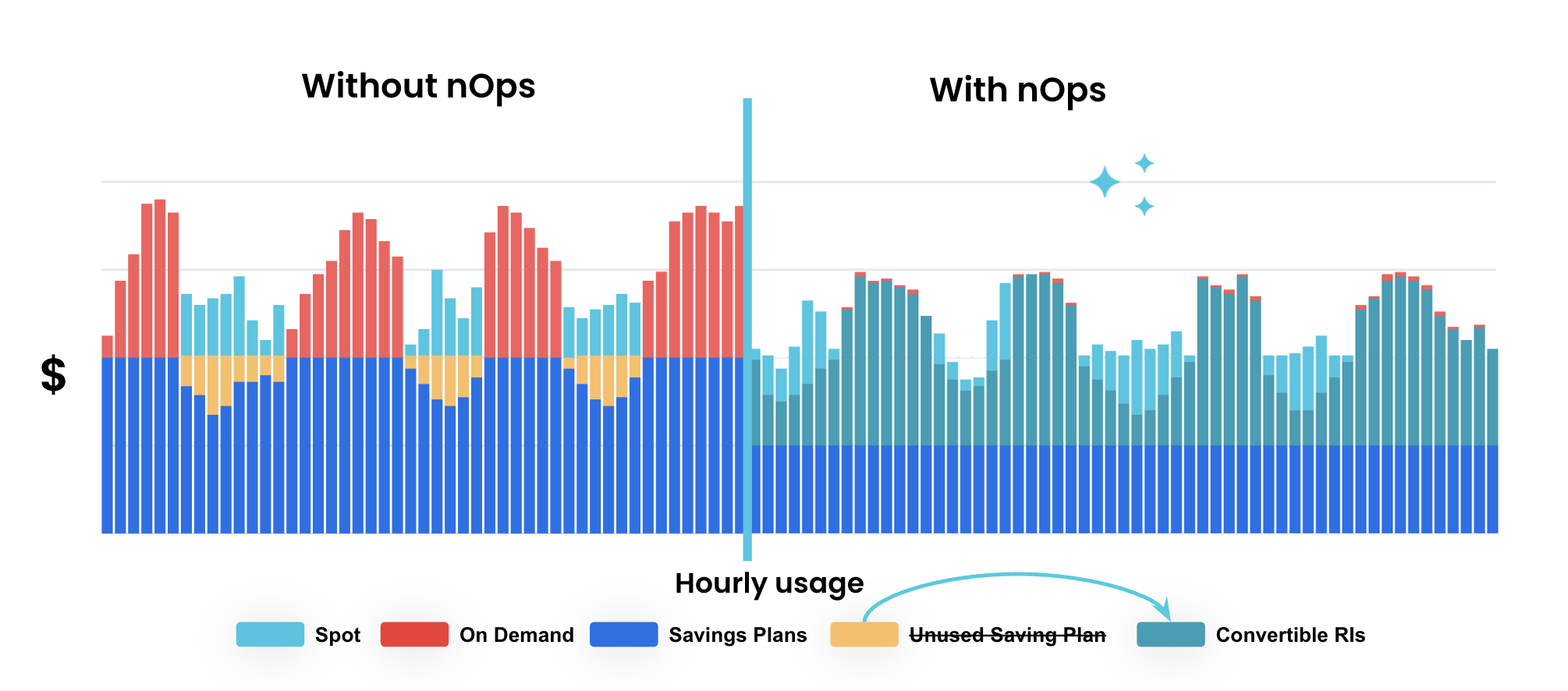
Automating the management and exchange of Convertible RIs can significantly enhance their value. AWS Marketplace offers tools like nOps that can automate tracking and exchanges, ensuring businesses are always optimizing costs. For example, these tools can monitor usage patterns, predict future requirements, and automate the RI exchange process via AWS APIs.
Here are the benefits of letting nOps manage your CRIs:
Ensuring your Convertible RIs are continuously optimized across your organization is prohibitively complex and time-consuming — on the other hand, it’s a breeze with nOps.
nOps was recently ranked #1 with five stars in G2’s cloud cost management category, and we optimize $1.5+ billion in cloud spend for our customers.
Join our customers using nOps to maximize your commitment savings and leverage automation with complete confidence by with one of our AWS experts.
Last Updated: February 9, 2026, Commitment Management
Last Updated: February 9, 2026, Commitment Management
AI-powered rate optimization with risk-free guarantee
AI-powered commitment management with risk-free guarantee