|
VOOZH | about |
|
VOOZH | about |
dotnet add package Elastic.Transport --version 1.0.0
NuGet\Install-Package Elastic.Transport -Version 1.0.0
<PackageReference Include="Elastic.Transport" Version="1.0.0" />
<PackageVersion Include="Elastic.Transport" Version="1.0.0" />Directory.Packages.props
<PackageReference Include="Elastic.Transport" />Project file
paket add Elastic.Transport --version 1.0.0
#r "nuget: Elastic.Transport, 1.0.0"
#:package Elastic.Transport@1.0.0
#addin nuget:?package=Elastic.Transport&version=1.0.0Install as a Cake Addin
#tool nuget:?package=Elastic.Transport&version=1.0.0Install as a Cake Tool
Transport classes and utilities shared among .NET Elastic client libraries. Provides cluster-aware, resilient HTTP transport optimized for the Elastic product suite and Elastic Cloud.
dotnet add package Elastic.Transport
var settings = new TransportConfiguration(new Uri("http://localhost:9200"));
var transport = new DistributedTransport(settings);

// GET request — returns body as string
var response = transport.Get<StringResponse>("/my-index/_search?q=title:hello");

// POST request — send JSON body
var body = PostData.String(@"{ ""query"": { ""match_all"": {} } }");
var searchResponse = transport.Post<StringResponse>("/my-index/_search", body);

// HEAD request — no body needed
var headResponse = transport.Head("/my-index");

// JSON DOM with safe path traversal
var jsonResponse = transport.Get<JsonResponse>("/my-index/_search?q=title:hello");
int totalHits = jsonResponse.Get<int>("hits.total.value");
string firstId = jsonResponse.Get<string>("hits.hits.[0]._id");

// Async variants
var asyncResponse = await transport.GetAsync<StringResponse>("/my-index/_search?q=title:hello");
The generic type parameter on Get<TResponse>, Post<TResponse>, etc. controls how the response body is read:
| Type | Body Representation | Notes |
|---|---|---|
StringResponse |
string |
Good for debugging and small payloads |
BytesResponse |
byte[] |
Raw bytes, useful for binary content |
VoidResponse |
(skipped) | Body is not read. Used for HEAD and fire-and-forget calls |
StreamResponse |
Stream |
Caller must dispose. Best for large payloads |
JsonResponse |
JsonNode |
System.Text.Json DOM with safe Get<T>() path traversal |
DynamicResponse |
DynamicDictionary |
Dynamic path traversal via Get<T>() |
PipeResponse |
PipeReader |
.NET 10+ only. Zero-copy streaming via System.IO.Pipelines |
JsonResponse deserializes JSON into a System.Text.Json.Nodes.JsonNode and exposes a Get<T>() method for safe, typed path traversal using dot-separated keys:
var response = transport.Get<JsonResponse>("/my-index/_search?q=title:hello");

// Traverse nested JSON with dot notation
int totalHits = response.Get<int>("hits.total.value");
string firstId = response.Get<string>("hits.hits.[0]._id");

// Bracket syntax for array access
string lastId = response.Get<string>("hits.hits.[last()]._id");
string firstSource = response.Get<string>("hits.hits.[first()]._source.title");

// _arbitrary_key_ traverses into the first key at that level
string fieldType = response.Get<string>("my-index.mappings.properties._arbitrary_key_.type");

// Direct DOM access is also available via .Body
JsonNode hitsNode = response.Body["hits"]["hits"];
On .NET 10+, PipeResponse exposes the response body as a PipeReader for zero-copy streaming. Pair it with PostData.PipeReader() and PostData.PipeWriter() for efficient request body handling via System.IO.Pipelines.
// Response streaming — deserialize directly from PipeReader
await using var response = await transport.GetAsync<PipeResponse>("/my-index/_search");
var result = await JsonSerializer.DeserializeAsync<SearchResult>(response.Body);

// Request forwarding — pipe an ASP.NET Core request body straight through
var postData = PostData.PipeReader(context.Request.BodyReader);
await using var fwd = await transport.PostAsync<PipeResponse>("/my-index/_doc", postData);
await fwd.CopyToAsync(context.Response.BodyWriter);
See docs/pipe-streaming.md for full API reference and examples.
var settings = new TransportConfiguration(new Uri("http://localhost:9200"));
var settings = new TransportConfiguration("my-cloud-id", new ApiKey("base64key"));
// or
var settings = new TransportConfiguration("my-cloud-id", new BasicAuthentication("user", "pass"));
var pool = new StaticNodePool(new[]
{
 new Node(new Uri("http://node1:9200")),
 new Node(new Uri("http://node2:9200")),
 new Node(new Uri("http://node3:9200"))
});
var settings = new TransportConfiguration(pool);
var transport = new DistributedTransport(settings);
var pool = new StaticNodePool(new[] { new Node(new Uri("http://localhost:9200")) });
var requestInvoker = new HttpRequestInvoker();
var product = ElasticsearchProductRegistration.Default;

var settings = new TransportConfiguration(pool, requestInvoker, productRegistration: product);
var transport = new DistributedTransport(settings);
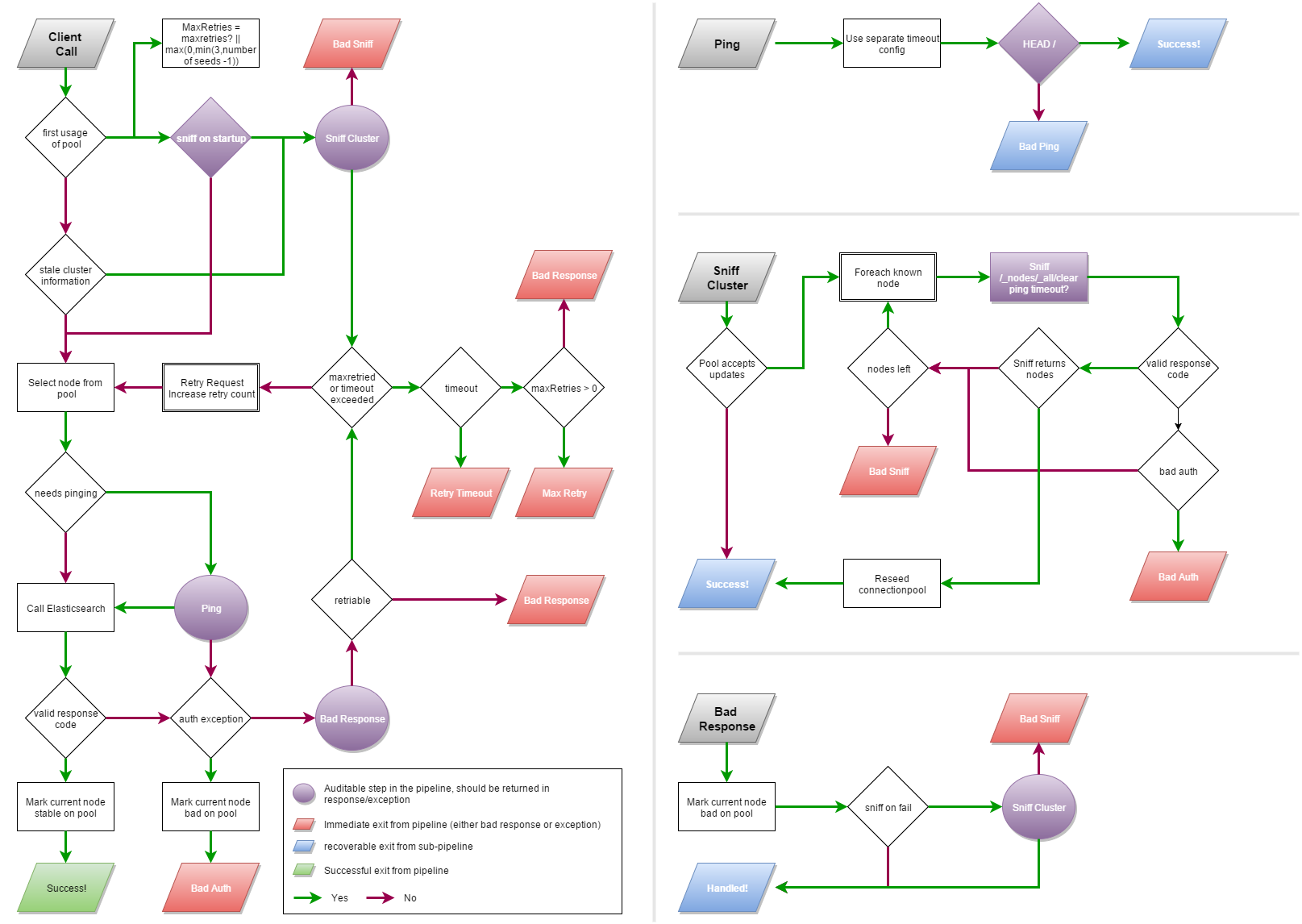
The transport models a request pipeline that handles node failover, sniffing, and pinging:
The pipeline introduces two special API calls:
The transport fails over in constant time. If a node is marked dead, it is skipped immediately (as long as the overall request timeout allows).
| Component | Description |
|---|---|
NodePool |
Registry of Node instances. Implementations: SingleNodePool, StaticNodePool, SniffingNodePool, StickyNodePool, CloudNodePool |
IRequestInvoker |
Abstraction for HTTP I/O. Default: HttpRequestInvoker |
Serializer |
Request/response serialization. Default uses System.Text.Json |
ProductRegistration |
Product-specific metadata, sniff/ping behavior. Use ElasticsearchProductRegistration for Elasticsearch |
Every response inherits from TransportResponse and exposes an ApiCallDetails property:
var response = transport.Get<StringResponse>("/");

// Structured call metadata
ApiCallDetails details = response.ApiCallDetails;
Console.WriteLine(details.HttpStatusCode);
Console.WriteLine(details.Uri);

// Human-readable debug string
Console.WriteLine(details.DebugInformation);
The transport also emits DiagnosticSource events for serialization timing, time-to-first-byte, and other counters.
Any class inheriting from TransportResponse can be used as a response type. The transport will deserialize the response body into it using System.Text.Json:
public class SearchResult : TransportResponse
{
 [JsonPropertyName("hits")]
 public HitsContainer Hits { get; set; }
}

public class HitsContainer
{
 [JsonPropertyName("total")]
 public TotalHits Total { get; set; }

 [JsonPropertyName("hits")]
 public List<Hit> Hits { get; set; }
}

public class TotalHits
{
 [JsonPropertyName("value")]
 public long Value { get; set; }
}

public class Hit
{
 [JsonPropertyName("_id")]
 public string Id { get; set; }

 [JsonPropertyName("_source")]
 public JsonNode Source { get; set; }
}

// Use it directly as a type parameter
var response = transport.Get<SearchResult>("/my-index/_search?q=title:hello");
long total = response.Hits.Total.Value;
For full control over how a response is built from the stream, implement TypedResponseBuilder<TResponse> and register it via ResponseBuilders on the configuration:
public class CsvResponse : TransportResponse
{
 public List<string[]> Rows { get; set; }
}

public class CsvResponseBuilder : TypedResponseBuilder<CsvResponse>
{
 protected override CsvResponse Build(ApiCallDetails apiCallDetails, BoundConfiguration boundConfiguration,
 Stream responseStream, string contentType, long contentLength)
 {
 using var reader = new StreamReader(responseStream);
 var rows = new List<string[]>();
 while (reader.ReadLine() is { } line)
 rows.Add(line.Split(','));
 return new CsvResponse { Rows = rows };
 }

 protected override async Task<CsvResponse> BuildAsync(ApiCallDetails apiCallDetails, BoundConfiguration boundConfiguration,
 Stream responseStream, string contentType, long contentLength, CancellationToken cancellationToken = default)
 {
 using var reader = new StreamReader(responseStream);
 var rows = new List<string[]>();
 while (await reader.ReadLineAsync(cancellationToken) is { } line)
 rows.Add(line.Split(','));
 return new CsvResponse { Rows = rows };
 }
}

var settings = new TransportConfiguration(new Uri("http://localhost:9200"))
{
 ResponseBuilders = [new CsvResponseBuilder()]
};
The default serializer uses System.Text.Json with a JsonSerializerContext for AOT compatibility. When using custom typed responses in AOT/trimmed applications, provide a JsonSerializerContext that includes your response types:
[JsonSerializable(typeof(SearchResult))]
[JsonSerializable(typeof(HitsContainer))]
[JsonSerializable(typeof(TotalHits))]
[JsonSerializable(typeof(Hit))]
public partial class MySerializerContext : JsonSerializerContext;
Create a concrete serializer that combines your context with the transport's built-in resolvers:
public class MySerializer : SystemTextJsonSerializer
{
 public MySerializer() : base(new TransportSerializerOptionsProvider([], null, options =>
 {
 options.TypeInfoResolver = JsonTypeInfoResolver.Combine(
 MySerializerContext.Default,
 new DefaultJsonTypeInfoResolver()
 );
 })) { }
}

var settings = new TransportConfiguration(
 new SingleNodePool(new Uri("http://localhost:9200")),
 serializer: new MySerializer()
);
| Product | Versions Compatible and additional computed target framework versions. |
|---|---|
| .NET | net5.0 net5.0 was computed. net5.0-windows net5.0-windows was computed. net6.0 net6.0 was computed. net6.0-android net6.0-android was computed. net6.0-ios net6.0-ios was computed. net6.0-maccatalyst net6.0-maccatalyst was computed. net6.0-macos net6.0-macos was computed. net6.0-tvos net6.0-tvos was computed. net6.0-windows net6.0-windows was computed. net7.0 net7.0 was computed. net7.0-android net7.0-android was computed. net7.0-ios net7.0-ios was computed. net7.0-maccatalyst net7.0-maccatalyst was computed. net7.0-macos net7.0-macos was computed. net7.0-tvos net7.0-tvos was computed. net7.0-windows net7.0-windows was computed. net8.0 net8.0 is compatible. net8.0-android net8.0-android was computed. net8.0-browser net8.0-browser was computed. net8.0-ios net8.0-ios was computed. net8.0-maccatalyst net8.0-maccatalyst was computed. net8.0-macos net8.0-macos was computed. net8.0-tvos net8.0-tvos was computed. net8.0-windows net8.0-windows was computed. net9.0 net9.0 was computed. net9.0-android net9.0-android was computed. net9.0-browser net9.0-browser was computed. net9.0-ios net9.0-ios was computed. net9.0-maccatalyst net9.0-maccatalyst was computed. net9.0-macos net9.0-macos was computed. net9.0-tvos net9.0-tvos was computed. net9.0-windows net9.0-windows was computed. net10.0 net10.0 is compatible. net10.0-android net10.0-android was computed. net10.0-browser net10.0-browser was computed. net10.0-ios net10.0-ios was computed. net10.0-maccatalyst net10.0-maccatalyst was computed. net10.0-macos net10.0-macos was computed. net10.0-tvos net10.0-tvos was computed. net10.0-windows net10.0-windows was computed. |
| .NET Core | netcoreapp2.0 netcoreapp2.0 was computed. netcoreapp2.1 netcoreapp2.1 was computed. netcoreapp2.2 netcoreapp2.2 was computed. netcoreapp3.0 netcoreapp3.0 was computed. netcoreapp3.1 netcoreapp3.1 was computed. |
| .NET Standard | netstandard2.0 netstandard2.0 is compatible. netstandard2.1 netstandard2.1 is compatible. |
| .NET Framework | net461 net461 was computed. net462 net462 is compatible. net463 net463 was computed. net47 net47 was computed. net471 net471 was computed. net472 net472 was computed. net48 net48 was computed. net481 net481 was computed. |
| MonoAndroid | monoandroid monoandroid was computed. |
| MonoMac | monomac monomac was computed. |
| MonoTouch | monotouch monotouch was computed. |
| Tizen | tizen40 tizen40 was computed. tizen60 tizen60 was computed. |
| Xamarin.iOS | xamarinios xamarinios was computed. |
| Xamarin.Mac | xamarinmac xamarinmac was computed. |
| Xamarin.TVOS | xamarintvos xamarintvos was computed. |
| Xamarin.WatchOS | xamarinwatchos xamarinwatchos was computed. |
Showing the top 5 NuGet packages that depend on Elastic.Transport:
| Package | Downloads |
|---|---|
|
Elastic.Clients.Elasticsearch
This strongly-typed, client library enables working with Elasticsearch. It is the official client maintained and supported by Elastic. |
|
|
Elastic.Ingest.Transport
Provides components to build a buffer-backed channel for publishing events to distributed systems over HTTP through Elastic.Transport |
|
|
Elastic.Transport.VirtualizedCluster
Provides a way to assert transport behaviour through a rule engine backed VirtualClusterConnection |
|
|
Elastic.Ingest
Provides components to build a buffer-backed channel for indexing documents into Elasticsearch |
|
|
Dnet.Elastic.Clients.Elasticsearch
This strongly-typed, client library enables working with Elasticsearch. It is the official client maintained and supported by Elastic. |
Showing the top 1 popular GitHub repositories that depend on Elastic.Transport:
| Repository | Stars |
|---|---|
|
elastic/elasticsearch-net
This strongly-typed, client library enables working with Elasticsearch. It is the official client maintained and supported by Elastic.
|
| Version | Downloads | Last Updated |
|---|---|---|
| 1.0.0 | 594 | 6/10/2026 |
| 0.17.3 | 12,497 | 5/11/2026 |
| 0.17.2 | 268 | 5/11/2026 |
| 0.17.1 | 253,651 | 4/28/2026 |
| 0.17.0 | 61,632 | 4/28/2026 |
| 0.16.0 | 55,432 | 4/20/2026 |
| 0.15.1 | 838,466 | 3/11/2026 |
| 0.15.0 | 179,600 | 2/24/2026 |
| 0.14.0 | 12,021 | 2/23/2026 |
| 0.13.0 | 724 | 2/23/2026 |
| 0.12.0 | 2,213 | 2/20/2026 |
| 0.11.1 | 1,630 | 2/17/2026 |
| 0.11.0 | 1,589 | 2/16/2026 |
| 0.10.3 | 549,145 | 1/22/2026 |
| 0.10.2 | 22,422 | 12/8/2025 |
| 0.10.1 | 2,777,283 | 8/19/2025 |
| 0.10.0 | 2,378,638 | 8/12/2025 |
| 0.9.2 | 1,267,759 | 5/29/2025 |
| 0.9.1 | 1,832 | 5/28/2025 |
| 0.9.0 | 1,648 | 5/28/2025 |