







- FASTA Sequence
- PDBx/mmCIF Format
- PDBx/mmCIF Format (gz)
- BinaryCIF Format (gz)
- Legacy PDB Format
- Legacy PDB Format (gz)
- PDBML/XML Format (gz)
- Structure Factors (CIF)
- Structure Factors (CIF - gz)
- Validation Full (PDF - gz)
- Validation (XML - gz)
- Validation (CIF - gz)
- Validation 2fo-fc coefficients (CIF - gz)
- Validation fo-fc coefficients (CIF - gz)
- Biological Assembly 1 (CIF - gz)
- Biological Assembly 1 (PDB - gz)
6M0J | pdb_00006m0j
Crystal structure of SARS-CoV-2 spike receptor-binding domain bound with ACE2
- PDB DOI: https://doi.org/10.2210/pdb6M0J/pdb
- Classification: VIRAL PROTEIN/HYDROLASE
- Organism(s): Homo sapiens, Severe acute respiratory syndrome coronavirus 2
- Expression System: Trichoplusia ni
- Mutation(s): No
- Membrane Protein: Yes mpstruc
- Deposited: 2020-02-21 Released: 2020-03-18
- Deposition Author(s): Wang, X., Lan, J., Ge, J., Yu, J., Shan, S.
Experimental Data Snapshot
- Method: X-RAY DIFFRACTION
- Resolution: 2.45 Å
- R-Value Free: 0.227 (Depositor), 0.234 (DCC)
- R-Value Work: 0.192 (Depositor), 0.199 (DCC)
- R-Value Observed: 0.194 (Depositor)
Starting Model: experimental
View more details

Literature
- 👁 Image
Download Mendeley

Structure of the SARS-CoV-2 spike receptor-binding domain bound to the ACE2 receptor.
Lan, J., Ge, J., Yu, J., Shan, S., Zhou, H., Fan, S., Zhang, Q., Shi, X., Wang, Q., Zhang, L., Wang, X.(2020) Nature 581: 215-220
- PubMed: 32225176 Search on PubMed
- DOI: https://doi.org/10.1038/s41586-020-2180-5
- Primary Citation Related Structures:
6M0J - PubMed Abstract:
A new and highly pathogenic coronavirus (severe acute respiratory syndrome coronavirus-2, SARS-CoV-2) caused an outbreak in Wuhan city, Hubei province, China, starting from December 2019 that quickly spread nationwide and to other countries around the world 1-3 . Here, to better understand the initial step of infection at an atomic level, we determined the crystal structure of the receptor-binding domain (RBD) of the spike protein of SARS-CoV-2 bound to the cell receptor ACE2. The overall ACE2-binding mode of the SARS-CoV-2 RBD is nearly identical to that of the SARS-CoV RBD, which also uses ACE2 as the cell receptor 4 . Structural analysis identified residues in the SARS-CoV-2 RBD that are essential for ACE2 binding, the majority of which either are highly conserved or share similar side chain properties with those in the SARS-CoV RBD. Such similarity in structure and sequence strongly indicate convergent evolution between the SARS-CoV-2 and SARS-CoV RBDs for improved binding to ACE2, although SARS-CoV-2 does not cluster within SARS and SARS-related coronaviruses 1-3,5 . The epitopes of two SARS-CoV antibodies that target the RBD are also analysed for binding to the SARS-CoV-2 RBD, providing insights into the future identification of cross-reactive antibodies.
- The Ministry of Education Key Laboratory of Protein Science, Beijing Advanced Innovation Center for Structural Biology, Beijing Frontier Research Center for Biological Structure, Collaborative Innovation Center for Biotherapy, School of Life Sciences, Tsinghua University, Beijing, China.
- Center for Global Health and Infectious Diseases, Comprehensive AIDS Research Center, Beijing Advanced Innovation Center for Structural Biology, School of Medicine, Tsinghua University, Beijing, China.
- Shanghai Synchrotron Radiation Facility, Shanghai Advanced Research Institute, Chinese Academy of Sciences, Shanghai, China.
- Center for Global Health and Infectious Diseases, Comprehensive AIDS Research Center, Beijing Advanced Innovation Center for Structural Biology, School of Medicine, Tsinghua University, Beijing, China. zhanglinqi@mail.tsinghua.edu.cn.
- The Ministry of Education Key Laboratory of Protein Science, Beijing Advanced Innovation Center for Structural Biology, Beijing Frontier Research Center for Biological Structure, Collaborative Innovation Center for Biotherapy, School of Life Sciences, Tsinghua University, Beijing, China. xinquanwang@mail.tsinghua.edu.cn.
Organizational Affiliation:
Explore in 3D: Structure | Sequence Annotations | Electron Density | Validation Report | Ligand Interaction (NAG) | Predict Membrane
Biological Assembly 1
Explore in 3D: Structure | Sequence Annotations | Electron Density | Validation Report | Ligand Interaction (NAG) | Predict Membrane
Global Symmetry: Asymmetric - C1
Global Stoichiometry: Hetero 2-mer - A1B1
Find Similar Assemblies
Biological assembly 1 assigned by authors.
Biological Assembly Evidence: gel filtration
Macromolecule Content
- Total Structure Weight: 97.14 kDa
- Atom Count: 6,571
- Modeled Residue Count: 791
- Deposited Residue Count: 832
- Unique protein chains: 2
Macromolecules
Entity ID: 1 | |||||
|---|---|---|---|---|---|
| Molecule | Chains | Sequence Length | Organism | Details | Image |
| Angiotensin-converting enzyme 2 | 603 | Homo sapiens | Mutation(s): 0 Gene Names: ACE2, UNQ868/PRO1885 EC: 3.4.17.23 (PDB Primary Data), 3.4.17 (PDB Primary Data) Membrane Entity: Yes | 👁 Image | |
UniProt & NIH Common Fund Data Resources | |||||
PHAROS: Q9BYF1 GTEx: ENSG00000130234 | |||||
Entity Groups | |||||
| Sequence Clusters | 30% Identity50% Identity70% Identity90% Identity95% Identity100% Identity | ||||
| UniProt Group | Q9BYF1 | ||||
Glycosylation | |||||
| Glycosylation Sites: 4 | Go to GlyGen: Q9BYF1-1 | ||||
Sequence AnnotationsExpand | |||||
Reference Sequence | |||||

Entity ID: 2 | |||||
|---|---|---|---|---|---|
| Molecule | Chains | Sequence Length | Organism | Details | Image |
| Spike protein S1 | B [auth E] | 229 | Severe acute respiratory syndrome coronavirus 2 | Mutation(s): 0 Gene Names: S, 2 Membrane Entity: Yes | 👁 Image |
UniProt | |||||
Entity Groups | |||||
| Sequence Clusters | 30% Identity50% Identity70% Identity90% Identity95% Identity100% Identity | ||||
| UniProt Group | P0DTC2 | ||||
Glycosylation | |||||
| Glycosylation Sites: 1 | Go to GlyGen: P0DTC2-1 | ||||
Sequence AnnotationsExpand | |||||
Reference Sequence | |||||

Small Molecules
| Ligands 3 Unique | |||||
|---|---|---|---|---|---|
| ID | Chains | Name / Formula / InChI Key | 2D Diagram | 3D Interactions | |
| NAG Download:Ideal Coordinates CCD File
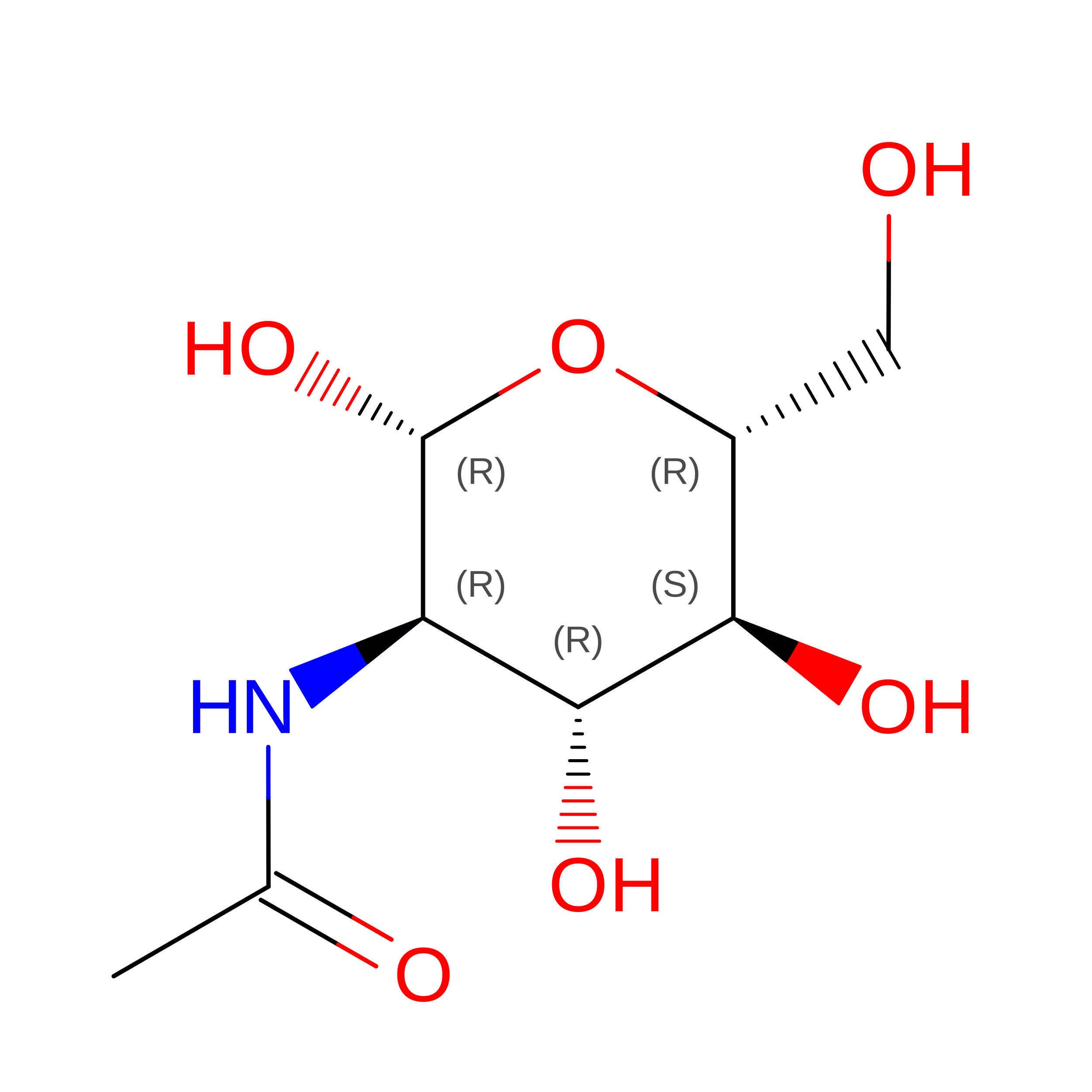
| E [auth A], F [auth A], G [auth A], H [auth A], I [auth E] | 2-acetamido-2-deoxy-beta-D-glucopyranose C8 H15 N O6 OVRNDRQMDRJTHS-FMDGEEDCSA-N | 👁 Image | ||
| ZN Download:Ideal Coordinates CCD File | C [auth A] | ZINC ION Zn PTFCDOFLOPIGGS-UHFFFAOYSA-N | 👁 Image | ||
| CL Download:Ideal Coordinates CCD File | D [auth A] | CHLORIDE ION Cl VEXZGXHMUGYJMC-UHFFFAOYSA-M | 👁 Image | ||


Experimental Data & Validation
Experimental Data
- Method: X-RAY DIFFRACTION
- Resolution: 2.45 Å
- R-Value Free: 0.227 (Depositor), 0.234 (DCC)
- R-Value Work: 0.192 (Depositor), 0.199 (DCC)
- R-Value Observed: 0.194 (Depositor)
| Length ( Å ) | Angle ( ˚ ) |
|---|---|
| a = 104.67 | α = 90 |
| b = 104.67 | β = 90 |
| c = 228.72 | γ = 90 |
| Software Name | Purpose |
|---|---|
| PHENIX | refinement |
| XDS | data reduction |
| XDS | data scaling |
| PHASER | phasing |
Entry History
Deposition Data
Revision History (Full details and data files)
- Version 1.0: 2020-03-18
Type: Initial release - Version 2.0: 2020-04-08
Type: Coordinate replacement
Reason: Model completeness
Changes: Advisory, Atomic model, Data collection, Database references, Derived calculations, Non-polymer description, Refinement description, Structure summary - Version 2.1: 2020-04-15
Changes: Database references - Version 2.2: 2020-05-06
Changes: Database references, Source and taxonomy, Structure summary - Version 2.3: 2020-05-27
Changes: Database references - Version 2.4: 2020-07-29
Type: Remediation
Reason: Carbohydrate remediation
Changes: Data collection, Derived calculations, Structure summary - Version 2.5: 2021-03-10
Changes: Structure summary - Version 2.6: 2023-11-29
Changes: Data collection, Database references, Refinement description - Version 2.7: 2024-10-23
Changes: Structure summary







