
- Why Script-Based Analytics Pipelines Break
- Fragile Model Dependencies
- Reproducibility Challenges
- Limited Scalability
- Lack of Observability
- Treasury Analytics Workloads in Practice
- Batch Model Execution
- Chained Model Pipelines
- Scenario and Sensitivity Simulations
- Architecture Overview
- Step 1: Define a Standard Model Interface
- Step 2: Organize Models as Python Packages
- Step 3: Implement a Model Registry
- Step 4: Configuration-Driven Execution
- Step 5: Implement a Data Access Layer
- Step 6: Build the Execution Engine
- Example: A Simple Loan Volume Projection Model
- Scaling Model Execution
- Parallel Portfolio Execution
- Efficient Data Processing
- Observability and Monitoring
- Structured Logging
- Execution Metrics
- Model Governance and Reproducibility
- Conclusion
- References
- Why Script-Based Analytics Pipelines Break
- Fragile Model Dependencies
- Reproducibility Challenges
- Limited Scalability
- Lack of Observability
- Treasury Analytics Workloads in Practice
- Batch Model Execution
- Chained Model Pipelines
- Scenario and Sensitivity Simulations
- Architecture Overview
- Step 1: Define a Standard Model Interface
- Step 2: Organize Models as Python Packages
- Step 3: Implement a Model Registry
- Step 4: Configuration-Driven Execution
- Step 5: Implement a Data Access Layer
- Step 6: Build the Execution Engine
- Example: A Simple Loan Volume Projection Model
- Scaling Model Execution
- Parallel Portfolio Execution
- Efficient Data Processing
- Observability and Monitoring
- Structured Logging
- Execution Metrics
- Model Governance and Reproducibility
- Conclusion
- References
How to Build a Python-Based Model Execution Framework for Treasury Analytics
Share this article
- Premium Results
- Publish articles on SitePoint
- Daily curated jobs
- Learning Paths
- Discounts to dev tools
7 Day Free Trial. Cancel Anytime.
How to Build a Python-Based Model Execution Framework for Treasury Analytics
I've seen plenty of analytics pipelines start the same way. A few Python scripts, a scheduled cron job, and possibly a manual notebook run when a report is required are the starting points. At first, everything worked fine. The models run, the outputs look correct, and the system feels simple enough to manage.
But as more models get added, liquidity forecasts, stress testing, and risk simulations, the pipeline slowly turns into a fragile chain of scripts. One failure breaks everything downstream, debugging becomes painful, and reproducing historical results becomes nearly impossible.
Eventually, a simple question arises: "Is it possible to rerun the model precisely as it performed last month?" And the honest answer is usually "not easily." The problem usually isn't the financial models themselves. It's the lack of proper execution infrastructure and controls around them.
In this article, we will explore how to design a Python-based model execution framework for treasury analytics workloads that improves reproducibility, scalability, and maintainability.
Why Script-Based Analytics Pipelines Break
Script-driven pipelines are common in early-stage analytics systems. They are quick to implement and require minimal infrastructure. However, treasury analytics workloads grow rapidly, and simple pipelines begin to show their limitations.
Fragile Model Dependencies
Treasury analytics often involves multiple models that depend on each other. For example:
- Each stage depends on the outputs from the previous stage.
- Without orchestration, these dependencies turn into fragile chains of scripts. If one model fails, the entire pipeline breaks.
- Troubleshooting becomes slow because there is no centralized execution tracking and logging.
Execution frameworks explicitly define dependencies and manage the order in which models run to solve these problems.
Reproducibility Challenges
Another common issue is reproducibility. Analytics pipelines frequently evolve due to the following:
- Models get updated
- Parameters change
- Datasets are refreshed
If these changes are not tracked systematically, it becomes extremely difficult to reproduce historical results. For financial institutions, this is more than an inconvenience. Reproducibility is often required for internal validation, regulatory reviews, and audit processes.
An execution framework helps maintain reproducibility by tracking:
- Model versions
- Dataset versions/vintage dates
- Execution parameters
- Execution timestamps
Limited Scalability
Treasury analytics often requires running models across many combinations of portfolios, scenarios, and time horizons. For example, a stress testing exercise may require running the same model across hundreds of simulated market conditions. Sequential script execution becomes inefficient in these cases. An execution framework enables parallel or distributed runs, significantly reducing runtime.
Lack of Observability
Another challenge with ad-hoc pipelines is limited visibility. When failures occur, teams may not know:
- Which model failed?
- What data/lack of data triggered the failure?
- How long did the model run?
- Whether outputs were successfully stored?
Execution frameworks simplify problem diagnosis and operational dependability with systematic logging and monitoring.
Treasury Analytics Workloads in Practice
Treasury analytics platforms typically run several categories of computational workloads. Understanding these patterns helps guide architecture decisions.
Batch Model Execution
Many treasury models operate on scheduled intervals, such as:
- Daily liquidity forecasts
- Weekly exposure calculations
- Monthly stress testing exercises
- Annual back-testing
These batch jobs analyze large financial datasets for treasury and risk departments. They need reliability and repeatability due to their schedule.
Chained Model Pipelines
Some models depend on upstream outputs. For example:
Market Data + Position Data → Volume Forecast Model → Portfolio Aggregation
This dependency structure naturally forms a directed acyclic graph (DAG). Execution frameworks can interpret this DAG structure and ensure models run in the correct order.
Scenario and Sensitivity Simulations
Scenario analysis is common in treasury analytics. Teams may simulate economic conditions such as:
- Interest rate shocks
- Currency volatility
- Liquidity stress scenarios
Each scenario requires separate model runs. Multiply that by several portfolios and time horizons, and computational demand grows quickly. A well-designed execution framework allows these workloads to scale efficiently.
Architecture Overview
This architecture separates model logic from orchestration and infrastructure, letting models focus on analytics while the framework executes and monitors them.
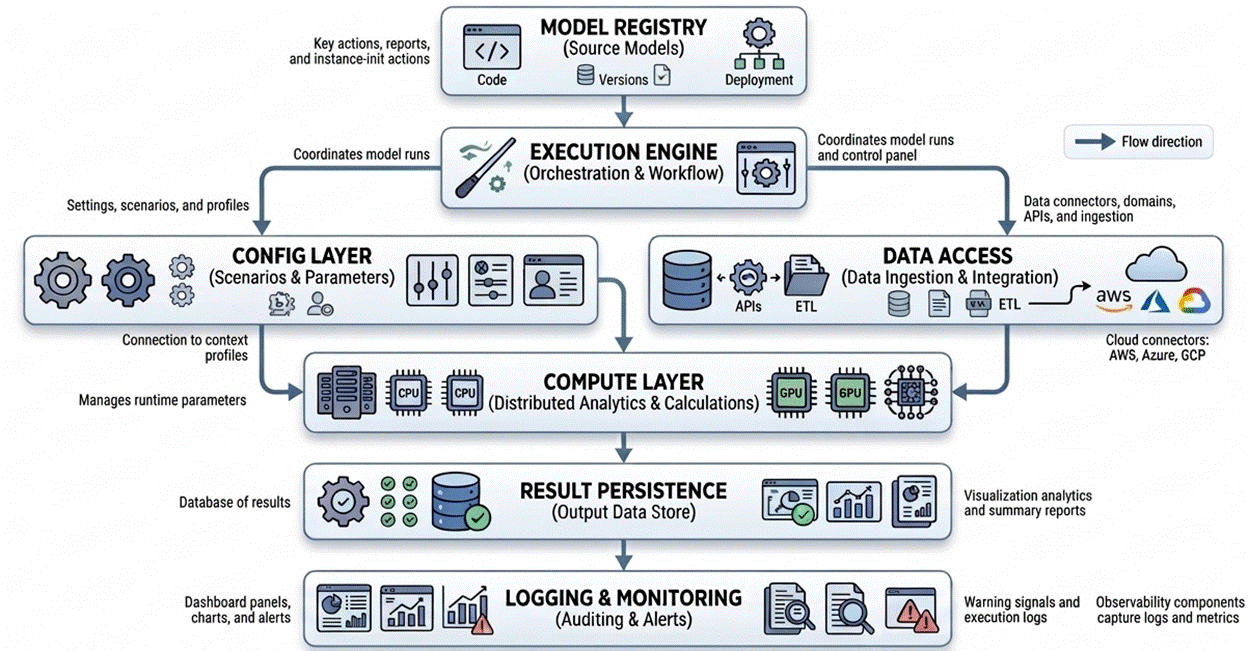
Each component serves a specific purpose:
- Model Registry stores metadata about available models (example: Model Name, ID, Version etc.)
- Execution Engine coordinates model runs
- Configuration Layer manages runtime parameters (example: run date, scenario name etc.)
- Data Access Layer retrieves datasets from upstream systems (example: connection details, query definitions etc.)
- Compute Layer runs the calculations to produce outputs (example: cashflow engine etc.)
- Persistence Layer stores outputs and execution metadata (example: model outputs, DQ checks etc.)
- Observability Components capture logs and operational metrics
Step 1: Define a Standard Model Interface
The first step in building the framework is defining a consistent interface for models. Without a standard interface, each model requires custom execution logic. Python's abstract base classes provide a simple way to enforce structure.
python
from abc import ABC, abstractmethod
class BaseModel(ABC):
 @abstractmethod
 def ingest_data(self, data_layer):
 pass
 @abstractmethod
 def preprocess(self, data):
 pass
 @abstractmethod
 def compute(self, processed_data):
 pass
 @abstractmethod
 def generate_output(self, results):
 pass
 @abstractmethod
 def shutdown(self, logger):
 pass
Each model follows the same lifecycle:
- Ingest required data
- Preprocess inputs
- Run the core computation
- Generate structured outputs
- Close the model run (e.g. printing end of model run message, closing log files, flushing buffered data etc.)
Step 2: Organize Models as Python Packages
As the number of models grows, organizing the codebase becomes increasingly important.
Example repository structure:
treasury-framework/
 models/
 liquidity_model/
 stress_test_model/
 risk_aggregation_model/
 core/
 base_model.py
 registry.py
 data/
 ingestion.py
 validation.py
 execution/
 engine.py
 config/
 loader.py
Shared utilities often include:
- Data validation routines
- Database connectors
- Financial time-series transformations
- Date utilities
- Log generation
Step 3: Implement a Model Registry
A model registry provides a centralized catalog of available models.
Each entry typically includes:
- Model name
- Version
- Package dependencies and versions
- Input data schema
- Configuration templates
Example registry entry:
yaml
model_name: loan_prepayment_projection
version 1.0
package_dependencies:
 - pandas 2.3.2
 - numpy 2.3.3
input_schema: prepayment_schema_v1
The execution engine queries the registry to dynamically load models. Registries also support version control, allowing teams to rerun historical model versions when required.
Step 4: Configuration-Driven Execution
Hardcoding parameters inside the model code quickly becomes difficult to manage. Instead, execution parameters should be externalized into configuration files.
Example:
execution:
 portfolio_id: loan_new_volume
 scenario: base
 mev_vintage_date: 2026-03-31
 run_date: 2026-04-01

data:
 market_data_source: vendor_feed
 lookback_days: 365

model_parameters:
 liquidity_threshold: 0.1
Configuration-driven execution provides:
- Reproducible runs
- Easier scenario testing
- Cleaner model code
Step 5: Implement a Data Access Layer
Models should avoid direct database queries. Instead, a data access layer should encapsulate upstream systems to get data.
python
class DataAccessLayer:
 def get_market_data(self, start_date, end_date):
 pass

 def get_portfolio_positions(self, portfolio_id, as_of_date):
 pass
This abstraction ensures consistent data formatting and allows storage systems to evolve without breaking model implementations.
Step 6: Build the Execution Engine
The execution engine orchestrates the model lifecycle.
python
class ExecutionEngine:
 def int(self, registry, data_layer, utility):
 self.registry = registry
 self.data_layer = data_layer
 self.logger = utility.logger
 self.config = utility.config

def run(self, model_name):
 model_cls = self.registry.get(model_name)
 model = model_cls(self.config)
 data = model.ingest_data(self.data_layer)
 processed = model.preprocess(data)
 results = model.compute(processed)
 run_id = self.persist_results(model_name, results)
 return run_id
In production systems, the execution engine may also manage:
- Job scheduling
- Dependency resolution
- Parallel execution
- Retry logic
Example: A Simple Loan Volume Projection Model
To illustrate how models integrate with the framework, consider a simplified Loan New Volume projection model. The example below estimates the amount of new loans that will be originated in a year. While real treasury models involve far more complex calculations, the example demonstrates how model logic fits into the execution framework.
python
class NewVolumeModel(BaseModel):
 def ingest_data(self, data_layer):
 portfolio = data_layer.get_loan_positions("treasury_loan_portfolio", "2025-12-31")
 market_data = data_layer.get_market_data("2025-01-01", "2025-12-31")
 return portfolio, market_data

 def preprocess(self, data):
 portfolio, market_data = data
 return portfolio, market_data

 def compute(self, processed_data):
 portfolio, market_data = processed_data
 target_ratio = 0.54
 new_volume = portfolio["previous_month_balance"].sum() * target_ratio
 return{
 "new_volume": new_volume
 }

 def generate_output(self, results):
 return Results
A model run might look like this:
python
engine.run(
 model_name = "loan_volume_projection",
 config = "configs/volume_scenario.yaml"
)
The framework records a run ID, ensuring outputs remain traceable and reproducible.
Scaling Model Execution
As workloads grow, the framework should support scalable execution strategies.
Parallel Portfolio Execution
Independent model runs can execute simultaneously across portfolios:
Portfolio A → Model Run
Portfolio B → Model Run
Portfolio C → Model Run
This significantly reduces total runtime.
Efficient Data Processing
Large financial datasets can strain memory. Libraries such as Polars provide faster dataframe operations and improved memory efficiency compared to traditional Pandas workflows.
Observability and Monitoring
Reliable analytics platforms require strong observability.
Structured Logging
Logs should capture:
- Model name
- Run ID
- Vintage dates
- Parameters used
- Execution status
Execution Metrics
Metrics may track:
- Execution duration
- Memory usage
- Dataset sizes
Model Governance and Reproducibility
Financial analytics platforms must support strong governance practices. Execution frameworks should track:
- Model versions
- Configuration parameters
- Dataset versions
- Execution timestamps
This metadata creates a full audit trail, allowing teams to reproduce historical model runs when needed.
Conclusion
Analytics teams may develop scalable, dependable analytics infrastructure by structuring model execution around registries, configuration layers, and orchestration engines, replacing brittle script-based workflows. Treasury analytics are becoming more complex. Modern financial platforms require dependability, scalability, and governance, which simple scripts cannot supply.
A practical approach is to start small. Begin by registering a few models and implementing a simple execution engine. Gradually introduce configuration-driven execution. Eventually, this system can enable large-scale simulations, forecasting models, and advanced financial analytics on a treasury analytics platform.
References
- Premium Results
- Publish articles on SitePoint
- Daily curated jobs
- Learning Paths
- Discounts to dev tools
7 Day Free Trial. Cancel Anytime.