What Is an Application Layer?
The application layer is the top OSI layer (Layer 7) of the Open Systems Interconnection (OSI) model – and focuses on protocols that support application-level interactions with the network. By prioritizing end-user services, the application layer facilitates data exchange between user applications across a network. Many services, including application programming interfaces (APIs), file transfers, and web browsing, operate at the application layer.
In order to understand individual OSI model layers, it’s important to know that this is a conceptual framework, not a strict set of designations. Some experts liken these abstraction layers to an onion — where the seven-layer model means peeling back each subsequent layer to reveal the functions beneath.
What does the application layer do? A simple way to understand the seven layers, including the application layer, is to consider each layer’s name as a description of its primary function. For example, the session layer deals with sessions between network components, the transport layer ensures data is delivered to the correct process on the receiving device, and the application layer focuses on application-specific activities.
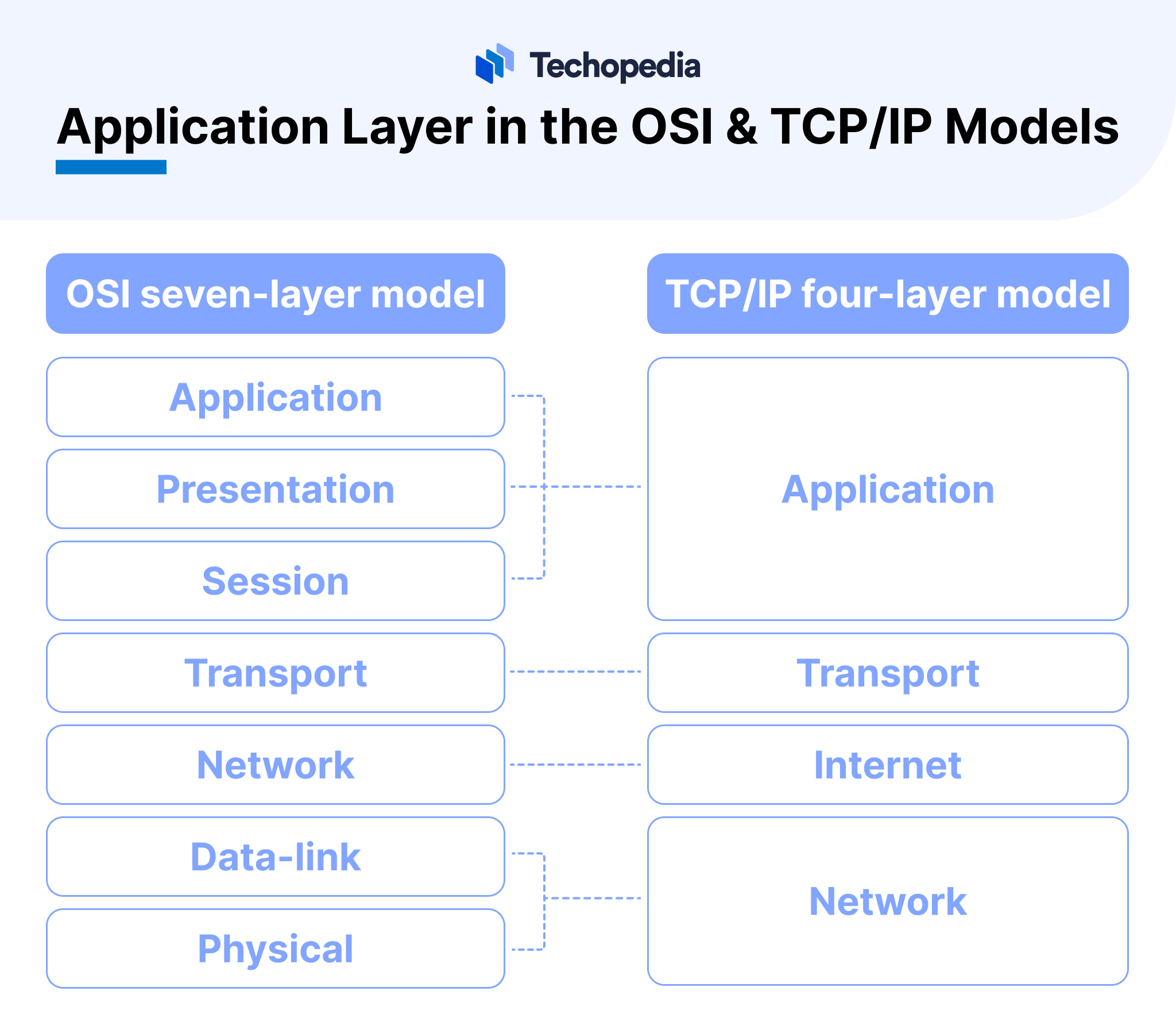
The application layer is also the top layer of the TCP/IP network model, which organizes networking tasks into a stack consisting of four layers. Unlike the OSI model, the application, presentation, and session layers are all combined in the application layer to deliver end-to-end communication between applications.
👁 What Is an Application Layer?
Key Takeaways
- The application layer is the topmost layer of the OSI 7-layer model and the TCP/IP 4-layer network model.
- It is the point where users interact with a network to send, receive, and access data.
- Many services, including APIs, file transfers, and web browsing, operate at this layer.
- A primary function of the application layer is to enable authentication for secure communication.
- It is vulnerable to application-layer attacks, like SQL injection and DDoS attacks.
Application Layer Importance
Understanding the OSI seven-layer model helps network administrators refine network builds and implement specific functionality and protocols that will optimize network performance.
As for the application layer specifically, this layer deals with protocols such as File Transfer Ptrotocol (FTP) and Secure Shell (SSH), which enable file transfers and remote access over networks. Other examples of application-layer systems include web browsers (which use HTTP/HTTPS protocols) and network management tools that use Simple Network Management Protocol (SNMP).
Application Layer in OSI & TCP/IP Models
| In OSI Model (Layer 7) | In TCP/IP Model |
|---|---|
| Facilitates data exchange between user applications and the network. | Delivers end-to-end communication between applications. |
| A conceptual framework used for design and troubleshooting. | A practical implementation for Internet and networking. |
| Works alongside the presentation (Layer 6) and session (Layer 5) layers. | Combines the application, presentation, and session layers into one application layer. |
| Defines user-level interactions; not tied to specific protocols (e.g., email, file transfers, remote access). | Supports user applications and implements protocols used on the Internet today (e.g., DNS, FTP, HTTP, SMTP). |
👁 Application Layer in OSI & TCP/IP Models
Application Layer Functions
The application layer is best explained as the point where users interact with a network to send, receive, and access data. It ensures devices can communicate securely and makes network services available to users.
Application layer functions include:
- Facilitates communication services (e.g., email, file sharing, video conferencing)
- Provides authentication for secure communication
- Maintains data transfer integrity and identifies receiving devices
- Manages application layer protocols and data syntax rules
- Supports remote hosting and directory access
Common Application Layer Services
A defining characteristic of the application layer is facilitating communication between software applications and the underlying network, involving direct user interaction with network services and applications.
Examples include:
- Domain name services
- File sharing
- Live chat
- Network monitoring
- Online gaming (matchmaking and real-time chat)
- Remote computer access
- Video streaming
- Video conferencing
- Web browsing
Application Layer Protocols
Application layer protocols establish rules and standards, ensuring services function efficiently across devices.
Examples include:
- Domain name system (DNS)
- Dynamic Host Configuration Protocol (DHCP)
- File Transfer Protocol (FTP)
- Hypertext Transfer Protocol (HTTP)
- Internet Message Access Protocol (IMAP)
- Lightweight Directory Access Protocol (LDAP)
- Network Time Protocol (NTP)
- Post Office Protocol (POP3)
- Remote Desktop Protocol (RDP)
- Secure Shell (SSH)
- Simple Mail Transfer Protocol (SMTP)
- Simple Network Management Protocol (SNMP)
Application Layer Examples
Applications that operate at the application layer (Layer 7) of the OSI model include:
It’s important to note that not all user-facing software and apps operate at the application layer. For example, VPN services may appear to operate at this layer from the user’s perspective, but the core functionality of VPNs – tunneling and encryption – occurs at lower levels of the OSI model, such as the network layer (Layer 3) or transport layer (Layer 4).
Application Layer Pros and Cons
Pros
- Allows users to interact with network services
- Facilitates email, messaging, and web browsing services
- Supports file sharing across networks
Cons
- Complex protocols may slow down network performance
- Unencrypted data exchange can expose sensitive information
- Vulnerable to application-layer attacks, like SQL injection and DDoS attacks
The Bottom Line
The application layer definition refers to the topmost layer of the OSI model (Layer 7) and the TCP/IP model, where users and software applications interact with the network. This layer enables services like web browsing, email, and file transfers while managing protocols that define how data is exchanged.
The application layer is a valuable tool for troubleshooting network issues and ensuring secure communication. However, it also introduces challenges, such as vulnerabilities to application-layer attacks.
Keep in mind that in the OSI model, the application layer is conceptual, focusing on user-level interactions. However, in the TCP/IP model, it combines the roles of the presentation and session layers for practical, end-to-end communication.
FAQs
What is an application layer in simple terms?
The application layer meaning refers to Layer 7 of the OSI model. It facilitates data exchange between user applications across a network.
What is the application data layer?
The application data layer is a phrase used to describe how data is managed within the application layer (Layer 7) of the OSI model. It is not a layer within the model itself.
What are the 4 application layers?
In addition to the application layer, the TCP/IP model also includes transport, Internet, and network layers.
What is the difference between an application layer and a network layer?
The application layer focuses on application-specific activities. The network layer allows for connecting and transferring data packets between devices or networks.
Where is the application layer?
The application layer is the top (Layer 7) of the OSI model and is also the top layer of the TCP/IP network model.
Related Terms
Related Reading

About Techopedia’s Editorial Process
Techopedia’s editorial policy is centered on delivering thoroughly researched, accurate, and unbiased content. We uphold strict sourcing standards, and each page undergoes diligent review by our team of top technology experts and seasoned editors. This process ensures the integrity, relevance, and value of our content for our readers.






Vangie Beal
Technology ExpertVangie Beal is a digital literacy instructor based in Nova Scotia, Canada, who joined Techopedia in 2024. She’s an award-winning business and technology writer with 20 years of experience in the technology and web publishing industry. Since the late ’90s, her byline has appeared in dozens of publications, including CIO, Webopedia, Computerworld, InternetNews, Small Business Computing, and many other tech and business publications. She is an avid gamer with deep roots in the female gaming community and a former Internet TV gaming host and games journalist.

Table of Contents
- What Is an Application Layer?
- Key Takeaways
- Application Layer Importance
- Application Layer in OSI & TCP/IP Models
- Application Layer Functions
- Common Application Layer Services
- Application Layer Protocols
- Application Layer Examples
- Application Layer Pros and Cons
- The Bottom Line
- FAQs