
Early Warnings for All
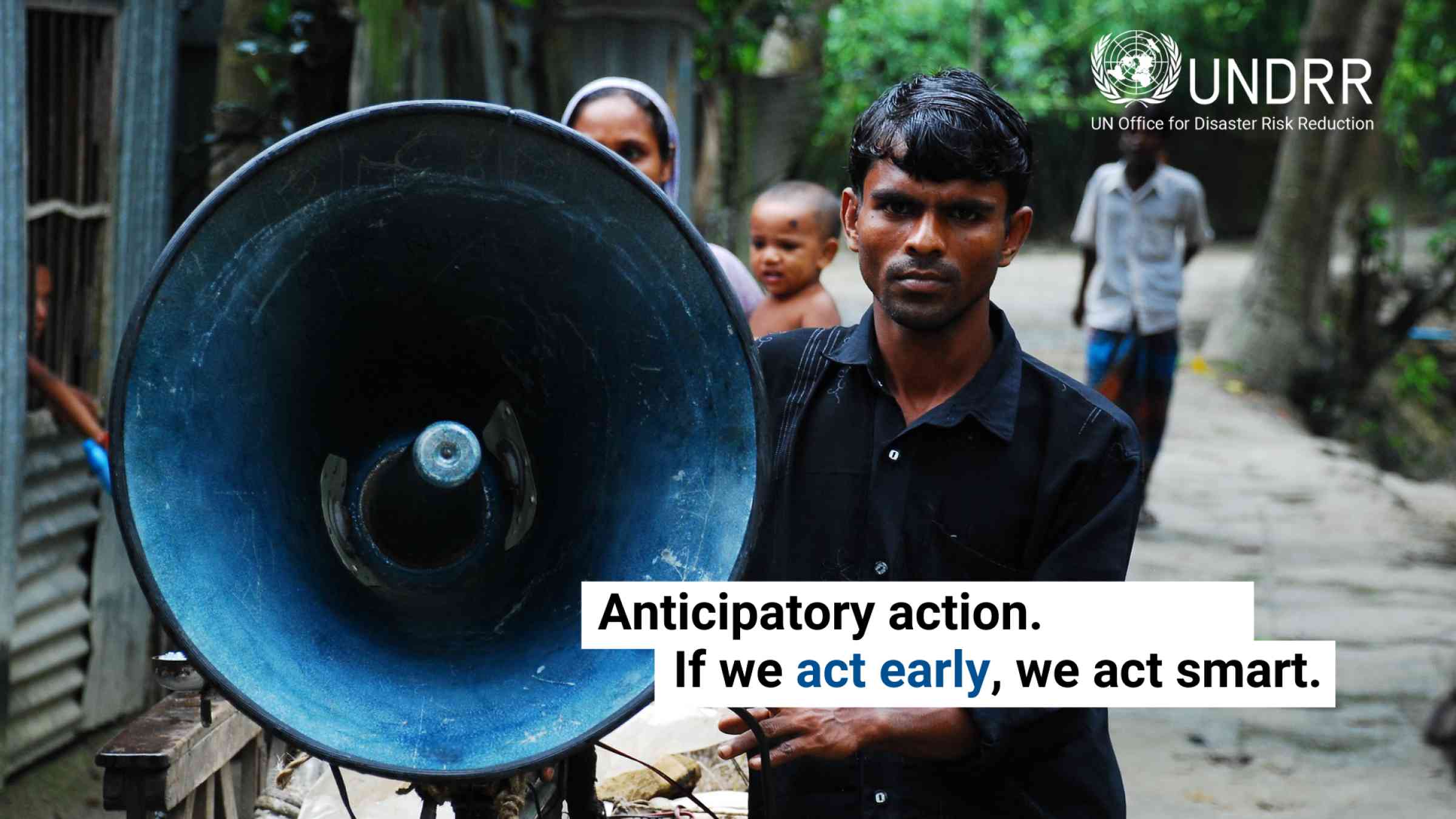
Of all disaster risk reduction and climate adaptation measures, early warning and anticipatory action are among the most proven and cost-effective ways to save lives and reduce losses.
Advances in early warning systems and preparedness have saved tens of thousands of lives and hundreds of billions of dollars. People-centered, end-to-end, multi-hazard early-warning systems can help minimize the harm to people, assets, and livelihoods by triggering early action that is well-prepared and tested.
UNDRR, as co-lead of the Early Warnings for All initiative, works with diverse partners from across nations and sectors to close gaps in coverage and ensure these systems protect people and safeguard development gains.
"All people on Earth must be protected by early warning systems within five years."
- UN Secretary-General Antonio Guterres, March 23, 2022
This is why in March 2022 the UN Secretary-General launched the Early Warnings for All initiative which called for every person on Earth to be protected by early warning systems by 2027.
In November 2022, the UN Secretary-General launched at COP27 an Executive Action Plan to implement the initiative and designated as the co-leads the World Meteorological Organization (WMO) and the United Nations Office for Disaster Risk Reduction (UNDRR).
Yet, as of 2022, only half of countries globally are protected by multi-hazard early warning systems. The numbers are even lower for developing countries; less than half of the Least Developed Countries and only one-third of Small Island Developing States have a multi-hazard early warning system.
What it will take to succeed
At the global level:
accelerating progress through timely, sustained, and well-targeted investment that supports infrastructure, operations, and enabling activities, from community engagement to participatory planning.
At the regional level:
strengthening coordination and alignment to expand early warning coverage and share expertise.
At the national and local levels:
building political momentum and whole-of-society support to make early warning systems inclusive and people-centered, so that they are trusted and actionable.
Action plan pillars
Under the Action Plan, different organizations will lead the implementation of the four elements or pillars that make up the early warning chain:
Pillar 1: Disaster risk knowledge, is led by UNDRR.
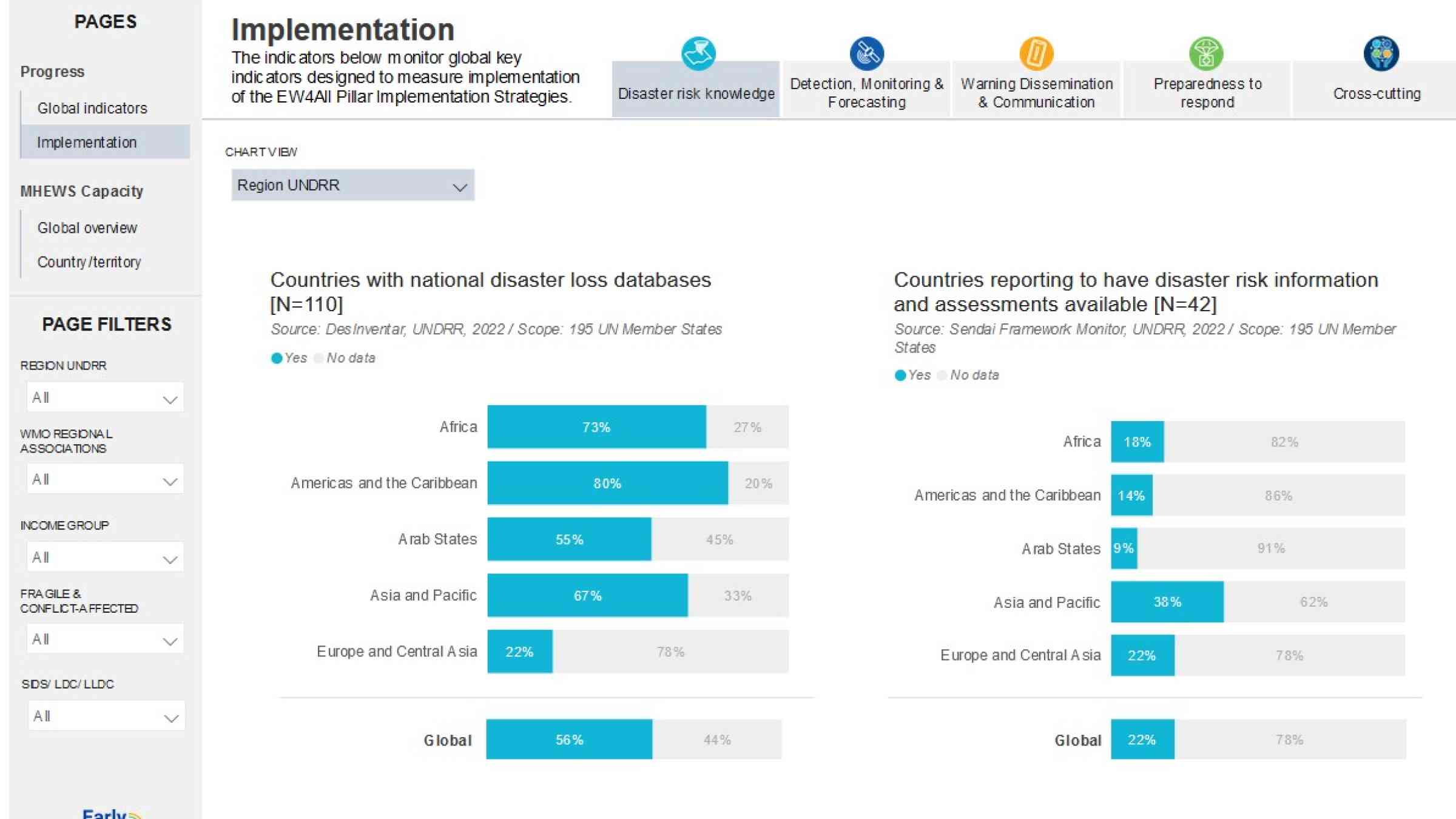
Risk knowledge represents the first foundational pillar of effective early warning systems. However, significant gaps in terms of risk information and assessments persist worldwide. Less than half of the countries with existing early warning systems have access to appropriate disaster risk information, and even fewer have national legislation and regulatory frameworks for emergency response.
As the Pillar 1 lead, UNDRR leverages its global leadership, trusted knowledge, and convening power to close gaps in data, strengthen governance, and empower decision-makers and vulnerable communities to act on risk.
Activities under Pillar 1 include building risk knowledge capacity through training, advancing the use of disaster loss and risk data for better forecasting and anticipatory action, developing new tools such as risk information systems and innovation with AI, strengthening governance and coordination, and supporting national implementation plans for early warning systems. This work empowers decision-makers to understand, identify, and respond to risks.
Throughout these activities, gender equality, disability inclusion, youth leadership, and Traditional and Indigenous knowledge are prioritised to ensure that no one is left behind.
Pillar 2: Detection, observations, monitoring, analysis and forecasting of hazards, is led by WMO.
Pillar 3: Warning dissemination and communication, is led by the International Telecommunication Union (ITU).
Pillar 4: Preparedness to respond, is led by the International Federation of Red Cross and Red Crescent Societies (IFRC).
Making early warning systems successful also depends on enablers that support all four pillars. Strong risk communication, effective governance and legislation, coherence with climate action and the 2030 Agenda for Sustainable Development, and the use of innovation and technology help ensure that warnings are trusted, acted upon, and reach everyone, everywhere. UNDRR, together with WMO, also leads work on monitoring and evaluation to track progress and drive accountability. This work also includes activities such as after-event reviews and simulations, national technical workshops, and the development of innovative tools like an AI toolkit.
- Implementation monitoring
Implementation monitoring
The report provides a snapshot of progress in achieving Target G of the Sendai Framework for Disaster Risk Reduction 2015-2030 and is also a midterm stock-take of the progress made towards Early Warnings for All since its launch in 2022. More importantly, the report provides a forward-looking perspective: clear pathways and recommendations to close remaining gaps and accelerate implementation.Learn about the status of global MHEWSThe Early Warnings for All Initiative dashboard aims at tracking progress, informing decision-making and measuring success as key elements for achieving its five-year goal of the Early Warnings for All Initiative: to ensure that all people on Earth are covered by early warning systems by 2027.View the dashboard- Early warning news
Early warning news
- In videos
In videos



Related activities and themes


Effective early warning
- Multi-Hazard: designed to detect different hazards that may occur alone, simultaneously, or cascade.
- End-to-end: cover the entire range, from hazard detection to action, which includes providing understandable and actionable warning messages.
- People-centered: designed to be inclusive and actionable for all, ensuring that women, youth, persons with disabilities, Indigenous Peoples, and those most at risk are empowered to act on time and in ways that reduce harm.

Act now for global resilience:
Support early warnings and disaster preparedness
There's nothing natural about disasters.
Hazards may be inevitable, but their impacts are not. With inclusive, multi-hazard, and people-centered early warning systems, we have the power to save lives, protect livelihoods, and strengthen resilience. Achieving this requires collective action, with governments and UN agencies, civil society, academia, and the private sector working together to expand early warning coverage and ensure no one is left behind.
Every contribution makes a difference.
Early warning's impact
30% reduction
24 hours of early warning can cut the ensuing damage by 30 per cent
$3-16B in losses
Investing US$ 800 million in early warning systems in developing countries would avoid losses of $3-16 billion per year
1-in-3 lack warning
One-third of the world’s people, mainly in the least developed countries and small island developing states, are still not covered by early warning systems. In Africa, 60% of people lack coverage
6x mortality
Countries with limited early warning coverage have disaster mortality that is six times higher than countries with substantial to comprehensive coverage