


Where we WERC
Our scientists conduct studies from the deserts of the Mojave to the diverse ecosystems of the Great Basin
Our scientists conduct studies from the deserts of the Mojave to the diverse ecosystems of the Great Basin
Our Scientists at WERC
Ecologists collecting field samples to detect contaminants in the environment
Ecologists collecting field samples to detect contaminants in the environment
Western Ecological Research Center (WERC)
The Western Ecological Research Center (WERC) is a USGS Ecosystems Mission Area operation serving primarily California and Nevada. WERC scientists work closely with Federal, State, academic, and other collaborators to address a diverse array of high-profile topics. Topics include research on effects of wildfire, sea level rise, drought, energy development and more on federal Trust species.

2025 in Review: The Saline Lake Ecosystems Integrated Water Availability Assessment
2025 in Review: The Saline Lake Ecosystems Integrated Water Availability Assessment
Earth Science Matters - Vol. 21 | Issue 1
Earth Science Matters - Vol. 21 | Issue 1
Helping the California Winter Rice Habitat Incentive Program increase bird use of winter-flooded rice fields
Helping the California Winter Rice Habitat Incentive Program increase bird use of winter-flooded rice fields
Distribution and abundance of Least Bell’s Vireo (Vireo bellii pusillus) and Southwestern Willow Flycatcher (Empidonax traillii extimus) at the Hansen Dam Basin, Los Angeles County, California—2025 data summary Distribution and abundance of Least Bell’s Vireo (Vireo bellii pusillus) and Southwestern Willow Flycatcher (Empidonax traillii extimus) at the Hansen Dam Basin, Los Angeles County, California—2025 data summary
Executive Summary We surveyed for Least Bell’s Vireos (Vireo bellii pusillus; vireo) and Southwestern Willow Flycatchers (Empidonax traillii extimus; flycatcher) along Big Tujunga Creek in the Hansen Dam Basin in Los Angeles County, California, in 2025. Four vireo surveys were completed between April 17 and July 2, 2025, and three flycatcher surveys were completed between May 20 and July...
Authors
Suellen Lynn, Barbara E. Kus
Distribution and abundance of Least Bell’s Vireos (Vireo bellii pusillus) and Southwestern Willow Flycatchers (Empidonax traillii extimus) at the Mojave River Dam, San Bernardino County, California—2025 Data Summary Distribution and abundance of Least Bell’s Vireos (Vireo bellii pusillus) and Southwestern Willow Flycatchers (Empidonax traillii extimus) at the Mojave River Dam, San Bernardino County, California—2025 Data Summary
Executive Summary We surveyed for Least Bell’s Vireos (Vireo bellii pusillus; vireo) and Southwestern Willow Flycatchers (Empidonax traillii extimus; flycatcher) at the Mojave River Dam study area near Hesperia, California, in 2025. Four vireo surveys were completed between April 23 and June 26, 2025, and three flycatcher surveys were completed between May 16 and June 26, 2025. We...
Authors
Scarlett L. Howell, Barbara E. Kus
Distribution and Abundance of Least Bell’s Vireo (Vireo bellii pusillus) and Southwestern Willow Flycatcher (Empidonax traillii extimus) at the Sepulveda Dam Basin, Los Angeles County, California—2025 Data Summary Distribution and Abundance of Least Bell’s Vireo (Vireo bellii pusillus) and Southwestern Willow Flycatcher (Empidonax traillii extimus) at the Sepulveda Dam Basin, Los Angeles County, California—2025 Data Summary
Executive Summary We surveyed for Least Bell’s Vireos (Vireo bellii pusillus; vireo) and Southwestern Willow Flycatchers (Empidonax traillii extimus; flycatcher) along Bull Creek, Haskell Creek, and the Los Angeles River (Sepulveda Dam project area) in Los Angeles County, California, in 2025. Four vireo surveys were completed between April 16 and July 2, 2025, and three flycatcher...
Authors
Lisa D. Allen, Barbara E. Kus
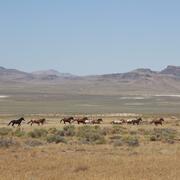
Science for management of America’s iconic wild horses and burros
Wild horses and burros are iconic wildlife of the western USA as well as a complicated management issue on tribal, state, and federal lands. Due to their history as domesticated animals, these wild equids – also called “free-roaming” or “feral” equids – can reproduce quickly, and have few natural predators, allowing their populations to grow rapidly if not managed. When populations are too large...
Science for management of America’s iconic wild horses and burros
Science for management of America’s iconic wild horses and burros
Wild horses and burros are iconic wildlife of the western USA as well as a complicated management issue on tribal, state, and federal lands. Due to their history as domesticated animals, these wild equids – also called “free-roaming” or “feral” equids – can reproduce quickly, and have few natural predators, allowing their populations to grow rapidly if not managed. When populations are too large...

Greater Sage-Grouse Population Monitoring Framework: Cheat Sheet
The Greater Sage-grouse Population Monitoring Framework fills a prominent information gap to help inform current assessments of sage-grouse population trends at nested spatial and temporal scales. It is centered on four objectives: (1) create a standardized database of lek counts; (2) develop biologically based spatial population structures by clustering leks; (3) estimate spatial trends at...
Greater Sage-Grouse Population Monitoring Framework: Cheat Sheet
Greater Sage-Grouse Population Monitoring Framework: Cheat Sheet
The Greater Sage-grouse Population Monitoring Framework fills a prominent information gap to help inform current assessments of sage-grouse population trends at nested spatial and temporal scales. It is centered on four objectives: (1) create a standardized database of lek counts; (2) develop biologically based spatial population structures by clustering leks; (3) estimate spatial trends at...

Greater Sage-Grouse Population Monitoring Framework: Targeted Annual Warning System Information Sheet
The Greater Sage-grouse Population Monitoring Framework helps fill a major information gap to aid current assessments of sage-grouse population trends across spatial and temporal scales. It centers on four objectives: 1) create a standardized database of lek counts; 2) cluster leks to develop spatial population structures; 3) estimate spatial trends across temporal extents; and 4) develop a system...
Greater Sage-Grouse Population Monitoring Framework: Targeted Annual Warning System Information Sheet
Greater Sage-Grouse Population Monitoring Framework: Targeted Annual Warning System Information Sheet
The Greater Sage-grouse Population Monitoring Framework helps fill a major information gap to aid current assessments of sage-grouse population trends across spatial and temporal scales. It centers on four objectives: 1) create a standardized database of lek counts; 2) cluster leks to develop spatial population structures; 3) estimate spatial trends across temporal extents; and 4) develop a system...