
Summary
- Valve plans to bring SteamOS to more devices like the Asus ROG Ally, challenging Windows as the default OS for PC gaming handhelds.
- SteamOS could make gaming handhelds more similar, potentially eliminating a key point of differentiation for consumers in the market.
- Windows still reigns supreme in some areas for gaming handhelds due to better game compatibility, highlighting the need for healthy competition between operating systems.
SteamOS, the Linux-based operating system created by Valve that gained fame on the Steam Deck, might be coming to more devices in the future. There has been talk and suspicion about SteamOS running on other devices for as long as the Steam Deck has been around. The best PC gaming handhelds not made by Valve resort to using Windows as their operating system, which is seen as lesser than SteamOS. Valve suddenly confirmed it's working on bringing SteamOS to other devices, namely the Asus ROG Ally, in SteamOS release notes last week.
For many, this was cause for a celebration. We didn't have official confirmation SteamOS supported any ROG Ally keys, but last week's release notes added support for additional ROG Ally keys. All signs point to SteamOS coming to more gaming handhelds in the future, but I want to pump the brakes on that. While it would be great to have the option of installing the operating system on your handhelds, making SteamOS the default OS for every PC gaming handheld would be a step back for the industry.

Asus ROG Ally X review: Top-notch hardware dragged down by Windows
The ROG Ally X’s hardware should make it dwarf the Steam Deck, but once again, Windows is a huge asterisk.
3 Handhelds are already starting to look and feel similar
Right now, different operating systems are part of what differentiates PC gaming handhelds
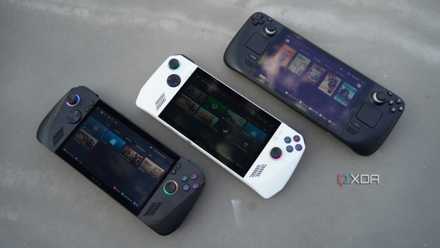
There are only so many things that can differentiate one PC gaming handheld from another, as they're all starting to look the same. Companies that have tried new things in the space haven't found success; neither the Lenovo Legion Go and its larger form factor nor the MSI Claw and its Intel Core Ultra platform have come close to meaningfully challenging the Steam Deck or ROG Ally. For now, the two main things that separate gaming handhelds from one another are their chipset and operating system. If SteamOS became the industry standard and shipped on every PC gaming handheld, we'd lose one more differentiating characteristic.

PC gaming handhelds already all look the same, but that's actually a good thing
If you're looking at PC gaming handhelds and thinking that they all look the same, you're absolutely right.
Additionally, it's hard to separate a device's chipset from its operating system. Part of what makes the Steam Deck great is that it uses a custom AMD processor and Valve's custom Linux distribution. Just like Apple optimizes macOS for Apple silicon, for example, Valve optimizes SteamOS for the Steam Deck hardware. The same goes for Asus and the ROG Ally, to a lesser degree. The company told The Verge that one of the reasons it uses Windows is Microsoft's validation teams that work to ensure the OS runs on all kinds of hardware, including the Asus ROG Ally.
We have no idea if SteamOS will even be good on a third-party gaming handheld. I suspect it'll take a lot of work for Valve to optimize it for devices like the ROG Ally, and that's why we haven't seen it debut yet. Even if it does end up running well on other devices in the future, I'd hate to see gaming handhelds become further alike and lose another differentiating feature.
2 SteamOS isn't perfect
Windows is still the superior gaming handheld OS for game compatibility
If SteamOS was perfect, I'd be much more excited about the prospect of all gaming handhelds running the operating system. There are things that SteamOS gets right, most notably an easy and familiar navigation method that feels more akin to a console than a PC. Other highlights include excellent standby battery life and a useful quick resume feature that lets you jump right into games. However, it's lacking in game compatibility.

4 reasons Windows is a better OS for gaming handhelds than Linux
Windows has a few issues running on gaming handhelds and touchscreens, but it's still a better option than Linux.
There are plenty of games that run on a Steam Deck, from classics like Grand Theft Auto V to flagships like Cyberpunk 2077. To Valve's credit, SteamOS does an excellent job of telling users which games will run on the Steam Deck, and how well they'll run. But not every game is supported, and those with custom anti-cheat software won't work at all on the Linux-based SteamOS. Epic Games' proprietary Easy Anti-Cheat software is one example, so that rules out the ever-popular Fortnite.
Additionally, SteamOS doesn't work with Xbox PC Game Pass, which is a bummer for those who like to download and play free games from that service. Game compatibility is more consistent on Windows overall, and this is a problem that SteamOS might never fully solve. As such, Windows gaming handhelds need to exist. They can't all run SteamOS, because SteamOS isn't capable in every single area.
1 Competition is key
I want SteamOS and Windows to be better for handhelds, not for one to win the battle outright
Competition is what drives improvement, and we see that across plenty of market categories in technology. We have Mac vs Windows, Android vs iOS, and Xbox vs PlayStation, just to name a few examples. To that end, we need SteamOS vs Windows to become a similar rivalry in the world of PC gaming handhelds. The two operating systems should be competing with each other to become the best, and in that effort, both will become improved.
3 ways the Steam Deck is still better than the Asus ROG Ally X
I wish the ROG Ally X had these three things, because then it’d be perfect.
It's clear that Windows is far from perfect for touchscreens and handheld devices. To me, the answer to that problem isn't simply putting SteamOS on more devices. Instead, the solution should be to improve Windows and make it better for those applications. Microsoft and its partner OEMs should continue working diligently to make Windows 11 a worthy competitor for SteamOS. Valve's operating system shouldn't consume the entire PC gaming handhelds market, no matter how good it is.
Options are great, but complacency is not
To be clear, I'd love for gamers to have the option of installing SteamOS on their PC gaming handhelds, regardless of if it's a Steam Deck or not. Any time consumers can make a choice for themselves, it's a good thing. Plus, imagine the power of an Asus ROG Ally X with the software prowess of a Steam Deck — it would be a dream.
My fear is that if all Windows gaming handhelds were able to run SteamOS, Microsoft and the OEMs would get complacent. Why would companies spend lots of time and money trying to fix the decades-old problems with Windows when they can just use SteamOS instead? It seems like an easy choice to me, and I think SteamOS would instantly become popular on Windows gaming handhelds. That would be unfortunate, because I want Windows 11 to get better for handhelds and touchscreen devices — not for it to get replaced.