
Summary
- Intel Core Ultra Series 2 processors feature integrated memory, just like Apple silicon processors.
- Integrated memory on Core Ultra Series 2 chips aims to enhance efficiency and performance
- Chipmakers like Intel are following Apple's lead in design and user trends, sacrificing upgradability.
Intel Lunar Lake, now known as Core Ultra Series 2, is finally here. The long-awaited platform is the one Intel has been telling its users to wait for, making some bold claims in the process. It called the notion that Arm architectures are inherently more efficient than x86 a "myth," and planned to bust that myth with Core Ultra Series 2. The company wants to take on everything, from Qualcomm's Snapdragon X, to Apple's M3 and M4, to AMD's Strix Point.
The verdict on that is yet to come, because the first wave of Intel Core Ultra Series 2 laptops won't ship until Sept. 24. But we already know that Intel took note of an old adage in developing the next generation of Core Ultra: if you can't beat them, join them. That's right — Core Ultra Series 2's thin-and-light laptop-class chips feature in-package memory. It won't be upgradeable, and it's essentially the exact same move Apple made four years ago. This really shouldn't come as a surprise to anyone, because Apple was clearly right on this from the jump.
3 Apple beat everyone to the punch
Slowly, chipmakers are following Apple's lead in ultrabook design
Apple is known for a lot of things, but being the first to develop something isn't usually one of them. Often, the company's approach is about refinement and patience. Let all the other companies toss out prototypes and early products, and then jump into the market when the tech has matured. If we ever see a foldable phone, tablet, or laptop from Apple, it'll be as a result of this exact strategy.
Sometimes, Apple does incite a shift in the tech industry — for better or for worse. We have Apple to thank for the death of the headphone jack on most consumer devices, as well as the movement towards non-upgradeable tech products. It started soldering memory to the logic boards of MacBook Air models nearly two decades ago. Almost everyone criticized the move, due to the high costs of RAM upgrades at the time of purchase, and the lack of post-purchase upgrade potential.
Starting with the move to Apple silicon in 2020, things have only gotten worse. Every M-series chip, from the first M1 to the latest M4 system-on-a-chip, features integrated memory. It's called unified memory, and it gives both the CPU, GPU, and NPU cores on the SoC access to the same system memory. This design avoids redundancy, as typical computing devices give RAM to multiple parts of the system separately, like CPU and GPU RAM.

iPad Pro (M4, 2024) review: The best tablet in the world gets better, but by how much?
The new iPad Pro with M4 is the most capable and powerful tablet on the market. But is it that much better than the M2 iPad Pro?
Intel is employing a very similar strategy with Core Ultra Series 2. There are nine different SKUs that make up Core Ultra Series 2, and they each have chip-level memory. So, you can configure each of those SKUs with either 16GB or 32GB of memory that's built into the chip itself. No more RAM upgrades, but hopefully better efficiency.
No matter what you think about the things Apple has done with Apple silicon — I'll personally miss the days of tinkering with a Mac Pro — it's inarguable that it beat Intel to the punch by a whole four years. It deserves some credit for that. Even Intel, the company Apple left in the dust in favor of its own silicon, agrees with Apple on chip-level memory for ultrabooks.
2 Who would've thought? It's all about efficiency
For x86 systems to match the power efficiency of Arm chips, they need all the help they can get
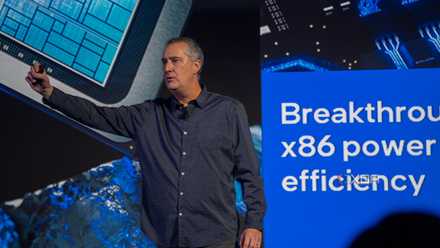
So, why is Intel following in Apple's footsteps anyway? If you recall, Apple's big advancement with its own silicon was its efficiency and performance-per-watt figures. Arm chips usually destroy x86 chips in this area, and Snapdragon X proved that again earlier this year. But Intel wants to bust this myth, so it needs to make Core Ultra Series 2 more efficient. It's now doing so the exact same way Apple did four years ago — by integrating system memory into the CPU.
The new processors have either 16GB or 32GB LPDDR5X memory soldered directly to the chip, and this is going to increase efficiency. Before, the CPU would have to talk to the motherboard and the RAM itself, and the reverse, which expends a lot of energy. Everything is in one place now, which cuts out the middle men, so to speak. This is part of the reason Intel Core Ultra Series 2 is claimed to offer 20% better performance-per-watt than Qualcomm's X1E-80-100 (Snapdragon X Elite) chip.
3 ways Intel Lunar Lake can actually beat Arm
I'm not saying it's going to happen, but if it were to happen, here's how Lunar Lake could beat Arm.
Integrated memory isn't the only reason Core Ultra Series 2 has the chops to challenge Apple and Qualcomm in performance and efficiency, but it's a big one. And without giving Apple too much credit, it's the company that pioneered this kind of architecture. It employed it on iPhones and iPads dating back more than a decade, and more recently introduced unified memory on Apple silicon in 2020.
1 Apple identified consumer trends early
Now, the rest of the PC industry is just starting to catch up
To computing enthusiasts, like many of XDA's readers, the tradeoffs might not be worth it. Maybe you'd take worse battery life and efficiency in exchange for keeping user-upgradeable memory. The problem is that consumer trends are moving in the opposite direction. I'd love to keep laptops as upgradeable as possible, but that conflicts with everything else consumers want. They crave more power, better battery life, and thinner chassis. It's simply not possible to have it all, so chipmakers and OEMs are consistently sacrificing repairability and upgradeability in favor of the rest.
Still, I'd be remiss if I didn't point out that Apple first identified these trends in 2008. The company put an iPod hard drive into the first-ever MacBook Air, defying modern conceptions of what a laptop could be at the time. It spurred an entire market category of thin-and-light laptops, both on the Mac and PC platforms. Everything Apple has done since, from soldering memory and SSDs to the logic board to introducing desktop-class SoCs with unified memory, was to match consumer desires.

MacBook Air (M3, 15-inch, 2024) review: The Goldilocks laptop size
The 15-inch MacBook Air offers an immersive large screen experience while keeping a slim and light(er) body than the MacBook Pro
The effort culminated in the M3 MacBook Air, which is a fanless ultrabook with mind-boggling battery life. Now, Intel is trying to make Core Ultra Series 2 chips to match the consumer trends Apple was first to spot. Intel claims that Core Ultra Series 2 supports 60% better battery life, and it's one of the chipmaker's big selling points for the platform. Adding CPU-level memory to Core Ultra Series 2 processors for the purpose of improving battery life and efficiency is just another way of Intel saying Apple was right all along.
Make no mistake, there are some things Intel is getting right
I love using the best Apple silicon Macs, and daily-drive an M2 MacBook Air, but I hate that Apple uses the same SoC strategy on the MacBook Air as the flagship Mac Pro. To Intel's credit, the company is learning from Apple's mistake. It won't be soldering RAM to the CPU for every new processor — just the ones intended for use in laptops. It's a great move that should please thin-and-light laptop buyers as well as desktop users. Still, there's no avoiding the fact that Intel is doing what Apple did years ago.