
Summary
- Noise cancelation technology, including Active Noise Cancelation (ANC) and Environmental Noise Cancelation (ENC), enhances audio experiences by reducing or eliminating unwanted ambient sounds.
- ANC relies on creating anti-noise signals to counteract external noises, while ENC focuses on isolating and amplifying the speaker's voice while suppressing background noise during voice communications.
- ANC creates a quiet listening environment, perfect for enjoying music or podcasts without distractions, while ENC is helpful for calls and meetings.
Noise cancelation technology has drastically transformed the way we experience audio, allowing for an immersive listening environment free from the disturbances of the outside world. This technology is primarily embodied through two innovative approaches: Active Noise Cancelation (ANC) and Environmental Noise Cancelation (ENC). Both technologies serve distinct purposes, enhancing our audio interactions whether we're diving into our favorite tunes or ensuring our voice cuts through the cacophony of environmental noise during a call.

What is noise cancelation?👁 Schematic diagram showing the basic working principle of how noise cancelation works
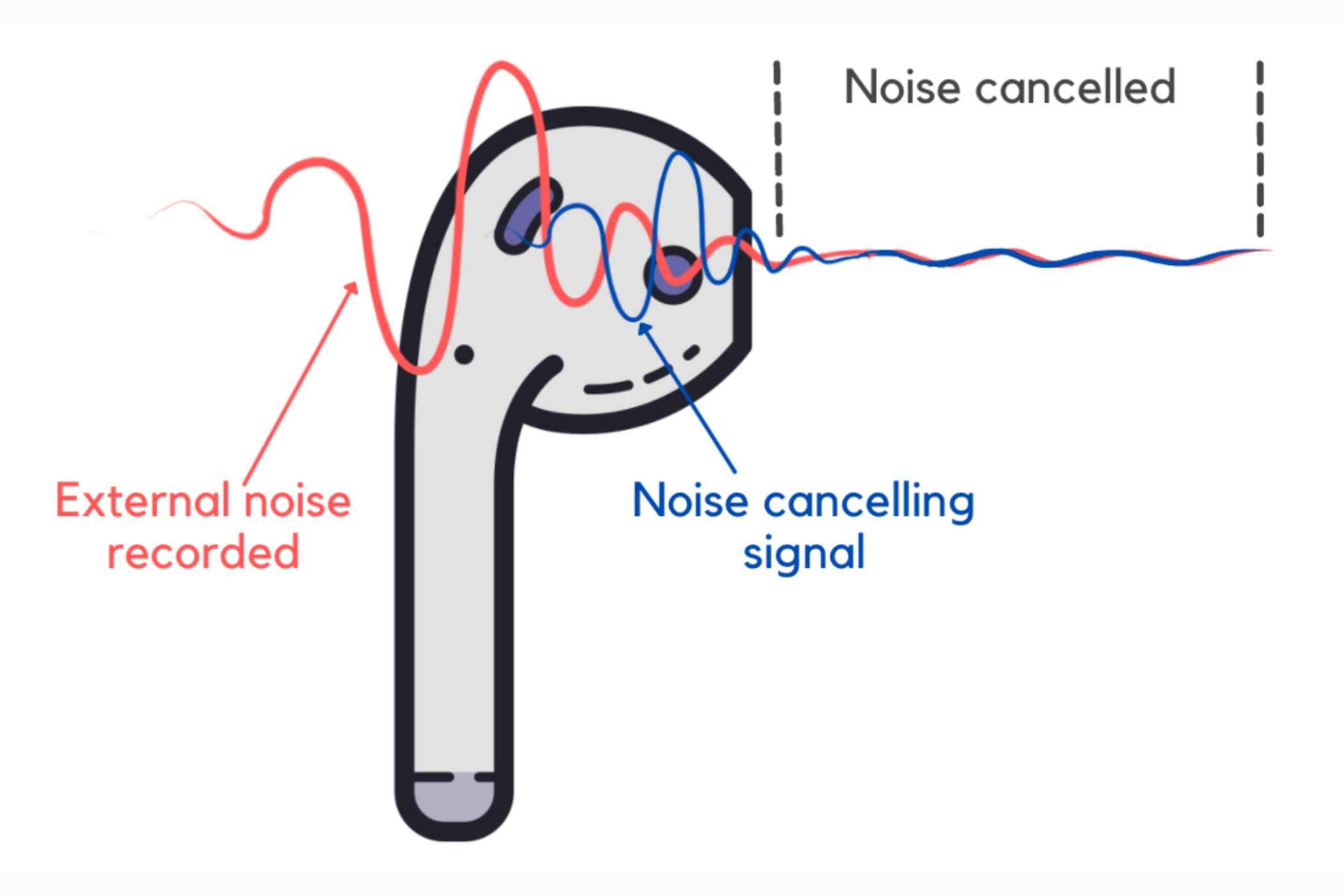
Noise cancelation refers to a variety of technologies and techniques designed to reduce or eliminate unwanted ambient sounds. This broad category includes both passive noise cancelation and active noise cancelation, each relying on different principles to achieve noise reduction.
Passive Noise Cancelation involves physically blocking sound waves from reaching the ears. This method can be as simple as using materials that absorb or reflect sound within headphones, earphones, or earplugs to prevent unwanted noise from entering the ear canal. The effectiveness of passive noise cancelation depends largely on the fit and the materials used in the device's construction, making it a fundamental aspect of many headphones and earplugs.
Active Noise Cancelation, on the other hand, is a more complex technology that uses electronics to reduce unwanted ambient sound. This method involves creating anti-noise signals that counteract ambient noise. Microphones placed near the ear collect external sounds, and then the ANC system generates a sound wave with the opposite phase (anti-noise) to cancel out the external noises before they reach the listener's ear. This technology is particularly effective against low-frequency sounds, such as the hum of an airplane engine or air conditioning units, and is commonly found in headphones, earbuds, and other personal audio devices.
The concept of noise cancelation has evolved significantly since its theoretical underpinnings were first patented by Dr. Paul Lueg in 1933. While Lueg's work laid the foundation for the ANC by demonstrating how sound waves could be canceled with opposite sound waves, the practical application of this theory has expanded over the decades. The first commercially available ANC headset, introduced by Bose Corporation in 1989, marked a significant milestone in bringing this technology to a wider audience.
What is Active Noise Cancelation?👁 Schematic showing the internal process of creating inverse sound waves to cancel out ambient noise.
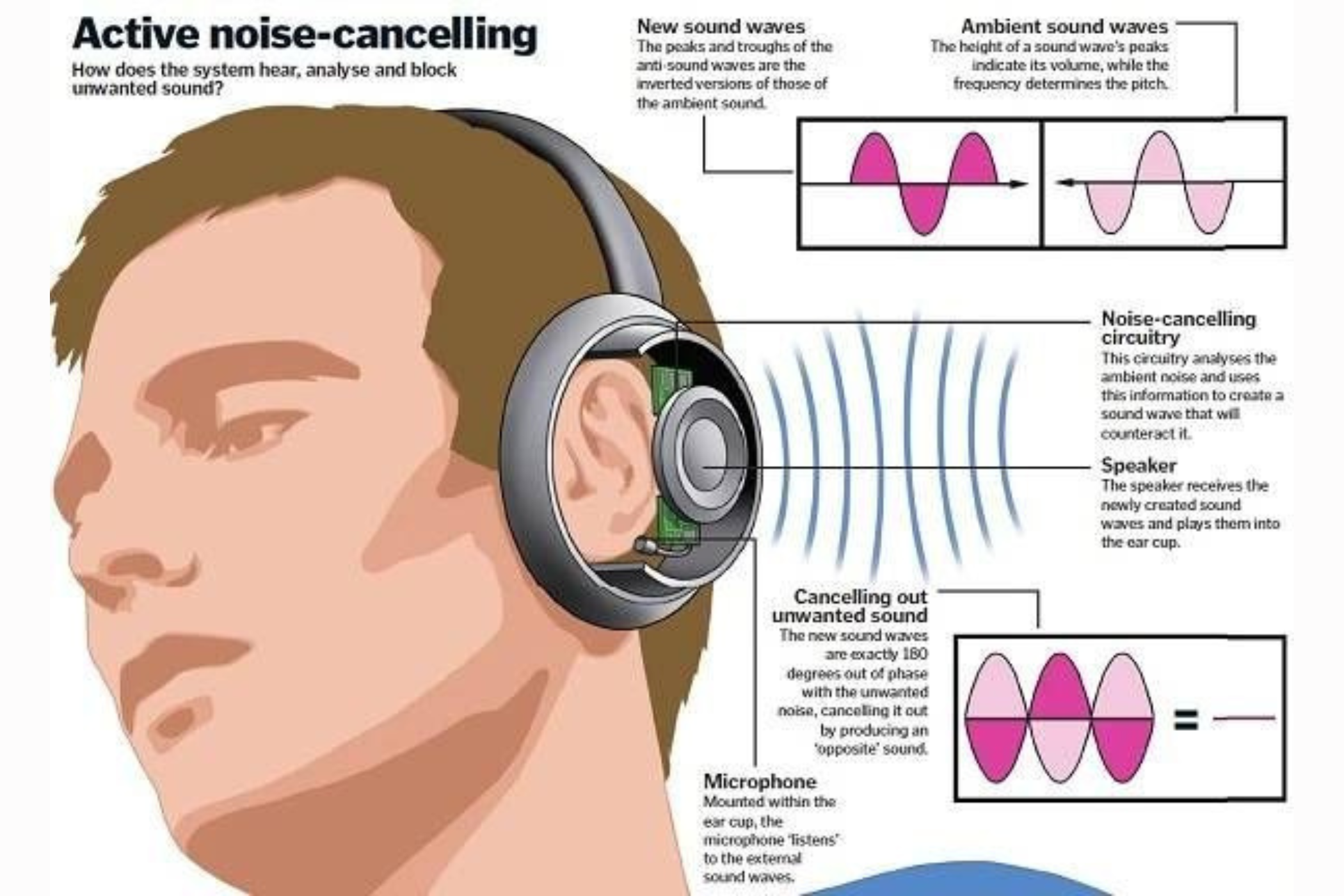
Active Noise Cancelation is used in headphones and earphones to reduce unwanted ambient sounds. It employs microphones to detect external noise and then generates an opposite "anti-noise" signal to neutralize it through destructive interference. This process effectively cancels out lower-frequency noises, such as the hum of an airplane or the rumble of public transport, enhancing the listening experience. ANC technology can be divided into feedforward and feedback systems, each targeting different types of noise. High-end devices often combine both to offer superior noise reduction, making listening at lower volumes more peaceful without compromising sound quality.
1. Sound detection: ANC headphones use external microphones to detect ambient sounds. These microphones capture a broad spectrum of frequencies, from the low rumble of something like an engine to the higher pitches of people's chatter. The precision in detecting these sounds is crucial; it determines how effectively the ANC system can identify the noise it needs to cancel. The location and quality of these microphones significantly influence the system's overall performance.
2. Signal inversion: After detecting ambient noise, the ANC system processes this audio to create an inverse sound wave. This phase inversion is done by flipping the detected sound wave 180 degrees out of phase. This is done using algorithms and an onboard processor to analyze and invert the sound wave in real time.
3. Sound neutralization: The inverted sound is then played through the headphones' speakers alongside the user's primary audio. This step relies on the principle of destructive interference, where the original noise and its inverted counterpart collide and cancel each other out. The synchronization of the inverted sound with the ambient noise has to be perfect; even slight delays can diminish the noise cancelation effect and might even cause some jarring effects.
ANC technology is divided into three main types, based on its mechanism and application:
- Feedforward ANC places microphones outside the earpiece to detect and cancel external noise before it reaches the ear, excelling at higher frequencies. It's effective against ambient sounds but struggles with wind noise due to its external mic placement, lacking the ability to correct prediction errors in real time.
- Feedback ANC uses internal microphones to analyze the sound that reaches the ear, offering superior cancelation at low to mid-frequencies. This setup allows for dynamic adjustments to the noise-canceling signal, correcting discrepancies, but is less effective against high-frequency noise.
- Hybrid ANC combines both external and internal microphones, offering comprehensive noise cancelation across a broad frequency range. This method optimizes noise cancelation effectiveness but introduces complexity and cost due to the dual-system integration, aiming to balance the strengths and weaknesses of feedforward and feedback systems.
What is Environmental Noise Cancellation (ENC)?
Environmental Noise Cancelation technology is designed to enhance voice clarity by isolating and amplifying the speaker's voice while suppressing background noise during voice communications. This technology is particularly valuable in noisy environments, ensuring that voice communications are clear and free from distractions. Here's how ENC works:
- Microphone arrays and directional audio capture: ENC employs arrays of microphones to capture audio from various directions. This setup allows the system to effectively distinguish between the speaker's voice and background noise. The use of multiple microphones, often placed around the device, enables a technique known as beamforming. This technique focuses the microphone's sensitivity toward the source of the voice while reducing the pickup of ambient sounds.
-
Advanced Signal Processing:
- Voice and Noise Differentiation: The core of ENC technology lies in its ability to process and differentiate between the speaker's voice and background noise. This is achieved through sophisticated signal processing algorithms that analyze the audio captured by the microphones.
- Noise Reduction and Voice Isolation: Once the ENC system identifies background noise, it works to reduce or eliminate these sounds from the audio signal. This process involves filtering and sometimes subtractive techniques to remove the unwanted noise frequencies, leaving the speaker's voice more isolated and clearer, and all of this processing work in real-time, handled by an onboard processor.
- Benefits of ENC: Environmental Noise Cancellation technology enhances voice transmission clarity by adeptly separating the speaker's voice from intrusive background noise, ensuring each word is heard distinctly and reducing the need for repetition. This comes in handy in noisy environments, such as bustling offices or windy outdoor spaces, where ENC manages to preserve the quality of voice communication.
ANC helps create a quiet listening environment, perfect for those moments when you want to enjoy your music like an audiophile or listen to a podcast without the distraction of background noise. It works by detecting external sounds and then generating opposing sound waves to cancel them out. This means you can enjoy a more immersive listening experience, whether you're in a busy cafe, on a plane, or working in a noisy office. On the other hand, ENC focuses on making sure your voice is heard clearly during voice calls. It uses an array of microphones to isolate your voice and minimize surrounding noise. This is incredibly useful for phone calls, video conferences, and voice recordings, ensuring that you're heard clearly by the person on the other end, even if you're in a loud environment.
They're not mutually exclusive
Active Noise Cancelation and Environmental Noise Cancelation have changed the game when it comes to how we listen to music and communicate. It's pretty impressive how these technologies help us tune out the background noise and focus on what we want to hear. What's more, ANC and ENC aren't mutually exclusive; in fact, some of the best headsets out there combine both features, offering a comprehensive solution for both immersive listening and clear communication. As we move forward, it's exciting to think about the improvements and new features we'll see in noise-cancellation technologies over the years.