
A 3D printer can make a lot of fun stuff, and I’m not immune to that pull. I’ve printed the cute desk things, the novelty brackets, and the little objects that make visitors ask whether I made them myself. That part is enjoyable, but it’s not the reason my printer has earned a permanent spot in my workspace. The real value showed up when I stopped treating it like a toy machine and started treating it like a small tool factory.
Toys may be what gets a lot of people interested in 3D printing, but tools are what make the printer worth keeping.
That shift changed how I think about ownership. Instead of waiting for a replacement part, ordering a cheap plastic adapter, or improvising with whatever I had nearby, I could make something that fit the job in front of me. Not every print needs to be clever or impressive. Sometimes the best print is the boring one that makes a drawer close cleanly, keeps a cable from snagging, or turns a messy setup into something I don’t have to think about again.
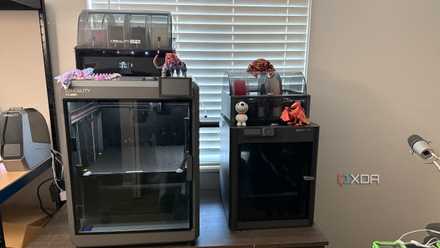
3D printing saved me money, but only after I stopped printing “solutions”
I had to stop printing novelty “solutions” and focus instead on durable replacements.
The best prints solve problems hiding in plain sight
Small practical prints can quietly improve everyday workflows
The first useful prints weren’t dramatic. They were small pieces that solved annoying problems I’d learned to ignore. A cable clip here, a spacer there, a little holder that kept a USB dongle from disappearing into the same drawer as every other tiny gadget I own. None of them looked like headline projects, but each one removed a point of friction from my day.
Before printing another desk toy, look around for one tiny annoyance you’ve stopped noticing. A cable that keeps sliding away, a drawer that never stays organized, or a device that needs a better stand can all be better test prints than something decorative. The best functional prints usually start as small irritations, not big project ideas.
That’s where a 3D printer starts to feel different from other tools. A screwdriver fixes what already exists, but a printer lets me make the part that should have existed in the first place. I don’t have to accept that a charging cable wants to slide behind the desk every time I unplug it. I can spend a few minutes measuring, print a tiny guide, and stop having that argument forever.
This kind of printing also rewards attention. Once I started looking around my workspace, I noticed problems everywhere. Not big problems, just little design gaps that had never been worth solving through normal retail channels. A 3D printer makes those gaps worth fixing because the cost of trying is low and the payoff stacks up over time.
Printed tools make repairs and organization feel personal
Custom parts often beat generic store-bought accessories
The best part of printing tools is that the finished object doesn’t have to work for everyone. It only has to work for me, in the exact place where I need it. A store-bought organizer has to fit thousands of people’s desks, shelves, and drawers. A printed organizer can fit one drawer, one awkward corner, or one pile of tools I keep pretending is an “active workspace.”
That specificity matters more than it sounds. I’ve printed holders, guides, bins, mounts, and little repair pieces that would’ve been either impossible to buy or too silly to justify ordering. A replacement foot for a device isn’t exciting, but it’s useful. A bracket that holds something at the right angle isn’t flashy, but it can make a setup feel finished instead of temporary.
It also changes how I approach broken or inconvenient things. Instead of jumping straight to replacement, I ask whether the problem is really the whole object or just one weak piece of plastic. Often, it’s the second one. When the failure point is small, printing a fix feels less wasteful, more satisfying, and far more practical than tossing something that still mostly works.
The toy reputation still follows every printer around
Novelty prints can distract from the printer’s real value
The obvious pushback is that 3D printers still produce a lot of junk. That’s not unfair. Anyone who has spent time around the hobby has seen endless trinkets, decorative dragons, and objects whose main purpose is proving the printer can print them. The machine can absolutely become a novelty dispenser if that’s how you use it.
There’s also a learning curve that can make the practical side feel less practical at first. Designing a useful part means measuring, testing, adjusting tolerances, and sometimes printing the same thing more than once. A failed toy print is annoying, but a failed functional print can feel like a waste of time. If the goal is instant utility, 3D printing can be stubborn.
The economics aren’t always clean either. Filament is cheap per print, but the printer, tools, spare parts, and time all count. A printed hook isn’t automatically cheaper than a hook from the hardware store. That’s especially true if you spend an hour designing something you could’ve bought in five minutes.
Practical printing works because it changes the equation
The savings come from control rather than raw material cost
The value of practical printing isn’t just about beating retail prices. It’s about control. I can make the part the size I need, in the color I want, with the mounting holes where they belong, without searching through pages of almost-right products. That control is what makes the printer feel less like a gadget and more like part of the repair kit.
The time cost also gets better as you build habits. The first custom bracket takes longer because you’re thinking through every step. The next one is faster, and the one after that is almost routine. Once you understand your printer, your slicer, and the materials you trust, small functional prints stop feeling like projects and start feeling like errands.
There’s also a quiet confidence that comes from being able to make your own fixes. It doesn’t mean every problem needs a printed solution, and it definitely doesn’t mean every print is worth keeping. But it does mean I’m less dependent on whatever replacement part happens to exist online. For a home office, a home lab, or a maker setup, that independence is where the printer earns its keep.
A practical printer is worth more than a novelty machine
A 3D printer doesn’t need to justify itself with showpiece prints. Those are fun, and there’s nothing wrong with making something just because it looks good on a shelf. But the machine becomes far more valuable when it starts solving the small problems that pile up around your workspace. That’s when it stops being a hobby purchase and starts becoming infrastructure.
For me, the prints that matter most aren’t the ones people notice first. They’re the cable guides, brackets, holders, spacers, repair parts, and organizers that quietly make everything else work better. Toys may be what get a lot of people interested in 3D printing, but tools are what make the printer worth keeping. The novelty wears off, but a useful part keeps doing its job every day.
Bambu Lab X2D
- Build Volume
- 256 x 256 x 256 mm
- Printing Speed
- 1000 mm/s
- Materials Used
- PLA, PETG, ABS, ASA, TPU, Support for PLA, Support for PLA/PETG, Support for ABS, Support for PA/PET, PET, PA, PC, PVA; Carbon/Glass Fiber Reinforced PLA, PETG, ABS, ASA, PA6, PAHT, PPA, PET
- Brand
- Bambu Lab
- Extruder Quantity
- 2
- Extruder
- Direct Drive (Primary), Bowden (Auxiliary)
Yes, the Bambu Lab X2D can print some impressive toys, but its real value shines when you use it to solve everyday household problems.