
At the start of 2026, the team behind Bazzite — one of the more popular Linux distros for gaming, specifically on handhelds — announced the Open Gaming Collective (OGC), an initiative bringing together developers from various projects to improve gaming across the board. Aside from Bazzite, the project was joined by the teams at Nobara, ChimeraOS, ASUS Linux, and more.
But one big distro with a focus on gaming was not part of that: CachyOS. The Arch-based distribution was notably missing from the list of partners, and not too long after the initiative was revealed, the team confirmed its intentions to stay out of this project. That may sound like a problem, but CachyOS seems to be fine with the current setup.
Why CachyOS stayed out of the OGC
The benefits weren't worth the trade-offs
If you're wondering why CachyOS is choosing to stay out of the Open Gaming Collective, the founder of CachyOS, Peter Jung, did provide an explanation, but essentially, the team worried about the benefits and trade-offs it would have to make to get them. While CachyOS is offered in a gaming handheld edition, its main focus is the desktop release, where all the optimization work for gaming handhelds is secondary. At the same time, abiding by the standard put forth by the OGC could add a bit of bureaucracy to the process of releasing updates, which would slow down development.
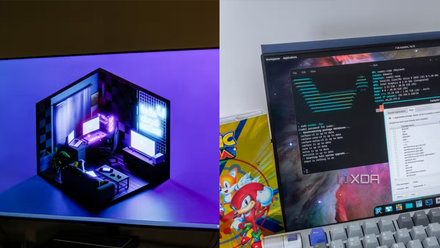
These are the only two Linux distros I'd use for gaming
Bazzite and CachyOS should be primary considerations for gamers looking to get out from under Microsoft
Jung also explained that while some theoretical benefits could come from working closely with Bazzite, the lead developer at Bazzite who made things work so well on gaming handhelds was kicked off the project, which leads us to a bit of drama. This developer, who goes by the name Antheas, was kicked from Bazzite shortly before the Open Gaming Collective was announced, which is why the CachyOS team perceives the OGC project as an attempt to save face by the Bazzite team. Without its lead developer, Bazzite didn't have anyone to maintain and develop its kernel and other technical aspects of the distro, so the OGC initiative comes off as an attempt to outsource some of that development work so it doesn't stall.
However, CachyOS has been working with members from other projects since long before the OGC project was announced. ChimeraOS, ASUS Linux, and inputplumber are some of the OGC members that have already been involved with CachyOS, so the team felt that creating a formal relationship was unnecessary, and that could be for the better.
CachyOS is still gamers' favorite
Who needs the help anyway?
Sitting out of a project that sounds as grandiose as the Open Gaming Collective may have seemed like a bad idea, but it didn't take long for CachyOS to prove otherwise. In early March, a report indicated that CachyOS had become the most popular Linux distro on ProtonDB, a platforms that tracks Linux usage on Steam.
For nearly five years, that top spot had been held by pure Arch Linux, but CachyOS has grown massively in the last couple of years, and it accounted for 21.1% of Linux users on Steam as of this report. It's worth noting that Bazzite sat in fourth place at 9.5%. That should make it obvious that gamers have a clear preference when it comes to gaming distros.
It's not surprising, either. Recently, a benchmark compared a wide range of games running on Windows and CachyOS, and in most instances, CachyOS came out on top. It also helps that Bazzite is a distro more focused on handheld gaming devices, whereas CachyOS focuses on desktop PCs, a much larger addressable market.
Why CachyOS is so good
It's all about optimization
I've spoken in the past about how CachyOS shows that it's possible for an Arch Linux derivative to be better than the original, and it holds true. I love Arch, but CachyOS takes that base and turns it into a more user-friendly and more performant experience.
You still have the rolling release model and lightweight core, but CachyOS gives you a GUI installer that anyone can use, so you don't have to rely on the command line. Plus, tools like the CachyOS Package Manager, CachyOS Update, and other preinstalled software makes things a little more well-rounded out of the box.
Perhaps most notable, though, is the optimization work done by the CachyOS team. This distro provides highly optimized and targeted versions of its packages to take full advantage of the architecture of each processor. That includes the x86-64-v3, x86-64-v4, and Zen 4+ architectures, and it's not just system packages that are optimized. CachyOS also includes its own repositories for pacman (the package manager) with optimized versions of all kinds of software, so you get the fastest experience possible across the board.

CachyOS is the best Arch-based Linux distro out there
Plain Arch is great, but CachyOS makes all the right improvements
The custom kernel is also optimized for performance and can often include patches that haven't been added to the mainline kernel yet, and support for the EEVDF scheduler, optimized for responsiveness on CachyOS, as well as a BORE scheduler for users who want maximum responsiveness. It all comes together to offer a snappy experience that feels great on the desktop, as well as for gaming. The gaming handheld edition of CachyOS also features the optimizations you'd expect, like Steam's Game Mode, along with the LAVD scheduler to optimize gaming performance and battery life.
Linux is getting better, and that's what matters
Whether you believe CachyOS should have joined the Open Gaming Collective or not, these projects continue driving Linux forward in gaming performance. The percentage of Linux users reported by Steam's hardware survey reached an all-time high in 2026, and any effort to streamline and push performance and reliability further can only be a good thing.
Like many other gamers, I'm more partial to CachyOS and its more free-form approach compared to immutable distros like Bazzite, though the latter is likely more suitable for someone switching from Windows for the first time.