
Summary
- DeepSeek is an LLM from China that's causing turbulence in the tech market.
- An older version of DeepSeek can run on Raspberry Pi 5 but with slow performance.
- The Raspberry Pi community may find a way to enhance DeepSeek's performance.
Well, it's been one turbulent week in tech, hasn't it? In case you haven't heard of DeepSeek, it's an LLM from China that has been around for a little while, but hit the public eye last Sunday. What followed was a whirlwind of activity: shareholders panicking and removing $1 trillion in stocks from the US AI and power market (about $600 billion of which was Nvidia stock), then DeepSeek was accused of training off ChatGPT's data, and then Microsoft added it as a supported model. All in a week! Incredible.
The big hype over DeepSeek is that it can run on less powerful hardware. And anytime something is refined for weaker hardware, the Raspberry Pi community isn't far behind. We're already seeing people squishing the hit AI model onto their boards, albeit it's not quite as powerful as you'd hope.
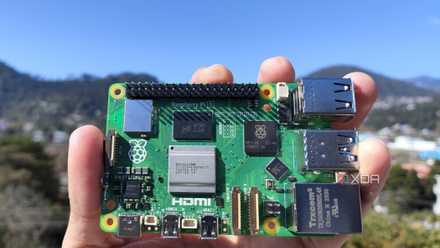
Raspberry Pi 5 review: The holy grail of DIY projects got even better (and rarer)
The Raspberry Pi 5 is one of the most powerful consumer-grade SBCs out there. Sadly, its limited stock means you'll have a hard time finding one.
DeepSeek gets the Raspberry Pi treatment
As demonstrated by Jeff Geerling (the mad scientist who was last seen sticking a desktop GPU onto his Pi), DeepSeek can, technically, run on a Raspberry Pi 5. The "technically" in that sentence is doing some heavy lifting, as there are some caveats.
First of all, the version of DeepSeek you'll see on a Pi 5 is not the same one as the version that recently topped the charts for performance. Instead, Jeff Geerling had to go back to DeepSeek version R1:14b to get things working. Even then, the Pi managed to output a token a second, meaning that if you asked it a question, it would take around that amount of time to "type" out one word.
So, it's not exactly perfect, but it's still really interesting. Usually, when someone wants to tap into a more advanced LLM like ChatGPT, they have the Pi send queries to an external server instead of processing them on-board. However, even at one token a second, that may be enough for a project that doesn't require super speedy responses. We'll have to see if the Raspberry Pi community finds a way to enhance DeepSeek's performance on their boards.