
When people recommend used PC components, they often leave SSDs out of the conversation. This is mostly due to concerns around the remaining longevity of the flash memory inside pre-owned SSDs, which can pose data integrity risks. While valid, these concerns often don't apply to enterprise SSDs, owing to their superior longevity. These drives are built for server environments, and are usually rotated out before they're ever near the end of their lifespan. Users who value affordable and reliable performance instead of the fastest transfer speeds should not ignore used enterprise SSDs on the secondary market.

Used storage is usually risky, but enterprise drives are pretty robust
They boast way more longevity than consumer drives
The NAND flash used in SSDs has limited write cycles, most commonly denoted by the metric "terabytes written" (TBW). Popular consumer SSDs are usually rated for 2400TBW for a 4TB model, which is pretty extensive even if you're a heavy user. You're more likely to replace the drive before it ever comes near its expiry date. Still, buying used consumer SSDs is usually avoided, since hidden defects and lifespan depletion can make them bad deals even at discounted rates. Your data, after all, is irreplaceable. Enterprise SSDs, on the other hand, are engineered for relentless server use, built with advanced NAND flash, better controllers and firmware, and higher-quality power delivery components.
These drives are overkill for most desktop users, but you can't deny their superior longevity. A 4TB enterprise SSD can boast 7000TBW of endurance, nearly thrice that of an equivalent consumer drive. Even if you account for years of use, a used enterprise SSD might still have more than double the life left compared to a brand-new consumer SSD. Considering that enterprises often phase out hardware long before it's worn out, you can snag near-perfect enterprise drives on the secondary market. You will most likely need an adapter to make U.2 or E1.S drives work on your NVMe slot, but aside from that, it's not a bad proposition at all.

5 ways to check how much life your SSD has left
Handy apps for monitoring SSD's health to avoid failure and data loss.
They can be better for your home lab
Consistent performance is the key
Most enterprise drives that you'll find on the used market aren't faster than your typical Gen4 or Gen5 consumer SSD. Despite being more robust, they're not ideal for a typical desktop system where peak performance is the priority. Still, they're fantastic for a home lab or workstation where you need reliability and consistency more than the best transfer speeds. Consumer SSDs are designed for burst and idle periods, whereas enterprise SSDs are built for consistent I/O requests. They're capable of handling hundreds of thousands of parallel requests without dropping speeds out of the blue.
Home lab users understand the value of such a drive, promising dependable performance and snappy multitasking for virtualization, containerization, code compilation, large data transfers, and continuous backup jobs. If you're after tons of storage for your 24/7 home server, used enterprise SSDs are better than consumer SSDs, old or new, especially if you don't want to go bankrupt. This brings me to my final argument.
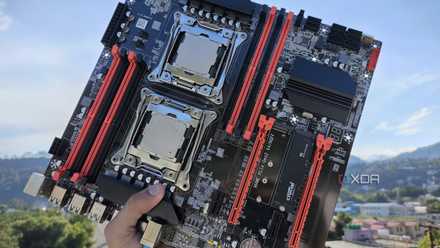
5 times older enterprise hardware beats newer consumer hardware
Enterprise CPUs and motherboards have a lot to offer to the right user
Enterprise drives are more affordable on the used market
Especially in the current economy
Finally, the cost of stuffing your system with used enterprise drives is what makes them highly enticing. For instance, compared to a brand-new 4TB SATA SSD that would cost over $350 right now, a 3.84TB enterprise SAS drive can be had for about $170. That's half the price for a drive that's twice as fast. If you consider used consumer drives for an apples-to-apples comparison, the cost of NVMe and SAS drives appears to be similar. However, you need to factor in the superior longevity and higher power efficiency, not to mention that enterprise drives are available in larger variants of up to 31TB.
You could pick up larger drives for a capacious home server, which might further bring down the cost per TB. Make sure you're buying from reliable sellers who have a track record of selling used enterprise gear. S.M.A.R.T. data might not tell you the whole picture about used drives, so use official tools to check for tampered firmware and readings.

3 reasons why used enterprise NVMe drives are the best storage bargain right now
They're built to perform, last a lifetime, and could save you a lot of money
Used enterprise SSDs can be your system's best upgrade
For the right price, a used enterprise drive might be the most attractive upgrade you make to your setup. You can buy tons of long-lasting and reliable storage for your home server while keeping the costs reasonable. Whether it's the larger capacities or better power efficiency, enterprise SSDs offer various benefits for always-on workstations. It's best to buy from trusted sellers and check for tampered S.M.A.R.T. data, so you can claim buyer protection or credit card chargeback facilities in time.