
With the launch of Nvidia's RTX 50 series GPUs, frame generation was in the limelight once again — this time for all the wrong reasons. And the blame lies with no one but Nvidia, thanks to their misleading claims regarding Multi Frame Generation (MFG). When the review embargo was lifted for the RTX 5090 and RTX 5080, it became clear why consumers and the community in general were against AI-generated frames.
While gamers aren't too happy with the way frame generation "enhances" performance, they're more than accommodating of upscaling. Both of these technologies use workarounds to improve framerates, but upscaling does it in a way that doesn't create new problems of its own, at least not as much as frame generation. There are broadly three ways upscaling is objectively better than frame generation in gaming.

5 reasons Nvidia's RTX 50 series hype is misplaced
Nvidia's RTX 50 series is out, but the company is still keeping the real details under wraps
3 Upscaling is real, frame generation is fake
Frame gen can only get you so far
Yes, there's actually merit in calling AI-generated frames "fake," since they aren't equivalent to those you get from upscaling. Whether it's DLSS, FSR, or XeSS, upscaling enhances framerates by first rendering the game at a lower resolution, and then enhancing it to the target resolution, using various computational techniques to fill in the gaps. This reduces the GPU overhead during the render stage, thereby allowing it to generate more frames, and thus, perform faster.
Over the years, upscaling has gotten way better at rendering games that look virtually identical to one rendered at the native resolution. The AI model at the heart of DLSS or other upscaling technologies is trained on vast amounts of offline data, enabling it to intelligently reconstruct an image that's being upscaled to a higher resolution. The additional frames generated due to upscaling not only make the game appear more fluid but also improve the responsiveness, even if the FPS is more than your monitor's maximum refresh rate.
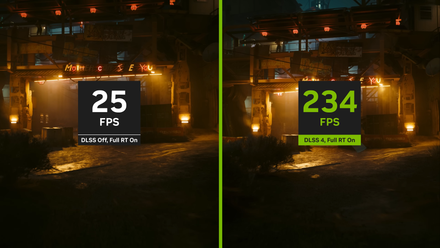
Frame generation also uses AI, but instead of rendering frames in the traditional sense, it predicts what they would look like, and inserts them between rendered frames. Nvidia's MFG takes the company's previous frame generation technology to the next level by inserting up to 3 AI-generated frames for every traditionally rendered frame. The problem with this technique is that while the game might appear smoother, the responsiveness of the experience is still linked to the base framerate.
What this does is make, say, a 120 FPS frame-gen experience feel much worse than that of 120 traditionally rendered frames (with or without the support of upscaling) due to the added latency penalty. This is exactly why gamers are miffed at Nvidia for charging thousands for what they term a "software upgrade" instead of raw hardware power.
5 reasons DLSS and FSR are game-changers for budget gaming PCs
Budget gaming PCs deal with aa ton of constraints. DLSS and FSR help ease the load
2 Upscaling is prone to fewer artifacts
A much more mature technology
Both upscaling and frame generation are prone to visual anomalies, but having existed for a lot longer, upscaling has become adept at eliminating them or keeping them to a level where gamers can't really see or feel them. Frame generation was giving rise to artifacts such as ghosting, shimmering, and distorted details even before the launch of DLSS 4.
What MFG does is amplify those inherent problems manifold, making gamers question its efficacy. Sure, you're seeing the FPS counter go up, and the game might appear to run smoother, but if the flaws in the resulting image are easily visible (and they are), what's the point of generating all those extra frames?
Frame generation, and specifically MFG, might need more time to refine the results, but as it stands, many gamers would prefer not to use it all if possible. Upscaling, in many cases, is more than sufficient to enhance the framerate to a playable window, and for the games it falls short, frame generation is unlikely to produce a worthwhile experience. This is what I expand on in the next section.
It's time to accept Nvidia's "fake frames" might be the new normal
Like it or not, Nvidia's RTX 50 series shows that AI-generated frames are here to stay
1 Upscaling is much more relevant for most gamers
Frame gen works best when you don't really need it
Frame generation increases latency when going from a lower framerate to a higher one. The lower the starting framerate, the higher the resulting latency would be. This is why 100 FPS is the ideal framerate before enabling frame generation so that the final output is mostly free from artifacts and the latency penalties are at a minimum. When you're already getting triple-digit FPS, you'd think twice before enabling frame generation.
Most gamers would think that frame generation would magically boost their unplayable FPS to a playable range, but that's exactly where frame generation fails. If you're getting 30 to 40 FPS, frame generation will not only reduce the native FPS (due to operational overhead) but also result in a flawed experience where you'd question the whole point of it.
In contrast, upscaling can work in more varied scenarios, boosting your framerates without needing high native FPS to start with. Frame generation works best when you have, say, a 240Hz or 360Hz monitor, and want to saturate the refresh rate by generating hundreds of additional frames. You still won't magically increase the responsiveness, but the game will at least "look" smoother. Most gamers have 144Hz or 60Hz monitors and aren't the target users of the technology.
Frame generation, as many have declared, is essentially a frame-smoothing technique rather than a performance-enhancing technology. Many gamers are legitimately deriding Nvidia for what they believe is the worst launch in GeForce history.
Nvidia's DLSS 4 multi frame generation works best when it doesn't make sense to use it
If you want to use Nvidia's new multi frame generation, keep in mind that there are very specific times where it can actually make a difference.
Upscaling suffered from a similar fate not long ago
A few years ago, gamers were hesitant about turning on upscaling after buying expensive graphics cards, thinking why should they have to rely on gimmicks after buying the most powerful GPUs on the market. Gradually, however, the stance on upscaling has softened, and whether that's due to frame generation creeping up in the rearview mirror or due to something else entirely, is hard to say. Frame generation going down the same route seems less likely since it's fundamentally quite different from upscaling.