
After a tough few years for the best graphics cards, it's not surprising that a crop of older, inexpensive GPUs still top the most popular cards among PC gamers. The GPU market is rapidly changing, though, as are games, and if you stick with the old guard, you'll find yourself being able to play fewer and fewer games.
From support for new features to lower VRAM capacity, there are a few popular GPUs that deserve an upgrade. Here are the cards that fall into that camp.

Intel's Arc B580 is great for budget gamers, except for one major flaw
Budget GPUs seemingly have a champion in the Arc B580, if only it didn't tank with budget CPUs.
4 Nvidia GTX 1650
It's time to let the GTX 16-series go
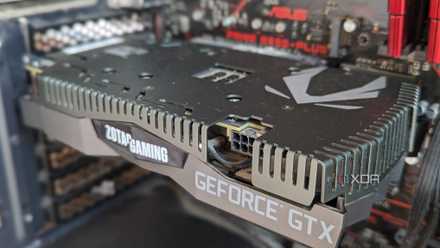
Much to my delight, Nvidia's storied GTX 16-series GPUs have been falling in popularity month-over-month in the Steam hardware survey. But they still represent far too many PC gamers. The GTX 1650 is the most popular, but if you round up other cards in the series, including the GTX 1660 Ti and GTX 1660 Super, you're looking at somewhere around 5% of PC gamers still using Nvidia's budget-focused workhorses.
And what workhorses they've been. Coming in under $200, the GTX 1650 was the go-to GPU for gamers who just need something to play lighter games at 1080p. They've quickly fallen out of favor, though. The GTX 16-series range is coming up on six years old, and they lack some key features that are critical for playing games in 2025. Notably, you're missing out on dedicated ray tracing hardware, and you're locked to 6GB of VRAM.
Perhaps more importantly, the GTX 1650 can't use Nvidia's Deep Learning Super Sampling (DLSS). Nvidia (and game developers) have increasingly leaned on DLSS to push visual fidelity to new heights. It's almost essential in 2025, and the GTX 16-series doesn't have access.

Nvidia GeForce GTX 16 series GPUs axed, limited stocks to vanish soon
New drivers will likely be released for existing GTX users, however.
3 AMD RX 580
The crypto champ has fallen on hard times
AMD's RX 580 was never a particularly good GPU, but it sure was a popular one. Launching nearly eight years ago -- the gray is coming in nicely, thank you very much -- the RX 580 was available in two flavors: one with 8GB of VRAM and another with 4GB. At release, it was a decent card for a good price, though it was built on the same GPU as the previous-gen RX 480 and only offered a marginal performance improvement.
That's not why it was popular, though. The RX 580 was released around the time that Bitcoin mining started to gain traction, and it was the go-to option for bootstrapping miners. With a low list price of $230 and 8GB of VRAM -- unheard of at the time in this price bracket -- it was an ideal choice for a massive mining rig packing dozens of GPUs. The mining craze died off, however, and the RX 580 was returned in droves. For a few years, it was almost impossible to avoid an open-box RX 580 for around $150 at retailers.
It was a great buy in 2017, but the RX 580 suffers from the same issues as the GTX 16-series in 2025. The 4GB version can't handle modern games, the GPU lacks dedicated ray tracing hardware, and although it can use AMD's FSR upscaling, it can't access new features like frame generation through FSR 3.

Sapphire Pulse Radeon RX 7600 OC review: Good 1080p performance in a pint-sized package
Great for 1080p gaming, as long as you don't mind skipping ray-tracing.
2 Nvidia GTX 1080 Ti
Holding onto former glory
It's shocking how well the GTX 1080 Ti has held up over the years. Launching in 2017 for a list price of $700, the GPU offered almost identical performance to the Titan X Pascal, just with a slightly smaller frame buffer at 11GB and a price that was $500 cheaper. For a while, you really couldn't buy anything better, and newer flagships like the RTX 2080 and eventually the RTX 3080 didn't do much to change that narrative.
At least, they didn't at the time. Although Nvidia's ray tracing ambitions were lofty in 2018, they're very much grounded in reality today. Games like Indiana Jones and the Great Circle, Alan Wake 2, and the upcoming Doom: The Dark Ages require a GPU with dedicated ray tracing hardware, locking out everything with Nvidia's GTX branding. You also can't leverage DLSS to improve your performance in games that don't require ray tracing.
The GTX 1080 Ti's 11GB frame buffer is also a poor point in 2025. Although that's plenty of VRAM to play games at 1080p, it's not enough to play games at the higher resolutions that the GTX 1080 Ti targeted. Today, something as mundane as the RTX 4060 offers better performance than the GTX 1080 Ti, and it can leverage all the modern bells and whistles like DLSS that have become a staple in games.

3 reasons why ray tracing is here to stay
Get used to it, because it's not going anywhere.
1 AMD RX 6500 XT
Dead on arrival, and even worse now
When it released in 2022, you could be generous and call the RX 6500 XT shortsighted. Today, I'd call it unusable. Despite sporting dedicated ray tracing hardware and the (relatively) new RDNA 2 architecture, the RX 6500 XT faced some unique problems when it released. And those issues have only grown over the past three years.
For starters, the GPU inexplicably uses a PCIe 4.0 x4 interface. Although that's enough if you have a PCIe 4.0 motherboard, the card runs into serious bandwidth issues if you're using an older chipset. It's not the PCIe standard that's the problem, but rather the number of lanes. With access to only four lanes, the RX 6500 XT often performs worse than the older RX 580 over a PCIe 3.0 interface.
The bigger issue in 2025, however, is memory. AMD decided to launch the RX 6500 XT with a 4GB frame buffer. In 2022, that was too little to play a lot of AAA games, and today, it's too little to play most of them. Even 8GB graphics cards can run into issues at 1080p, and those problems are only more severe on the RX 6500 XT.
4 reasons PCIe 5.0 still doesn't matter for most people
If you've been wondering whether your GPU uses PCIe 5.0 or you want an SSD that supports it, here's why it doesn't matter.
Some great alternatives
If you're sitting on one of these GPUs and need an upgrade, you have a lot of options. If you're trying to get the best bang for your buck, the Intel Arc B580 is easily your best bet due to its low price and 1440p levels of performance. For those who can stretch their budget more, the Nvidia RTX 4070 Super remains an excellent option for 1440p and even 4K, and it has access to DLSS.

Best budget GPUs in 2025
It's tough to find a graphics card on a budget these days, but there are still some good options available